|
 |
 |
 |
|
|
Home | More Articles | Join as a Member! | Post Your Job - Free! | All Translation Agencies | |
|
|||||||
|
|
|
|
A Roadmap to Quality Translations, Part 2
In part two, Muzii continues his roadmap, offering more insights on further milestones, and then showing how quality is ultimately a journey, not a destination, and a worthwhile journey at that. SAMPLING
Acceptance sampling is the middle-of-theroad approach between no inspection and 100-percent inspection. Its main purpose is to decide whether the lot is acceptable, not to estimate its quality, and it should be employed when:
For acceptance sampling to be effective, a Lot Acceptance Sampling Plan (LASP) should be implemented. Such a plan indicates the conditions for acceptance or rejection of the lot that is being inspected. The parameters usually include the allowable number of defects in a sample, indicating both quantity and severity. To make assessment criteria, methods, and tools unambiguous, Acceptance Quality Levels (AQLs) can be used, allowing for tolerances and deviations (errors). Acceptance quality levels should be agreed upon in service level agreements and should specify the maximum allowable percentage of non-conforming items. Different AQLs may be designated for different types of defects. Usually, an AQL of 1 percent is used for major defects, and 2.5 percent for minor defects. By their very nature, AQLs imply that a level of non-quality exists in a product, despite being “acceptable.” Among the many erroneous assumptions on quality, uncertainty in control is probably the most impeding. Yet, a certain degree of ambiguity is obvious, particularly if assessment goals and criteria are not explicit and objective. This is why, in the language industry, quality control is often confused with quality assurance. A fully-fledged quality assurance process cannot do without inspections and auditing, as quality is not the result of assessment procedures that lead only to the removal of defective products; quality is a derivative property. THE FOUR RULES OF QUALITY Offering a better-than-acceptable level of quality without missing any deadlines, but at a reduced cost, requires considerable process innovation. Quality is not the exclusive responsibility of the quality department. Quality is the responsibility of everyone in the organization. And quality improvement, contrary to traditional belief, has a cost-reducing effect. Doing it right the first time might require an initial investment, but the impact in the long term generates many advantages outside the limited framework of quality. Quality systems hinge on four basic rules: 1. Write down what to do.2. Do what you have written. 3. Substantiate what you have done. 4. Reflect on how to improve it. Quality, from this view, is an endless work cycle where deliverables are analyzed, proposed, developed, delivered, and then once again analyzed. The cycle involves constant listening, observing, and quantifying, in order to refine and improve. Therefore, quality must be planned into a project and managed over the project life. Ensuring quality means accounting for the review time in the project plan. It means taking the time to assess the needs of the user and setting aside the time to meet and come to agreement on how quality will be measured and who will measure it. QUALITY IS MONEY From an economic point of view, time is money, and the faster a translation is completed, the better. But a common issue in translation is the tradeoff between time and quality. There is no getting around the fact that quality takes time. Achieving accuracy in particular is time consuming. But consider the value of quality. Value can be defined as the benefit of an activity minus its cost. When both benefit and cost of translation can be expressed in monetary terms, a monetary value can be calculated. To the user, the cost of poor quality is in the waste of time and effort; to the client, it is in extra support time and the immense cost of revising translations. On the other hand, the greatest value of quality is in increased customer satisfaction and likely increased sales. During the first international conference on specialized translation, which took place in Barcelona in March 2000, Salvador Aparicio i Paradell illustrated the following formula to calculate the real cost of a translation: 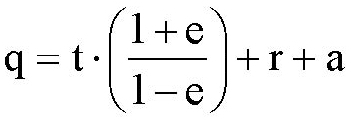
The value of effective communication is most frequently measured in the negative. That is, only when there are problems with effective communication do figures get generated, and only to denote the extent of the problem. In the worst case, this negative example could be a lawsuit in which a client asks for reimbursement of several million dollars (or euros), because the handling of a machine according to the documentation has led to severe damages. CONTINUOUS IMPROVEMENT The process of continuous improvement is primarily based on incremental adjustments, which are the result of a Plan-Do-Check- Act (PDCA) approach:
Continuous improvement involves everyone in an organization. It means working together to make improvements, but without continuous large capital investments. The focus is on eliminating waste in all systems and processes of an organization. The key elements are the willingness to change, neverending efforts for improvement, and communication. Quality improvement and cost reduction are, in fact, compatible, since quality is the responsibility of everyone in the organization and not exclusively that of the quality department. This means that everyone involved in a project should monitor the quality at every stage of the process. Incremental improvements have a cost-reducing effect. The long-term impact of a do-it-right-the-first-time philosophy generates many advantages outside the limited framework of quality. Eliminating most of the repetitive, measurable, and predictable mistakes in advance can considerably reduce the time required for correction work afterward. SUSTAINABLE QUALITY Translation is often at the end of a supply chain where all parties assume the preceding contributors have done their tasks to the best of their abilities. In most cases, translation does not pertain to the core business of the client. Indeed, most clients consider localization to be a non-critical purchase, a commodity. One indicator of this is the practice of reverse auctions for the award of translation projects. Also, tools are increasingly spreading that reduce source content in order to reduce translation costs. In this respect, pricing strategies are crucial, as different requirements or jobs with different AQLs call for different offers. Indeed, taking full advantage of appropriate technology is essential to improve efficiency and still maintain economic sustainability. Clients are interested in getting the lowest price possible, while retaining the best service providers. Conversely, vendors are motivated to get a fair price for their services and to resist downward price pressure. Since auctioning is aimed at driving the price down, stressing quality makes no sense when the main parameter is the discount floor. The acceptable price is the one that shows balance with the service capability, rather than with the value of the auctioned item. Translators, unfortunately, are so focused on their “art,” they pretend to ignore the question of long-term sustainability, even though money is and must be a priority. The economic sustainability of a translation must be valid for the translator as much for the client. In short, quality must be proportioned to profit, and translators should be taught to think of their job in terms of making a living, not as a form of art. And since quality is a shared effort, any impediments in the quest for quality should be tackled in partnership with the client. This will also increase the client’s understanding of why translations are priced differently for different types of deliverables. Briefly, translators should learn to speak their client’s language (business) to explain how their services are different — in terms of quality. See Part 1
|
|
|
|
|
|
|
| |||
Legal Disclaimer Site Map |
 CSN
Magazine published the first part of this article
in last month’s edition (February 2007). In part one,
Luigi Muzii proposed that business processes can consistently
produce good translation quality through the use of
pre-established quality standards. Muzii recommended
a “Specification of Requirements” for every project,
defining what it is and how best to establish it.
Plus, he offered insights on certain milestones along
the roadmap to quality: metrics, assessment, measurability,
and rules of engagement.
CSN
Magazine published the first part of this article
in last month’s edition (February 2007). In part one,
Luigi Muzii proposed that business processes can consistently
produce good translation quality through the use of
pre-established quality standards. Muzii recommended
a “Specification of Requirements” for every project,
defining what it is and how best to establish it.
Plus, he offered insights on certain milestones along
the roadmap to quality: metrics, assessment, measurability,
and rules of engagement.