|
 |
 |
 |
|
|
Home | More Articles | Join as a Member! | Post Your Job - Free! | All Translation Agencies | |
|
|||||||
|
|
|
|
XTM for Language Service Providers
1. Introduction
XTM is a Highly Scalable, Open Architecture, Open Standards, Open Source, advanced CAT tool from XML-INTL. XTM is designed on SOA (Service Oriented Architecture) principles as a Web 2.0 suite of modular components that address the direct needs of the following types of customer:
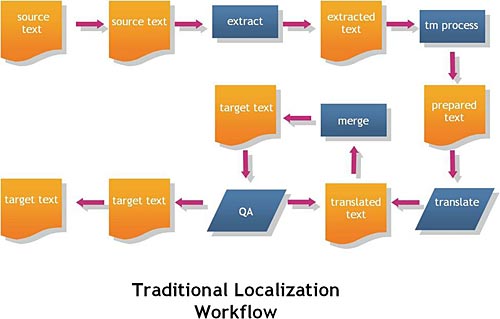
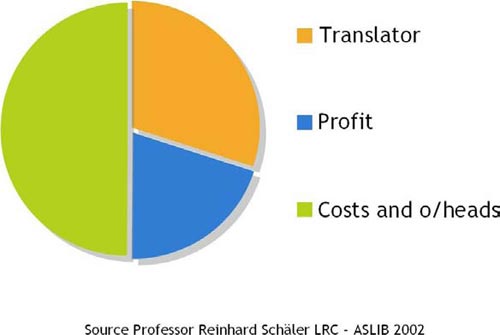
The user interface of XTM is completely browser based, including the fully featured revolutionary translation editor. One of the biggest problems facing Localization Service Providers is how to stay competitive. Traditional desktop based CAT tools are inherently expensive to run and maintain. They offer very little in the way of process automation apart from providing some benefit in the form of translation memory for updated documents that have previously been translated. Moreover, running and maintaining a translation project using these tools is very labor intensive and leads to the creation of little islands of translation that are not shared between translators working on the same language: The net effect of this way of working is that half of the cost of translation is taken up by project management and manual data handling:
XTM completely breaks this mold. It uses the power of modern software techniques and architecture to free up the desktop and to provide a high degree of automation and sharing, thus eliminating most of the costs and overheads associated with running a translation project:
2. Open Architecture XTM comprises the following modular components based on SOA (Service Oriented Architecture) principles:
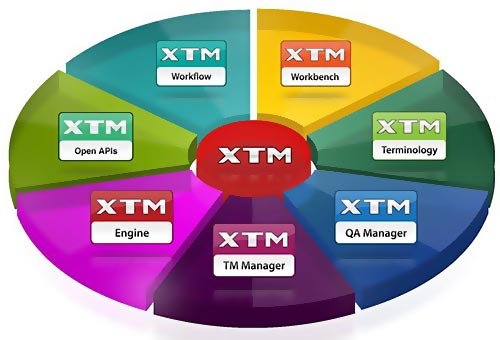
The whole concept behind the architecture of XTM is to ensure that the individual modules can be easily integrated with existing systems. The XTM modules are all written in Java which ensures cross platform compatibility. The database layer of XTM is handled via an abstraction layer which means that XTM can work seamlessly with MySQL, MS SQL Server, PostgreSQL and Oracle without any problems. XTM supports Linux, Windows, MacOS and Solaris platforms. The XTM Engine is accessible via exposed APIs as well as Web Services. All the other XTM modules are accessible via Web Services. XTM has been successfully integrated with .Net Java and C/C++ systems. The use internally of the OASIS XLIFF (XML Localization Interchange File Format) as the translation format also means that XTM can exchange data freely with tools that support XLIFF natively of which there is a steadily increasing number. 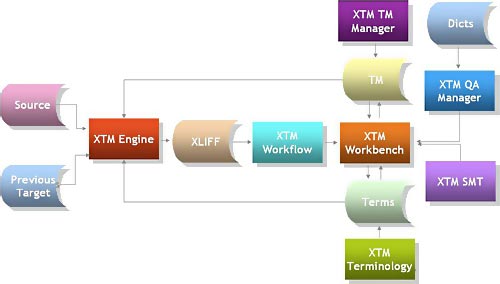
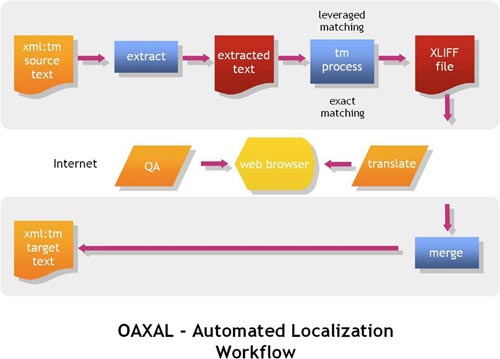
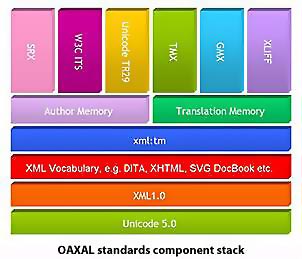
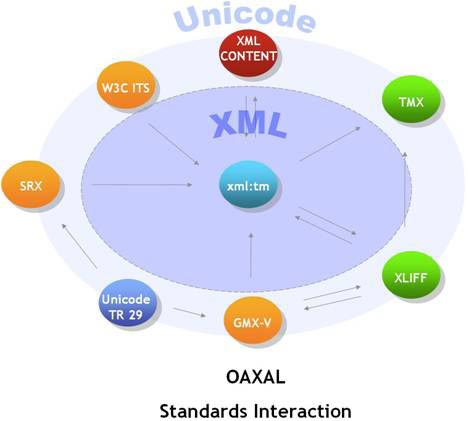
3. Open Standards XTM is based on the new OASIS Open Architecture for XML Authoring and Localization (OAXAL ) reference model, comprising the following Open Standards:
XTM provides a complete OAXAL implementation. The benefits of Open Standards are that they not only provide good engineering practice, but also allows for the easy interchange with other compliant systems.
The real power of XTM is that it is primarily XML based. XTM converts all non-XML file formats to XML prior to processing and then back into the native format post translation. Obviously if the file format is already XML such as In Design, XHTML, OOXML, ODF or DITA, then XTM processes the files natively. Having one internal format means that processing is greatly simplified. Internally XTM also uses XLIFF as the translation format so that interchange with XLIFF compliant systems is guaranteed. XTM can handle the following file formats:
filesIn addition XTM can import translation memories in TMX format from Trados and other CAT tools as well as being able to accept the following formats from other CAT tools:
Using Open Standards guarantees that you will not be locked into a proprietary trap and forced upgrade treadmill. It also makes for much easier interoperability with clients and partners who also use these standards. 4. Open Source The source code of XTM is available to customers within the price list. This means that customers can extend and/or customize XTM to their own requirements. This offers not only greater security in commercial terms given the volatile nature of the translation tool market place, but also the ability to mold XTM to their own precise requirements. 5. Advanced Translation Technology XTM introduces the concept of document centric translation memory based on the LISA OSCAR xml:tm standard. This advanced technology allows for the maintenance of Author Memory within a CMS environment providing every sentence in a document with a unique identifier. Furthermore, using this approach enables in-document matching when translating the document during its life cycle, along with in document exact (ICE) matching as well as in-document leveraged and fuzzy matching. XTM also makes use of traditional database matching technology, but enhances this with linguistic stemming and advanced web search technology. XTM can also deliver high quality Statistical Machine Translation (SMT) based on the acclaimed Google SMT engine during the translation cycle thereby further reducing the costs of localization. The key concepts of XTM are automation, ubiquity in terms of browser interface, maximum re-utilization of linguistic assets through its server based architecture and extensive use of available Internet resources. 6. Web 2.0 based A core design principle of XTM is that only a web interface is required. Thanks to the significant advances in browser technology over the past 8 years the power and capabilities of the current generation of browsers allows for advanced applications like XTM to be run straight from the browser window. An example of this is the extensive use of Ajax technologies, seen in Gmail and Google Docs. In addition SalesForce.com has also shown what can be achieved with current technology. There are many more examples. XTM supports both Firefox/Mozilla as well as Internet Explorer. Opera support will be available later on this year.
The XTM translator workbench also provides the following facilities:
The benefits of a browser based user interface are multi-fold:
XTM comprises the complete set of tools required by the translator, including terminology, dictionary and translation memory management. The speed and reliability of such an approach is significant compared with the alternative of desktop based translation. No individual licenses to buy, no desktop software to maintain. XTM does not preclude the fact that in certain circumstances the translators may have to work on their local desktop with their own translation tools. To this end XTM provides the ability to download the XLIFF translation file and edit it using the increasing number of low cost XLIFF translation editors. The key feature of the XTM architecture and browser based translation workbench is that most of the tasks apart from the actual translation are automated. This means that the translator merely has to concentrate on the task at hand: translation. The user interface demonstrates this: it is the essence of simplicity in the same way as many Google web applications. The user is not assailed with countless confusing icons and menu options. The interface is finely tuned to the translator’s needs and requirements. 7. XTM for Localization Service Providers XTM is above all an affordable, flexible and technically advanced solution for LSPs. XTM can be easily integrated with existing LSP workflow and project management systems. Written in Java and supporting multiple databases it is designed for integration. XTM is currently being integrated in multiple top tier LSP systems. XTM has also been integrated with XTRF the SRC, CRM and Project Management tool. As both systems are browser based and written in Java this is a formidable tool for medium to small LSPs. In addition XTRF TM will be shortly made available as Software as a Service (SaaS) solution for medium and small sized LSPs. 8. Content Management Systems Vendors XTM has been successfully integrated with leading commercial and Open Source CMS systems. XTM is designed to provide the maximum benefit from the automation of the translation process for such systems. XTM also provides the important benefit of Author Memory which is provided by means of the xml:tm standard used to maintain transparent unique identifiers for all pieces of text in a document. 9. Organizations with translation requirements XTM can be used to great effect by commercial and government organizations with localization requirements. The benefits are that full control of the translation process is maintained along with a high degree of automation allowing for substantial reductions in translation costs.
Published - July 2009 ClientSide News Magazine
- www.clientsidenews.com
E-mail this article to your colleague! Need more translation jobs? Click here! Translation agencies are welcome to register here - Free! Freelance translators are welcome to register here - Free! |
|
|
|
|
|
|
| |||
Legal Disclaimer Site Map |