|
 |
 |
 |
|
|
Home | More Articles | Join as a Member! | Post Your Job - Free! | All Translation Agencies | |
|
|||||||
|
|
|
|
Translation from Hallidayan Perspective
Abstract
Key words: translation, register, register variables and register theory. 1. Introduction Translation phenomenon has attracted different people miraculously, so there has been different categorization for it. Generally speaking we have word-for-word, literal, faithful, semantic, adaptation, free, idiomatic, communicative and cognitive translation. In a closer look we can have Roman Jakobson's interlingual, intralingual and intersemiotic, Dryden's metaphrase, paraphrase and imitation, George Steiner's literal, free and faithful, and Cicero's Word-for-word and sense-for-sense. Translation has always been of great need in human societies. I define translation as a process through which a passenger (ST) by help of a pilot (translator) takes a flight to its destination (TT). There has been different views toward translation process, its method and quality assessment. Despite variety of view points toward translation, we have normally three parties involved : Author, translator and reader in case of written translation and speaker, interpreter and listener in case of oral translation. Without doubt the text to be translated happens in a context. Context can be a written piece or every thing else that helps to understanding of the meaning or message. In this case translator should pay attention to the context of situation or register to be able to render the acceptable translation in TT. In linguistics, a register is a variety of a language used for a particular purpose or in a particular social setting. For example, an English speaker may adhere more closely to prescribed grammar, pronounce words ending in -ing with a velar nasal (e.g. "walking", not "walkin'") and refrain from using the word "ain't" when speaking in a formal setting, but the same person could violate all of these prescriptions in an informal setting. The term register was first used by the linguist Thomas Bertram Reid in 1956, and brought into general currency in the 1960s by a group of linguists who wanted to distinguish between variations in language according to the user (defined by variables such as social background, geography, sex and age), and variations according to use, "in the sense that each speaker has a range of varieties and choices between them at different times" (Halliday et al., 1964). The focus is on the way language is used in particular situations, such as legalese or motherese, the language of a biology research lab, of a news report, or of the bedroom. M.A.K Halliday and R. Hasan (in 'Cohesion in English') interpret 'register' as 'the linguistic features which are typically associated with a configuration of situational features - with particular values of the field, mode and tenor. Register concept comes under the bigger heading of language variation which is a determining factor in selecting the right meaning. Halliday believed types of linguistic situation differ from one another, generally speaking, in three ways: what actually is taking place; what is the role of language; and who is taking part. They determine the range within which meanings are selected. He also paid especial attention to sentence as default equivalence level. Equivalence in its own turn can be considered as a reasonable criterion for quality assessment. Quality assessment shows how well the pilot has let the plane land on in destination. Register analysis plays the role of weather condition which guarantees the safety of flight and landing if analyzed correctly by the pilot. ATC worker 's correct calculation which clears the way for landing, plays the role of correct selection of equivalence level. 2. Register or context of situation is set of vocabularies and their meanings, configuration of semantic pattern, along with words and structures such as double negative (among black American) used in realization of these meanings.It relates variation of language use to variations of social context. Every context has its distinctive vocabularies. You can see a great difference in vocabularies used by mechanics in a garage and that of doctors. Selection of meanings constitute variety to which a text belongs. Halliday discusses the term Register in detail. This term refers to the relationship between language (and other semiotic forms) and the features of the context. All along, we have been characterizing this relationship (which we can now call register) by using the descriptive categories of Field, Tenor, and Mode. Registers vary. There are clues or indices in the language that help us predict what the register of a given text (spoken or written) is. Halliday uses the example of the phrase "Once upon a time" as an indexical feature that signals to us that we're about to read or hear a folk tale. Halliday also distinguishes between register and another kind of language variety, dialect. For Halliday, dialect variety is a variety according to the user. Dialects can be regional or social. Register is a variety according to use, or the social activity in which you are engaged. Halliday says, "dialects are saying the same thing in different ways, whereas registers are saying different things." 3. Register Variables delineate relationship between language function and language form. To have a clear understanding of language form and function, we have an example here. Consider words cats and dogs. Final s in both has the same written form. In cats it is pronounced /s/, but in dogs it is pronounced /z/, so they have different spoken form. It functions the same in both because it turns them into plural form. Language functions are also of great importance.Some of language functions are vocative, aesthetic, phatic, metalingual, informative, descriptive, expressive and social. Among them the last four ones are more important here, so let's take a brief look at them. Descriptive function gives actual information. You can test this information, then accept or reject it.(It's – 10° outside. If it's winter it can be accepted. But in summer it will be rejected in normal situation.). Expressive function supplies information about speaker and his/her fleeing.(I don't invite her again. It is implied that the speaker didn't like her in the first meeting.). Newmark believes the core of expressive function is the mind of speaker, the writer or the originator of the utterance. He uses the utterance to express his feelings irrespective of any response. Social function shows particular relationship between speaker and listener.(Will that be all sir? The sentence implies the context of a restaurant.). Informative function Newmark believes the core of informative function of language is external situation, the facts of a topic, reality outside language, including reported ideas or theories. The format of an informative text is often standard: a textbook, a technical report, an article in newspaper or a periodical, a scientific paper, a thesis, minutes or agenda of a meeting 3-1. Field: or the features of the situation, lend themselves to a certain kind of language use. The language is filled with words related to objects in the environment ("train" "rails" "chair"), the processes of the activity ("go" "carry" "put" "round and round") and so on. What's happening to the nature of social action that is taking place? In other words" what is being written about. 3-2. Mode: or the part played by the language itself, in the event, that is, the textual function. In this case, the spoken channel, in English, alternates between dialogue and monologue. The talk is highly task-oriented: the focus is on getting something accomplished (rather than having a conversation). Thus, there is frequent use of pronouns which refer to objects in the environment ("it" "that"). Further, utterances in which words are omitted ("Which engine [do you want]?"), a feature in linguistics called ellipsis, signals dialogic text. Finally, the close association among the words across the whole interaction make the entire text cohesive; that is, the two participants are using language to co-construct a meaningful communicative event. What participants expect language to do for them in that situation? 3-3. Tenor: or the relationships between the participants, also lend themselves to a particular kind of language use—the interpersonal functions of the language. In this case, the person-reference choices ("Daddy" "you" "I") and use of imperatives ("Daddy go and see" "I don't want") can be seen.Who are taking part in transaction, nature of participants, their role and status. In other words" who is communicating and to whom, e.g a child to his father. They set up a communicative transaction in the sense that they provide basic conditions for communication to take place. 4. Meaning components meaning in linguistics is what a language expresses about the world we live in or any possible or imaginary world. Ideational meaning organizes the speaker's or writer's experience of the real or imaginary world, i.e language refers to real or imagined persons, things, actions, events, states, etc. Textual meaning creates written or spoken texts which cohere within themselves and which fit the particular situation in which they are used. Interpersonal meaning indicates, establishes, or maintains social relationships between people. It includes forms of address, speech function, etc. Halliday believes meaning is fundamental component of language and each variables of register is associated with a strand of meaning. These strand of meaning together form the discourse semantic. You can find the relationships in the following chart.
Relationship between language components (ideational, interpersonal and textual meaning) and register variables (filed, tenor and mode); or the way variables condition three types of meanings from perspective of context is called realization. 5. Register Theory Language varies according to the situation in which it is used, and these varieties of language can be referred to as registers. If we examine a text we can make guesses about the situation; on the other hand, if we are in a particular situation we make certain linguistic choices based on that situation. In other words, the language we use needs to be appropriate to the situation in which we use it. Followers of Australian (Hallidayan) perspective believe texts arise in specific social situation, constructed by specific purpose where meanings find their expression and are negotiated in concrete situation of social exchange. Interaction between texts and contexts = nexus between language and society. Text is piece of written or spoken language. It can be as short as one word or as long as a novel. Every text finds its meaning in a context. Consider the text" loud" in context "loud music" or in " loud tie." The former means noisy while the latter means unpleasantly colorful!" Three variables _ field, tenor and mode, combine to form the register of the text. 6. Translation the term translation itself has several meanings: it can refer to subject field, the product (the text that has been translated) or the process (the act of producing the translation, otherwise known as translating). The process of translation between two different languages involves the translator changing an original text (ST) in original verbal language (SL) into a written text (TT) in a different verbal language (TL). In this replacement, only form of SL is changed and the meaning is held constant. Translation in this view is a contextual thing; a cross-cultural communication, communicative act that attempts to render the exact contextual meaning in such a way that both content and language are readily acceptable to the readership. It should be clear, simple, social and produce on its reader an effect as close as possible to that obtained on the readers of original. It conforms to a particular register of the language, concerns mainly with the receptors usually in the context of a language and register variety and recreates the precise flavor and the tone of original. Translator has right to modify and clarify jargons, and normalize bizarre idiolect. Now it's time to answer the question "what is a good translation?" simply it depends on your criterion. 7. Equivalence can be a good criterion provided that we accept equivalence as criteria, it is both central and controversial. Central in that it's necessary condition for translation and controversial in that it's obstacle to progress in translation studies / useful category for describing translation. Equivalence exists at different levels. 7-1. Equivalence at word level:
7-2. Equivalence above word level:
7-3 Grammatical equivalence:
7-4. Textual equivalence: 7-4-1. Thematic and information structure:
7-4-2.Cohesion:
7-5. Pragmatic equivalence:
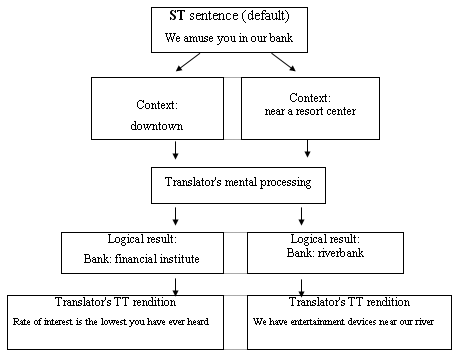
Which equivalence level can be considered as a good criteria for assessing the quality of translation? There are different views in this respect. Koller: equivalence is special relationship between 2 texts; source(primary)and resultant one. Jakobson: there's no full equivalence between code-units (ST &TT) because they belong to different sign systems (languages.) Nord: equivalence is static result-oriented concept describing equal communicative value between 2 texts, or on a lower rank between words, phrases and syntactic structures. Halliday: equivalence of units and items is lost as soon as we go below the sentence level. The lower the rank, the less is left. Morpheme is untranslatable. The higher the stratum, the more valuable the equivalence. Halliday's equivalence is our focus of attention. Based on what he said, equivalence at word level can't be acceptable. In his view sentence is default track and translator is allowed to translate the thought behind ST sentence to TT. 8. Assessing the quality of a translation through Hallidayan perspective In assessing the quality of a translation through Hallidayan perspective, we should take sentence as the unit of equivalence (default) that finds its meaning in a special context. As an example consider the sentence "we amuse you in our bank!". Look at the chart.
Interpretation of the chart: what do you think is a suitable translation for it? what do you think is an acceptable translation for it ?We have entertainment devices near our river or rate of interest is the lowest you have ever heard. It's the context of the text "bank" that helps you in judging. If you see the sentence on a sign outside city near a resort center with water, the former translation is right and if you see it on the wall of a financial institute downtown, the latter will be correct one! In analyzing the quality of translation, you paid attention to the context of situation (register) and its variables – mode: what you expect the sentence to do for you (entertain you or giving a low interest loan), field: what is being written about (bank of a river or a bank for depositing or withdrawing money), Tenor: Who are taking part in transaction, nature of participants, their role and status (is the character in the story a person with casual cloth suitable for camping or a person in formal cloth and a briefcase). Conclusion In assessing the quality of a translation, unless we have a criterion in mind, our assessment is of no value. This criterion can be equivalence. In this paper equivalence lower than sentence level isn't acceptable based on what Halliday said. In processing a sentence to translate it, we should consider its register – context in which the sentence happens. Context of situation or Register finds meaning in relation with its variables. Variables can be good determiners of the context and aim of communication. Translator should analyze every thing in mind before synthesizing the idea behind ST sentence in TT cast. o Translation which is a contextual thing and a cross-cultural communication attempts to render the exact contextual meaning in a natural form in new language. o Pilot of translation flight (translator), carries out this process by exact calculation and careful movement from departure (ST) to destination (TT). Remember that only a moderate, wise pilot can safely passe all air bumps (translation traps.) o Register relates variation of language use to variations of social context. Every context has its distinctive vocabularies. o Register variables which delineate relationship between language function and language form are field, mode and tenor. o Each register variable has a one by one relationship with one meaning out of three and this relationship is called realization. o Register Analysis refers to how language is maneuvered to make meaning. It is a tool that provides necessary link between communicative act and context of situation (register) in which it occurs. In this process, the translator analyses the SL message into its simplest and structurally clearest form (kernels), transfers the message at this kernel level and restructures the message in the TL to the level which is most appropriate for the audience addressed. o Analysts aren't just interested in what language is and what it means, but in why language is and how it means. o Register analysis is a part of context in translation; it involves reader in reconstruction of context through an analysis of what has taken place (field), who has participated (tenor) and what medium has been selected for relaying the message (mode). o Register theory recognizes that different contexts of situation encode meaning in different way. References 1. Hatim B and Munday J.(2004).Translation an Advanced Resource Book. NY: Routledge. 2. Ketabi S and Ordudari M. (2008).Translation Focus. Isfahan: Chaharbagh Publication. 3. Munday J.(2001).Introducing Translation Studies: Theories and Applications. NY: Routledge. 4. Newmark P.(1988).A Textbook of Translation.UK: Prentice Hall International. 5. Retrieved to July 14, 2009 from http:// www. en.wikipedia.org/ 6. Retrieved to July 14, 2009 from http:// www. studyplace.org/ 7. Retrieved to July 13, 2009 from http:// www. teachingenglish.org/ 8. Richards J. C., et al.(1992). Dictionary of Language Teaching & Applied Linguistics.UK: Longman. 9. Zequan L. Register analysis as a tool for translation quality assessment. Translation Journal. Biography It’s my honor to publish my article under the title of "Translation from Hallidayan Perspective" in your journal. Following there's my bio. My name is Forogh Karimipur Davaninezhad. I was born in
Iran, Shiraz in 1982.I graduated from Payame Noor University
of Shahreza in English Translation at the top of my class.
As soon as I entered university I started teaching English
in a conversation Institute in Shahreza. For about eight
months I taught at the 'Ostad Taher' language laboratory
dependent on the institute. I taught listening and movie
courses there. I also translate , and I'm somehow skillful
in translating texts related to chemistry. After graduation
I took part in TOLIMO exam in Isfahan University and I acquired
the score 89 .Then I was accepted in state university MA
entrance exam( in English translation) in Ghazvin Alborz
University . I also took part in Islamic Azad university
MA entrance exam of Shareza . At the moment I'm studying
English translation in Azad university of Shahreza.
Published - July 2009
E-mail this article to your colleague! Need more translation jobs? Click here! Translation agencies are welcome to register here - Free! Freelance translators are welcome to register here - Free! |
|
|
|
||||||||||||||||||
|
|
|
| |||
Legal Disclaimer Site Map |
 In
this paper we are going to find a rational answer to the
question of "What is a good translation?" You
may have heard this question before and encountered cases
when different students of translation have evaluated the
same piece of translated text as high and low quality simultaneously.
Problem is that criterion for quality assessment isn't determined
by teacher in advance. Simply without having a criterion
in mind, judging is vain! Based on the situation, level
of student and goal of translation this criterion will vary.
Criterion for assessing the quality of translation in this
paper is Hallidayan equivalence associated with his idea
of the text that happens in context rather than in vacuum
and that every context of situation or register along with
its association such as variables can be of great help in
translation.
In
this paper we are going to find a rational answer to the
question of "What is a good translation?" You
may have heard this question before and encountered cases
when different students of translation have evaluated the
same piece of translated text as high and low quality simultaneously.
Problem is that criterion for quality assessment isn't determined
by teacher in advance. Simply without having a criterion
in mind, judging is vain! Based on the situation, level
of student and goal of translation this criterion will vary.
Criterion for assessing the quality of translation in this
paper is Hallidayan equivalence associated with his idea
of the text that happens in context rather than in vacuum
and that every context of situation or register along with
its association such as variables can be of great help in
translation.