|
 |
 |
 |
|
|
Home | More Articles | Join as a Member! | Post Your Job - Free! | All Translation Agencies | |
|
|||||||
|
|
|
|
Glearch.com - New Global Search Engine
This year they are at it again with the launch of their very own search engine aptly named GLEARCH. “Glearch stands for “Global Search” and is designed to be a tool for international business professionals, translators, travelers, students, researchers and anyone else who needs to easily search the web by language, by country, and by search engine. We caught up with Martin Spethman, GPI’s Founder and Managing Partner to learn more about a localization company entering the world of global metasearching. CSN: Where did the idea for Glearch come from? MS: Glearch started as an internal tool for GPI’s staff of translators, researchers, copy writers and global search engine specialists, as well as an answer to a common request from clients to find country specific information from hundreds of separate sources on the web. Our teams would need to search first by a country, then in a specific language. Of course we wanted to include results and information from as many country specific resources as possible including popular search engines, news and general sites. It was a big hit internally and with clients so we decided to make it available to the public.
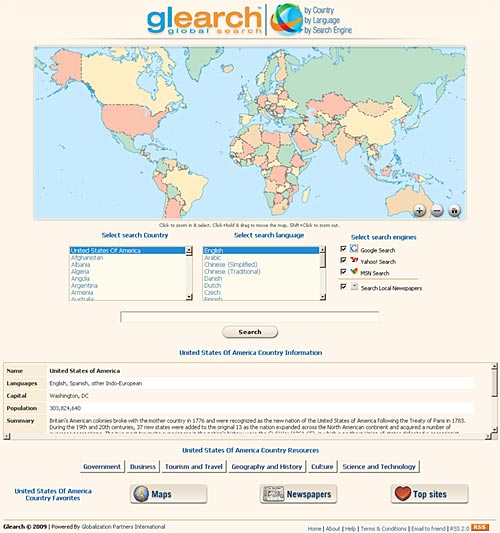
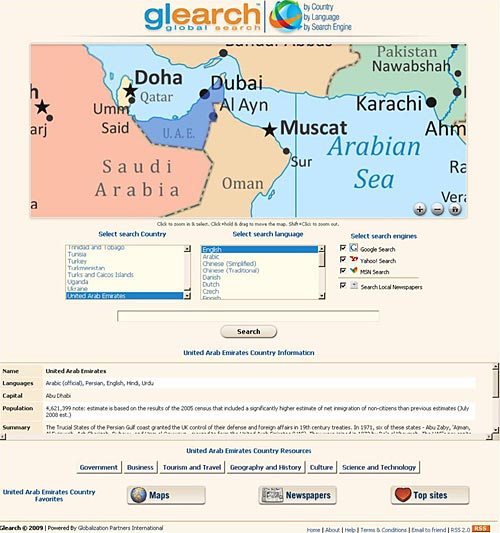
CSN: The map being used to delineate search by country is really useful…any challenges with the interface? MS: That has been the most well received feature of the search engine. Users appreciate Glearch’s global map-based interface and compilation of country specific facts, web resources, maps, newspapers and top sites on the home page. We needed to be careful to keep load times to a minimum, but with a graphical interface you may lose a second or two. CSN: How long did it take to develop? MS: It has been under development and used for about a year and a half internally and it will continually be under development as we get feedback from users. It was a truly global tool from the start even as far as development goes since the GPI in-house web team that developed Glearch are from the USA, Argentina and Egypt. CSN: How does Glearch work? MS: Glearch allows users to perform searches by language, by country, and by search engine. Glearch combines results from Google, Yahoo and MSN, plus select country-specific popular search engines into one search. This service makes use of Google’s Web API, Yahoo search API and MSN search API, as well as other search engines’ APIs. Results are ranked according to the ranks given from each of the different search engines. A higher ranking is given to search results that were found in multiple search engines. CSN: Anything you would like to see improved with Glearch? MS: As I said we will continually improve it based on user feedback but search engine algorithms, meta-searching and the SERPs that are generated can be tricky. Search engines are not smart. They cannot use the websites IP to get the exact “location” of a page nor do they know the natural language necessarily. Search engines recognize countries by their domain name (so, .com.ar means Argentina, co.jp Japan, etc) and languages by the language defined in the HTML / headers sent by the server. If the headers or the HTML codes are wrong, sometimes it works, sometimes it does not. And by applying a search filter, it does not mean you will absolutely get perfect results if the specific combination of search term/ country / language you select does not have well indexed relevant content on the web. SEs will go down the tree and try the search only by country and only by language, so you will get mixed results. CSN: You just launched Glearch publicly this month…how has it been received by the searching public? MS: Very well… our team and clients have
been big fans and now we are seeing some real search experts
have given us good reviews in a variety of blogs even recognizing
SERPs can be tricky in any mash up and Glearch’s results
are those of top search engines. Published - July 2009 ClientSide News Magazine
- www.clientsidenews.com
E-mail this article to your colleague! Need more translation jobs? Click here! Translation agencies are welcome to register here - Free! Freelance translators are welcome to register here - Free! |
|
|
|
|
|
|
| |||
Legal Disclaimer Site Map |