|
 |
 |
 |
|
|
Home | More Articles | Join as a Member! | Post Your Job - Free! | All Translation Agencies | |
|
|||||||
|
|
|
|
The European Library Opens Up 48 Jewel Boxes using TransiBar
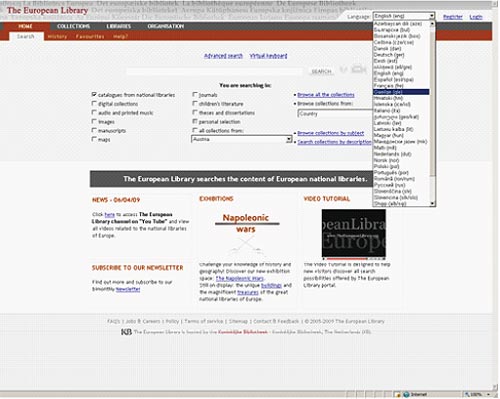
Currently 8 new languages are being added, scaling up the project to a Europe-wide exposé as far as the Southern boundaries of the Caucasus. The funding for this project comes from co-funding of European Commission through the TELplus project and the Conference of European National Libraries. Organizational Profile The European Library is a free service that offers access to 150 million books, magazines, posters, images, maps, videos, etc. of the 48 national libraries of Europe. A national library is the library specifically established by a country to store its information database. National libraries usually host the legal deposit and the bibliographic control centre of a nation. The user interface of The European Library is currently available in 35 languages [Image 1] and the collection descriptions are part of this service. Characteristics:
Image 1. Home Page The European Library Technical Overview The European Library first translated the user interface through the support of the associated national libraries. For the translation of the titles and descriptions, however, a translation service provider was needed. This was because of time and resource constraints, review requirements and the large volume of translatable content. In line with The European Library’s vision localized collection descriptions were needed, besides a localized interface.
Consequently the decision was made to free funds that would allow a full-blown localization project. The choice for a translation environment was based on the following technical conditions:
Business Benefit It was expected that the use of an XML-based translation tool would largely facilitate the translation of the xml files. In addition it was likely that there would be repetitions in the search records. Given the volumes, the European Library office decided that this project needed to be outsourced. In August 2008 all translations were realized and linguistically checked by Scriptware Language Engineers. After a full review round by representatives from the national libraries, the project was delivered by September. By early November 2008 the 330 translated collection descriptions were accessible via The European Library portal in 27 languages. The European Library stakeholders were pleased with the outcomes; full translation of all collection descriptions will require further analysis to fully measure the end-user benefits. Currently the second translation phase has started involving 8 new languages, like Azeri, Albanian and Ukrainian. For maintenance purposes, The European Library will be able to export new collection descriptions and start up an update project in 35 languages instantly. The European Library Users It is in the vision of The European Library to provide equal access to the richness and diversity of European learning and culture. Equal access to the public implies a translation mission. This is also reflected in the language policy and this is why The European Library undertakes the translation of collection descriptions. The European Library primarily targets its service to librarians and members of the academics community. Both the CENL libraries and their customers will benefit greatly from the translated collection descriptions and titles in The European Library. There will be benefits for: end users:
libraries:
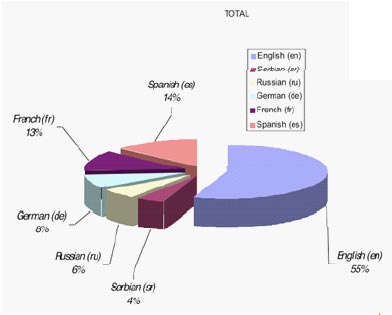
User studies from the TELplus project show that users appreciate the functionality of a multilingual service. One of the first things users do when entering the portal is change the language of the interface. In addition statistical data [Image 3] of the website usage shows the most popular languages selected for services such as the 1st Time User Guide and FAQ, which shows a need for multiple language offering (source Awstats). Statistics about the usage of the translated collection descriptions will be part of future user analysis, following adequate promotion of this service.
Image 2. FAQ’s + USER GUIDE: Most
Popular Languages Dissemination of the translation project took place in the first instance via the TELplus project, which reports the project outcomes to the European Commission. The 8availability of the translations was also distributed via The European Library newsletter, to the library partners and wider audience of The European Library. Additionally the national libraries translated The European Library press release issued in April 2009, which announced the increase of multilingual facilities. TransiBar On-line Services Scriptware developed a web portal called TransiBar. A XML-based platform that allows customers, project managers, translators and local reviewers to collaborate.
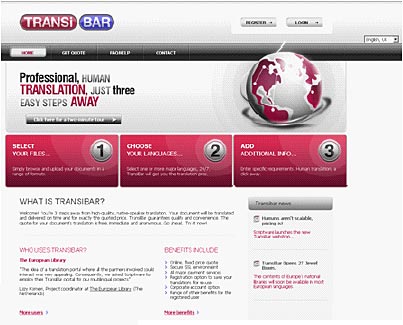
Image 3. Home Page TransiBar TransiBar was first announced beginning 2008 as a ‘closed’ portal that required a Login and Password before entering. Basically it functioned as a webtool that allowed customers to get a quote after uploading their files and clicking the [I agree] button to get started. TransiBar consisted of three basic user groups: customer coordinators, project managers and translators. The main idea was to reduce the number of necessary steps between customer and translator. By virtue of the middle position of the language service provider this could easily be up to 4 to 5 layers, that would each store a copy of the source file and target languages. TransiBar was meant to improve efficiency, facilitate project management and to allow customers to get a direct quote. The application was built on a Java platform, a web content management system and SQL database. It is hosted in a data center to create uptime guarantee and internet backbone speed. The application revolves around XTM, an xml-based innovative translation memory (TM) engine. This module controls the centralized TM and automates many of the traditional processes involved in using it. By using XML with advanced database and web search technology it outperforms traditional translation memory systems, enabling substantial reductions in through put time and translation cost during a typical document life cycle. Other functionality includes:
“This is the first time we have had 27 languages in one go in TransiBar. It is a significant development, particularly as we have now submitted the translation to online review by locally-based reviewers in each of the national libraries”. Frank ter Reehorst, Managing Director of Scriptware TransiBar and Industry Developments “The Web environment offers new challenging business models to the translation industry”, says Frank ter Reehorst, Director at Scriptware. In his view, the translation industry is rapidly changing and challenging new business models are being launched. Name-your-price, a choice in price, quality or speed and crowdsourcing are but a few of those directions. Conclusion The European Library project has been a showcase for TransiBar. It has proven that XML content is well geared for online translation. The combination with representatives from the national libraries that could review and correct the translations created a smooth workflow that enabled all TransiBar users to collaborate intensively. Future updates will be easy and fast. As of summer 2009, The European Library collections will be searchable in 36 languages (including English). It will open up 48 priceless jewel boxes and unveil the European cultural heritage to all European citizens. Author Bios Lizzy Komen, Project Coordinator for The European Library and Europeana.
Frank ter Reehorst – General Manager Scriptware translations - The Netherlands.
ClientSide
News Magazine - www.clientsidenews.com
E-mail this article to your colleague! Need more translation jobs? Click here! Translation agencies are welcome to register here - Free! Freelance translators are welcome to register here - Free! |
|
|
|
|
|
|
| |||
Legal Disclaimer Site Map |

 In
2007 the collection descriptions from the European national
libraries were only available in the native language and
in English via The European Library portal.
The European Library Office aimed to have all 330 collection
descriptions available in 27 languages by mid 2008. To fully
understand the scope of the project, it is important to
know what a collection and a collection description is.
It is common understanding that a collection covers the
total accumulation of books or other materials owned by
a library, organized and catalogued for ease of access by
its users. A collection description allows the owners or
curators of collections to disclose information about their
existence and availability.
In
2007 the collection descriptions from the European national
libraries were only available in the native language and
in English via The European Library portal.
The European Library Office aimed to have all 330 collection
descriptions available in 27 languages by mid 2008. To fully
understand the scope of the project, it is important to
know what a collection and a collection description is.
It is common understanding that a collection covers the
total accumulation of books or other materials owned by
a library, organized and catalogued for ease of access by
its users. A collection description allows the owners or
curators of collections to disclose information about their
existence and availability.