|
 |
 |
 |
|
|
Home | More Articles | Join as a Member! | Post Your Job - Free! | All Translation Agencies | |
|
|||||||
|
|
|
|
The Mechanism of Anime translation
Abstract
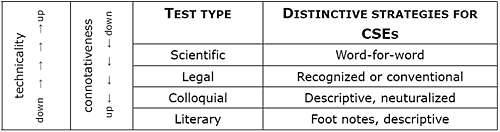
Keywords: Japanese animation, Anime, culture specific elements, translation, SC (source culture), TC (target culture) 1. Introduction Anime is an original Japanese term which means cartoon, a loan word from the English animation, abbreviated into Japanese transliteration. The term Anime is defined as ‘Japanese cartoon’ in prestigious dictionaries such as Miriam-Webster. Since the huge worldwide success of “Astro Boy” in the 60’s, the usage of this term is now accepted in all the countries which the Anime industry has reached. Anime hobbyists have attained a cultural status stepping up from a sub culture. These obsessive Anime hobbyists have become a target for the mass-market entertainment industry. Numerous emblematic events have taken place, which have caused radical changes within the world of Anime. The Television series that originated from Japan “Pokémon” became a billion-dollar business[1] all over the world during the late nineties. The theatrical Anime film by Hayao Miyazaki “Spirited Away” won international recognition by winning awards such as Best Animation film at the Academy Awards[2], The Golden Bear at Berlin Film Festival, Best Film Awards at Durban International Film Festival, The Special Mention Award at Sitges-Catalonian International Film Festival, The Silver Scream Award at Amsterdam Fantastic Film Festival etc.. In order to introduce Anime and live-action films to an international audience it is necessary to translate the films into the languages of the target audience. Inevitable problems relating to translation exist. For example, the issues concerning the choice of words or expressions that are suitable in another cultural context need close attention when performing translation. Ironically, the studies of Anime translation have often been neglected. Recently, we have witnessed the growing global phenomenon of a forum in which people comment on the translation of their TL versions. We can observe a great number of "Funsub", a fan-translating club of amateur translators who try to translate subtitles within unreleased products (JETRO, 2007)[3]. However, despite their immense interest, the opinions on the forum and the translations by "Funsub" are often superficial and are not at an academic level. The objective of this paper is to present an overview of Anime translation and point out the problems that exist when translation is done. I will define the text type of Anime dubbed in Italian, offer an insight into its difficulties of translation and seek proper approaches to solve cultural translation in Anime. Initially, linguistic aspects will be examined. Secondly extra linguistic factors that greatly influence the process of translation will be debated. 2. Text type and translation strategy Language has a cultural origin within itself. Words have meanings within their cultural context. Therefore every text type translated contains its own culture specific items that create difficulties for translators. Nuances and connotations of the Culture Specific Elements (CSEs) vary according to the text type. Strategies that are adopted to select the renderings are different. We can classify the text types into four categories[4]: Scientific, Legal, Colloquial, and Literary (see Table 1). Scientific text is best described by an example. Carbon dioxide is always carbon dioxide (CO2), and immune from any connotation. There are no emotional factors to be considered such as being happy or sad, beautiful or ugly when translated. There is only one equivalent translation for each linguistic element. In these situations the word-for-word translation method should be applied. (Hirako, 1999) The translator doesn’t need to have knowledge about the culture of the source language (SL) but would need to be competent in the technical terms in that specific field. Legal text is similar to scientific text translation. The translator needs to be competent in the technical terms in the specific field to translate. But the difference is that every country’s CSEs have their own different legislative system with their own specific concepts (Symigné Fenyő, 2005). In this situation the conventional or explanatory translation is generally useful if there’s no equivalence in the TL. Colloquial text is connected with the cultural context of the SL. The translator must be knowledgeable about both source culture (SC) and target culture (TC) in order to render CSEs. For example, a tourist text in colloquial diction that is written to introduce a culture to the people in another culture would include a lot of CSEs. In this situation the transliteration and descriptive strategies[5] would apply to maintain the exotic feel of the description and convey the information at the same time. Literary text has a wider range of interpretation than all the other text types listed above. In Literary text translation, not only are the collective experiences of the people of the SC important, but also the personal experiences of the author have great value. The translator should be able to understand the author’s intention and be able to render the equivalent effect evoked to the readers in SL. The translator can resort to footnotes to describe in more words those CSEs which are not familiar to the public in the TL. How can we classify the Anime text? In the following chapter, we are going to examine the text type of Anime and the difficulties assosciated with it. Table 1. Classification of text type
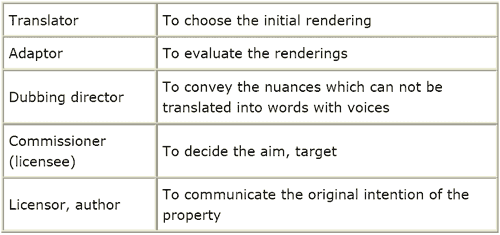
3. Text type of Anime and its CSEs In the world of Anime there are three different types of text to translate: Dialogue, Title, and Credits. This chapter will analyze the problems that are inherited in the CSEs in each of them. 3.1. Dialogue The dialogue consists of the content of an Anime where the message of the product interrelates with the cultural context of SL. The dialogue belongs to the category of the colloquial text type[6], which distinctively conveys its message in synergy with visual signs and voices. Taking advantage of the voice effects, while the others require verbal solutions, can solve problems related to CSEs in dialogue. They have different options of rendering due to the different linguistic system between the SL and the TL. 3.1.1. Gender and age specific speech The Japanese language is full of specific use of gender and age within the grammar. It is very difficult to find the matching linguistic rendering in different languages but it is possible to approach its original effect on the SC audience by means of the intonation and the type of voice (Hanada, 2005). The character “Lin” in the Anime movie from Hayao Miyazaki’s “Spirited Away” is a boyish female character who employs male gender speech. Even though a TL has no equivalent linguistic system, the choice of the type of voice and the way of speaking can help to achieve the effect of the original Anime. The translator should be responsible for advising those who have access to the following production stages (e.g. adaptor, dubbing director and so forth) that these points cannot completely convey the original message in the TL but they can be improved by other means like voices. Even though the stage of dubbing is not directly within the translators responsibilities, suggestion by the translator at this stage are crucial to convey the subtle nuances which are culturally impossible to express with words in the TL. These suggestions will improve the quality as a whole. These issues are closely related to the topic of communication and we will discuss this further in 4.4 as one of the extra-linguistic aspect. 3.1.2. Redundancy Redundancy is CSEs without word and should be considered as a nonverbal solution like the cases of speech (3.1.1.). Japanese culture does not have the culture of eloquence. Being indirect, remaining vague and avoiding expressing emotions in words are just a few examples within the culture. Often, conversations in Japanese include many varieties of redundancy, which are expressions full of connotation and nuances. For example Chihiro, the main character of “Spirited Away”, finds an attendant who works at the boiling room of the bathhouse known as Kamaji for the first time. She says in Japanese (SL) “Anooo” which means she would like to talk to him but fears doing so. In the Italian version, she greets him using the word Salve, ‘Hello’. Although it’s said in a shy tone, the sense of distance between Kamaji and Chiharu is lost to some extent. The translator should take into consideration the fluency in the TL but this doesn’t mean he or she is forced either to edit or to select the verbal expression in the TL. It’s true that redundancy is applied more often in Japanese and can be considered as CSE but it’s not advisable to take it for granted, as CSEs are difficult to understand for TL audience. Instead of deleting all the CSEs, it is often enough to replace them with redundancy in the TL in order to gain a similar effect to the original. When translated into Italian, an evasive expression such as “ehmmm” can fulfil the function. 3.1.3 Culture specific term Among the CSEs, culture specific terms (CSTs) are one of the most troublesome factors in translation. There are various solutions such as omission, transliteration, and naturalization. The following examples can be argued because of the way they approach the CSTs. In the Anime “Spirited Away” the Italian rendering selected for hakama, a type of traditional Japanese trousers, was pantaloni, which means pants. In order not to confuse the Italian viewers, this cultural neutral term `pants` might be appropriate. Borrowing[7] can be adopted only when the term is widely known in the TL (e.g. sushi, kimono, judo). But there is another important factor which a translator should take into consideration. The culture of a country is not static but dynamic. Hakama are not commonly used outside of the SC (Japan) but they are used as sports wear for martial arts such as Kendo, Aikido, and Kyudo. The Aikido population overseas has been growing for the last twenty years[8] and in the near future the borrowing strategy would be suitable instead of using the cultural neutral term. We should keep an eye on the evolution of such examples between the SL and the TLmined l argue d thal,es ount the knowledge about the case of as time passes. A culture can assimilate the CSEs of another culture and the CSTs can be absorbed into the vocabulary of the TL, just like kimono, sushi etc. This is related also to the issue of the target, which will be discussed in section 4.3.. Another symbolic example is bandai in “Spirited Away”. Bandai has multiple meanings. One is a small counter where a guard sits in a traditional public bathhouse. It could also mean the guard himself or herself in a public bathhouse. The numbers of bathhouses in Japan are presently decreasing[9] and that changes the viewers’ TL understanding of the term bandai itself. Now that a bathhouse is not a familiar place any more to the new generation, they may not even know that the term bandai is related to bathhouses. In fact, when Lin tells Chihiro to go to the bandai, Chihiro answers; “Bandaitte nani?” (What is the bandai?). The Italian version chose to render bandai into caporeparto ’head of the department’. We notice that caporeparto is inaccurate from the semantic point of view. Besides, it does not have a similar effect to the original term bandai, as it is not yet an obsolete word. In this situation it is not necessary to find some laboured term in the TL since the CST is an unfamiliar element to the audience in SL as well. The translator tends to focus only on the differences between the SC and the TC. However in the case of bandai, it shows clearly that not only is SC evolving but TC culture is evolving also. Thus transferring the original term into the TL text can be more functional than creating some substitutive expression for it. (Hanada, 2008). The CSEs in the dialogue can be hidden within the gestures. We can observe a situation in the film “Laputa: The Castle in the Sky”. The day after the fall of Sheeta from the dirigible, Pazu asks her “Non te lo ricordi?” - ‘Don’t you remember?’ She gives an affirmative nod, which in Japanese (SL) means the confirmation of what he said to her. But in Italian the affirmative answer to the negative question is “No, non me lo ricordo” - ‘No, I don’t remember’. In this situation, there is an inconsistency between the gesture and the answer in the Italian version. The translator can’t intervene with the gesture. One can find a solution by changing the question to fit the answer to the gesture or by notifying the adapter of it. In order to make such judgement the translator should be provided with both the script and the original DVD. Judgements such as these are only possible when there is a full understanding of extra-linguistic problems, which will be dealt with in more detail in the next chapter. 3.2. Title In comparison to dialogue translation, the aim of title translation is not only to sum up the artistic concepts present in the work but also to attract the public attention thus making a profit for the business. Therefore it is not always good to condemn the titles in the TL due to inconsistencies with the original. The suggestion by the translator from the linguistic point of view is undoubtedly essential but at the same time the importance of the commercial intent can often prevail. For example “Sen to Chihiro no Kamikakushi” in English was “Spirited Away’”. In Italian the title was “Città Incantata”, which did not have any relation to the original Japanese title. The translations do not incorporate the wordplay of the main characters (Sen and Chihiro)[10] in kanji (CSEs) and the main concept of this anime, kamikakushi, which is completely omitted with no logical explanation. The choice of this Italian title is due to the difficulty of rendering the wordplay based on the Japanese ideograms kanji and the cultural specific mode of expression in SL. “Città Incantata” ‘Enchanted Town’ is closer to the original subtitle, “Tonnreru no mukou wa fushigina machideshita” ‘Beyond the tunnel, There was a Strange Town’. The Italian term villaggio, ‘village’, is more suitable as the rendering for machi rather than città, which may recall a place much bigger than that portrayed in the film. Nevertheless the Italian title works well taking into account the immediacy, the euphony, and the impact toward the TC public. Therefore it is necessary to pay special attention to not only the linguistic accuracy but also to whom it is addressed, and to see the function of the translation even though it fails to convey the cultural specific elements. 3.3. Credits The credits are the list of the production staff involved in production of the film. The translation involving them is the easiest part of the translation process within the film because of its aim. The technical terms such as director or animator have their own conventional translation, i.e. word-for-word translation, immune to misunderstanding. With applicable knowledge of each member of the production staff’s functions the translator should be able to apply the same expertise to almost every product. 4. Extra-linguistic aspects in translating anime As mentioned in the previous chapter (3.1.3), there are factors that influence the choice of the types of rendering. There are three types of rendering that I would like to focus on in this report. 4.1. Aim The aim is a version of rendering. For example in American, they definitely want to make an American show for Americans, not a Japanese show for the Americans (Bernarski, 2001)[11], and it would be right to substitute all the CSEs with something neutral or local, completely removing cultural uniqueness from the work. For example doughnuts, a well-known dessert in America became the anecdote for riceballs in the Pokémon series[12]. This was due to the fact that America was a much more culturally diverse country with various sensibilities to contend with. All the dialogue was re-written to target the American audience. In this event it remains to be debated whether the rewritten text for the TC can be defined as a translated version or an American audience adapted version. On the other hand, the present mainstream in Italy is to be faithful to the original SC. The effect they intend to achieve is to give the impression that the characters are Japanese and speak in Japanese. The audience merely listens to them in Italian. Therefore they should not twist CSEs but find a rendering maintaining the original feel. 4.2. Cost It is essential that the translator be competent both culturally and linguistically. If the translator were a native speaker of the TL, it would be appropriate to set a co-translator or consultant of a SL native speaker in order to compensate cultural lacunae, shed light on delicate nuances, connotations and effect of the CSEs. Having two translators usually means more cost and is normally not provided for. In general the adaptation succeeds the translation. Some adapters define their function as to transfer the concept from one cultural context to the other. Besides adjusting the duration of every dialogue of the translated script and rewriting them in the fluent TL, they should make the cultural references (such as jokes, proverbs, wordplays etc.) clear (Animeye, 2004). They are responsible for the renderings of CSEs as well as translators. Therefore in order to make essential choices of words or expressions, it is crucial to have seamless communication between the translator and the adapter. We will discuss this in more details in the next section 4.4. However, the adapters can sometimes be absent. Even when they are present, they would be in charge exclusively of the technical aspect, adjusting the length of dialogue in the TL to match it to the motion[13]. This happens because the Italian market is not very profitable, so the publishers, especially those who release the titles only on DVD, have to operate on low translation budgets. They are often not able to afford personnel expenses for this stage of adaptation[14]. Even though the popularity of anime has increased in Italy, the market is still small in comparison with America and therefore it would not be financially beneficial to do so. The publishers would have to balance the high cost of the rights with the labor cost. Unfortunately many of them would be forced to give up pursuing the linguistic accuracy or cultural suitability due to the limited financial resources. 4.3. Target The background knowledge about the SL audience will determine the translation[15]. When choosing how to render, we would need to take into consideration the target we are rendering too. Replacing or omitting CSEs is barely necessary if the product is targeted at the hard-core fans[16]. Hard-core fans have a background in the SC which allows them to grasp the cultural references and they often prefer enjoying the SC oriented translation. The neutralization[17] and omission strategy can be applied in the case of anime work that is for theatrical movies or TV series targeted at a mass audience including children whose background knowledge varies. Therefore the frequency of generalizing CSEs can be increased as the target age is lower, or the target is more general. 4.4. Communication Another linguistic factor that should not be undervalued is the communication between the translator, adaptor, dubbing director, commissioner and the original licensor/author (see Table 2). The Production staff can be highly competent but if they don’t know the reasoning and the intention hidden behind the original work, there’s a risk of interpreting them incorrectly. It is necessary to check every doubt, consult difficult parts and to make things clear. Japanese licensors are known for their lack of flexibility and taking time to make decisions. This is because many animated series are conceived only for the domestic market (Winslow, 2005). On the other hand foreign licensees tend to change or omit the cultural references. Without mutual communication they might misunderstand or fail to notice the author’s intention. Each member of staff should actively interact with the people handling other stages, since the TL version is not the work of a translator but is the result of the effort of all the staff involved. Table 2 ROLES and tasks related to the making of the TL version
5. Conclusion Making a TL version is a complex process due to the problems that are inherent in the peculiarity of the SL and the SC. This is partly due to the many extra-linguistic factors that are a unique blend of cooperation between many people[18]. It is not only the translator’s competence in SL and SC that is important, but only the awareness of the mechanism by all of the staff involved will foster the improvement of anime translation. As Miyazaki said, “Shakespeare, unfortunately, is not the same in Japanese as it is in English, … there are cultural changes that are inevitable, no matter how scrupulous one tries to be.”[19]. Making alterations is unavoidable in order to introduce the product to a foreign audience. For the purpose of achieving the best rendering, all people involved in making the TL version should be broad-minded enough to try to meet each other halfway. It is also important to be capable of grasping the CSEs that can be comprehensible to the TL public. Being flexible enough to accept changes over time and trying to seek a proper translation at the moment are other important factors. As the exportation of Anime increases year by year[20], the research into Anime translation will be more pertinent to better the quality of the translation itself and also to expand the understanding of other “traditional” translation studies. Notes [1] The TV series Pokémon is broadcasted in 68 countries and translated into 25 languages. [2] It is the first anime film to have won an Academy Award, the second Oscar ever awarded for Best Animated Feature. [3] Jenkins (2006) asserts that although the ethic and copyright problems have arisen, the phenomena filled the role to induce the further popularization of Japanese animation. [4] Hirako (1999) made the classification of the text type (scientific, legal, daily, poetic) according the extent of the limitation of code. [5] The meaning of the CST is explained in several words (Newmark, 1988a). [6] There can be also legal or scientific cartoons, but in this paper those with great importance on the mass market is intended by “anime”, for the purpose of giving an outline of this genre. [7] Reproducing or where necessary transliterating the original term [8] The International Aikido Federation declares the 1.7 times growth of foreign practitioners in 90 countries in the last 20 years. [9] According to the research of The Bureau of Citizens, Culture and Sport, the number of bathhouses in Tokyo has reduced by less than half in the last forty years. [10] The kanji is the Japanese ideogram and each letter often has more than one pronunciation. It is impossible to transfer the play even in a language which uses the kanji because the pronunciation and the meaning are not the same in another language. In this case the main character who is called “Chihiro” becomes “Sen” in the middle of the story because the old witch Yubaba erases one of the two kanji constituting the name “Chihiro” and she calls the girl “Sen” with the another pronunciation of the remaining kanji. [11] Quote from Tylor Loch of Toonami Digital Arsenal concerning the dubbing company perspective. On the other side Michael Haigney, famous rewriter of 4kids claims that he has nothing against the Japanese cultural references but his job is to remake the series for a mass U.S. audience (Rasmussen, 2006). [12] In episode 25 of Pokémon, the handy Japanese food “riceball” is translated into English as “doughnut”. Doughnuts are certainly more familiar to American children, but this is debatable, firstly because the image of the riceballs was not altered and also because the term “riceball” can be understood by the viewers with the aid of the image. [13] In dubbing cartoons the lip synchronization is less problematic than in live action movies. [14] Even when a big international distributor handles the product, there would be a problem; they do not always make the source text available in SL but provide it already translated into English. [15] This issue overlaps the aforementioned (3.1.3) strategies to adopt in order to translate the CSEs according to the aim of the translated version. The aim and the target condition each other. [16] The products for the niche market are usually edited only on DVD since generally there is no time slot to air them, while in Japan they can be broadcasted late at night. [17] Neutralizing or generalizing the SL word using a culture-free word (Newmark, 1988b) [18] In this sense, the process of anime translation can be called language localization, a definition usually used also for videogame translation, another ex sub-culture made in Japan. Localization means linguistic and cultural adaptation and recently the profession of “localizer” has started to appear. [19] Miyazaki said these phrases during the interview for the Detroit Free Press when in 1999 he released “Princess Mononoke” for the western market with his approval of the script and the casting after a decade of refusal to export any film because of the distress caused by the inappropriate alteration made to the “Warriors of the Wind”. [20] According to the research of The Institute of Information and Communications Policy, more than 30% of the increasing export values of Japanese TV programs are the anime product. References - Bednarski, Dan (2001). “The Anime Translation and American Society Problem”. Sailor Moon Uncensored, 6 Aug. - Hanada, Mariko (2005). “Translating Anime and Methods of Dealing with them”. Tokuma Commemorative Animation Cultural Foundation Annual Report 2004-2005, 10-38. - Hanada, Mariko (2008). ”The Translation of Anime: the Transfer of a Culture”. Paper presented at TILS 2009 Research in cross-lingual communication: theories and methodologies (University of Macerata, 1-2 February 2008) - Hirako, Yoshio (1999). The Principle of Translation, Tokyo:Taishukan - JETRO(2007) “Basic research on the comic and anime market in Italy”. JETRO Resarch Report. Mar. - Jenkins, Henry (2006). “When Piracy Becomes Promotion”. Reason Magazine, Dec. - Newmark, Peter (1988a). Approaches to Translation. Hertfordshire: Prentice Hall. - Newmark, Peter (1988b). A Textbook of Translation. Hertfordshire: Prentice Hall. - Rasmussen, David (2006). “Mr Michael Haigney Interview (4kids)”. animeboredom, Feb. 12. - Simigné Fenyò, Sarolta (2005). “The Translator’s Cultural Competence, European Integration Studies”. Miskolc 4(2), 61-72. - Winslow, George (2005). “Japan Rising”. World Screen News, Jan. 17. - “Dell’Arte Dell’Adattamento” (2004). AnimeEye, Speciali Dossier, 19 May.
E-mail this article to your colleague! Need more translation jobs? Click here! Translation agencies are welcome to register here - Free! Freelance translators are welcome to register here - Free! |
|
|
|
|
|
|
| |||
Legal Disclaimer Site Map |
 S
S