 |
 |
 |
 |
|
|
Home | More Articles | Join as a Member! | Post Your Job - Free! | All Translation Agencies | |
|
|||||||
|
|
|
|
List of writing systems
This is a list of writing systems (or scripts), classified according to some common distinguishing features. The usual name of the script is given first (and bolded); the name of the language(s) in which the script is written follows (in brackets), particularly in the case where the language name differs from the script name. Other informative or qualifying annotations for the script may also be provided. 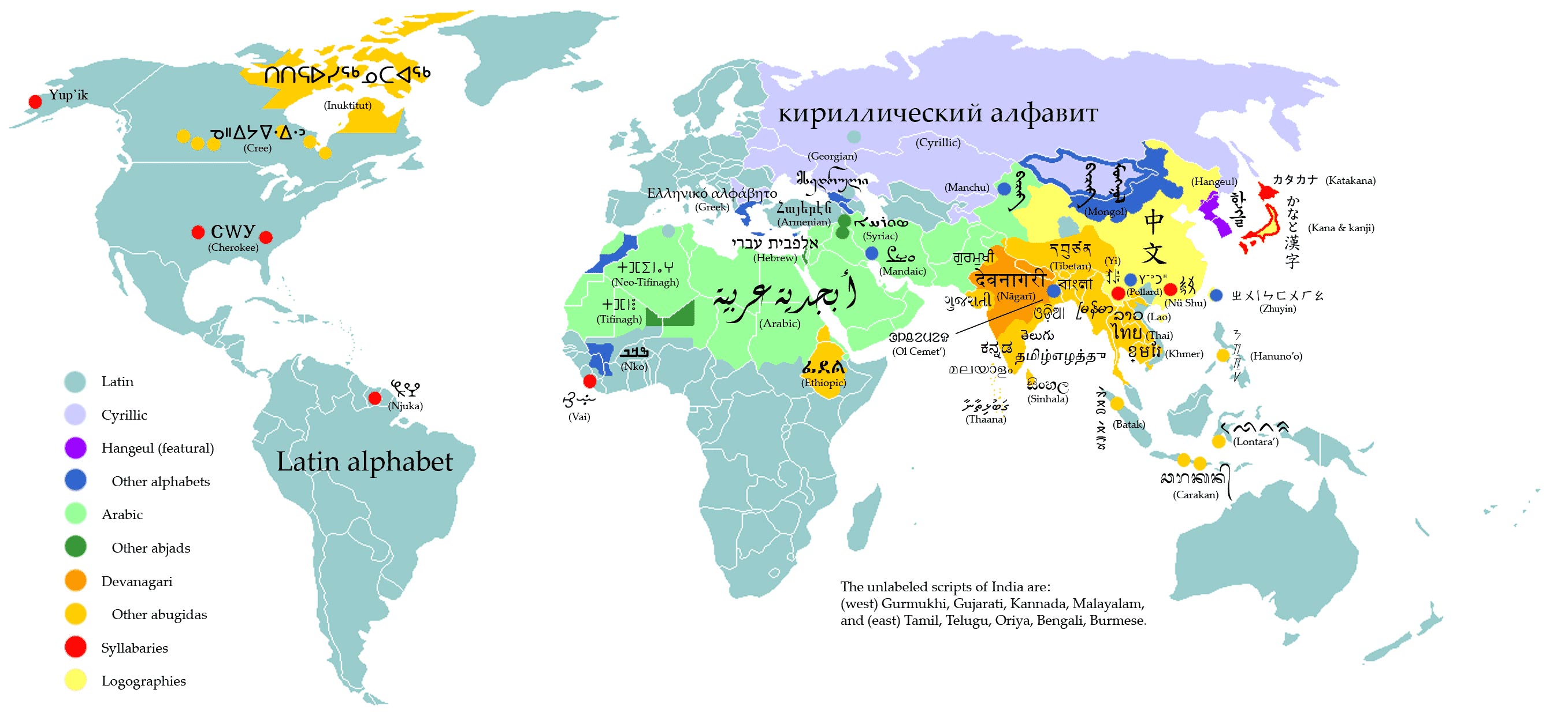
Writing systems of the world today.
Pictographic/ideographic writing systemsIdeographic scripts (in which graphemes are ideograms representing concepts or ideas, rather than a specific word in a language), and pictographic scripts (in which the graphemes are iconic pictures) are not thought to be able to express all that can be communicated by language, as argued by the linguists John DeFrancis and J. Marshall Unger. Essentially, they postulate that no full writing system can be completely pictographic or ideographic; it must be able to refer directly to a language in order to have the full expressive capacity of a language. Unger disputes claims made on behalf of Blissymbols in his 2004 book Ideogram. Although a few pictographic or ideographic scripts exist today, there is no single way to read them, because there is no one-to-one correspondence between symbol and language. Hieroglyphs were commonly thought to be ideographic before they were translated, and to this day Chinese is often erroneously said to be ideographic. In some cases of ideographic scripts, only the author of a text can read it with any certainty, and it may be said that they are interpreted rather than read. Such scripts often work best as mnemonic aids for oral texts, or as outlines that will be fleshed out in speech.
There are also symbol systems used to represent things other than language. Some of these are
Logographic writing systemsIn logographic writing systems, glyphs represent words or morphemes (meaningful components of words, as in mean-ing-ful), rather than phonetic elements. Note that no logographic script is comprised solely of logograms. All contain graphemes which represent phonetic (sound-based) elements as well. These phonetic elements may be used on their own (to represent, for example, grammatical inflections or foreign words), or may serve as phonetic complements to a logogram (used to specify the sound of a logogram which might otherwise represent more than one word). In the case of Chinese, the phonetic element is built into the logogram itself; in Egyptian and Mayan, many glyphs are purely phonetic, while others function as either logograms or phonetic elements, depending on context. For this reason, many such scripts may be more properly referred to as logosyllabic or complex scripts; the terminology used is largely a product of custom in the field, and is to an extent arbitrary. Consonant-based logographies
Syllable-based logographies
Logographies based on Chinese
SyllabariesIn a syllabary, graphemes represent syllables or moras. (Note that the 19th century term syllabics usually referred to abugidas rather than true syllabaries.)
Semi-syllabaries: Part syllabic, part alphabetic scriptsIn most of these systems, some consonant-vowel combinations are written as syllables, but others are written as consonant plus vowel. In the case of Old Persian, all vowels were written regardless, so it was effectively a true alphabet despite its syllabic component. In Japanese a similar system plays a minor role in foreign borrowings; for example, [tu] is written [to]+[u], and [ti] as [te]+[i]. Paleohispanic semi-syllabaries behaved as a syllabary for the stop consonants and as an alphabet for the rest of consonants and vowels. The Tartessian or Southwestern script is typologically intermediate between a pure alphabet and the Paleohispanic full semi-syllabaries. Although the letter used to write a stop consonant was determined by the following vowel, as in a full semi-syllabary, the following vowel was also written, as in an alphabet. Some scholars treat Tartessian as a redundant semi-syllabary, others treat it as a redundant alphabet. Zhuyin is semi-syllabic in a different sense: it transcribes half syllables. That is, it has letters for syllable onsets and rimes (kan = "k-an") rather than for consonants and vowels (kan = "k-a-n").
Segmental scriptsA segmental script has graphemes which represent the phonemes (basic unit of sound) of a language. Note that there need not be (and rarely is) a one-to-one correspondence between the graphemes of the script and the phonemes of a language. A phoneme may be represented only by some combination or string of graphemes, the same phoneme may be represented by more than one distinct grapheme, the same grapheme may stand for more than one phoneme, or some combination of all of the above. Segmental scripts may be further divided according to the types of phonemes they typically record: AbjadsAn abjad is a segmental script containing symbols for consonants only, or where vowels are optionally written with diacritics ("pointing") or only written word-initially.
True alphabetsA true alphabet contains separate letters (not diacritic marks) for both consonants and vowels. Linear nonfeatural alphabetsLinear alphabets are composed of lines on a surface, such as ink on paper.
Featural linear alphabetsA featural script has elements that indicate the components of articulation, such as bilabial consonants, fricatives, or back vowels. Scripts differ in how many features they indicate.
Manual alphabetsManual alphabets are frequently found as parts of sign languages. They are not used for writing per se, but for spelling out words while signing.
Other non-linear alphabetsThese are other alphabets composed of something other than lines on a surface.
AbugidasAn abugida, or alphasyllabary, is a segmental script in which vowel sounds are denoted by diacritical marks or other systematic modification of the consonants. Generally, however, if a single letter is understood to have an inherent unwritten vowel, and only vowels other than this are written, then the system is classified as an abugida regardless of whether the vowels look like diacritics or full letters. The vast majority of abugidas are found from India to Southeast Asia and belong historically to the Brāhmī family. Abugidas of the Brāhmī family
Other Abugidas
Final consonant-diacritic abugidasIn at least one abugida, not only the vowel but any syllable-final consonant is written with a diacritic. That is, representing [o] with an under-ring, and final [k] with an over-cross, [sok] would written as s̥̽. Vowel-based abugidasIn a couple abugidas, the vowels are basic, and the consonants secondary. If no consonant is written in Pahawh Hmong, it is understood to be /k/; consonants are written after the vowel they precede in speech. In Japanese Braille, the vowels but not the consonants have independent status, and it is the vowels which are modified when the consonant is y or w. Undeciphered systems thought to be writingThese writing systems have not been deciphered. In some cases, such as Meroitic, the sound values of the glyphs are known, but the texts still cannot be read because the language is not understood. In others, such as the Phaistos Disc, there is little hope of progress unless further texts are found. Several of these systems, such as Epi-Olmec and Indus, are claimed to have been deciphered, but these claims have not been confirmed by independent researchers. In Vinca and other cases the system, although symbolic, may turn out to not be writing.
Undeciphered manuscriptsA number of manuscripts from comparable recent past may be written in an invented writing system, a cipher of an existing writing system or may only be a hoax. OtherPhonetic alphabetsThis section lists alphabets used to transcribe phonetic or phonemic sound; not to be confused with spelling alphabets like the NATO phonetic alphabet.
Special alphabetsAlphabets may exist in forms other than visible symbols on a surface. Some of these are: Tactile alphabetsManual alphabetsFor example: Long-Distance SignalingAlternative alphabetsFictional writing systemsSee also
References
Published - December 2008 Information from Wikipedia
is available under the terms of the GNU Free Documentation
License
E-mail this article to your colleague! Need more translation jobs? Click here! Translation agencies are welcome to register here - Free! Freelance translators are welcome to register here - Free! |
|
|
|
|
|
|
| |||
Legal Disclaimer Site Map |



