|
 |
 |
 |
|
|
Home | More Articles | Join as a Member! | Post Your Job - Free! | All Translation Agencies | |
|
|||||||
|
|
|
|
Glottal consonant
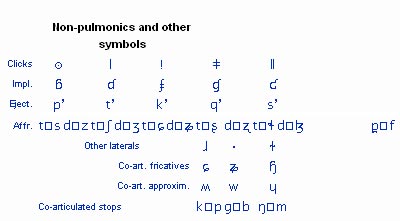
Glottal consonants are consonants articulated with the glottis. Many phoneticians consider them, or at least the so-called fricatives, to be transitional states of the glottis without a point of articulation as other consonants have; in fact, some do not consider them to be consonants at all. However, the glottal stop at least behaves as a typical consonant in languages such as Tsou. Glottal consonants in the International Phonetic Alphabet:
The "fricatives" are not true fricatives. This is a historical usage of the word. They instead represent transitional states of the glottis (phonation) without a specific place of articulation. [h] is a voiceless transition. [ɦ] is a breathy-voiced transition, and could be transcribed as [h̤]. The glottal stop occurs in many languages. Often all vocalic onsets are preceded by a glottal stop, for example in German. The Hawaiian language writes the glottal stop as an opening single quote ‘. Some alphabets use diacritics for the glottal stop, such as hamza <ء> in the Arabic alphabet; in many languages of Mesoamerica, the Latin letter <h> is used for glottal stop. Because the glottis is necessarily closed for the glottal stop, it cannot be voiced. See alsoReferences
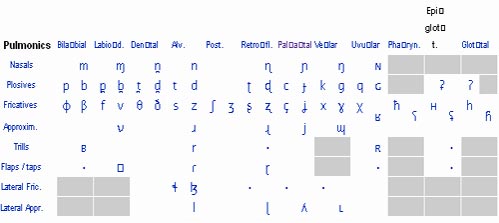
This table contains phonetic
information in IPA,
which may not display correctly in some browsers.
Published - November 2008 Information from Wikipedia
is available under the terms of the GNU Free Documentation
License
E-mail this article to your colleague! Need more translation jobs? Click here! Translation agencies are welcome to register here - Free! Freelance translators are welcome to register here - Free! |
|
|
|
||||||||||||||||||||||||||||||||||||||
|
|
|
| |||
Legal Disclaimer Site Map |