|
 |
 |
 |
|
|
Home | More Articles | Join as a Member! | Post Your Job - Free! | All Translation Agencies | |
|
|||||||
|
|
|
|
Translation Management System: Is Bigger Really Better?By Greg Rosner,
Examining the structure of different products and approaches can provide insight into the nuances of different translation solutions. When it comes to building a translation solution there are what seem to be an unlimited number of choices available, all with a slightly different methods of how to solve your problem. Current client needs and the plethora of services available are just too diverse to synthesize into an all-encompassing solution; hence the problem with creating a solution purely out of an M&A transaction. WHAT DO YOU EXPECT FROM A TRANSLATION MANAGEMENT SYSTEM? (TMS) With TMS systems, the current industry buzz is focused on where a system begins and where it ends; what is chargeable and what is not. Features such as Content Management, or integration with other Content Management Systems (CMS) as well as whether to include workflow and translation memory into your TMS are determining factors on what solution you should choose. Using online banking as a metaphor, most banks have an on-line transactional portal which you expect to be free, with some basic self-management functionality such as:
Much like a TMS, fees are waived if you keep your money (content in the case of TMS) in the bank of the web portal you use. However, if your banking needs are complex, say you wish to be able to manage all your money regardless of which bank(s) your money is in, and/or you wish to buy and sell stocks real-time, you may need to "rent" software to manage all that in one place (or portal). Most banks have realized this concept by offering this extended functionality for a fee. Similarly, most current TMS systems allow you to add features or use premium features for a fee. While these systems are still taking shape on staging servers behind the closed doors of LSP’s and Software companies, most of them have a web-based portal which clients expect to be free along with some basic functionality, like being able to:
WHAT DO TMS USERS REALLY NEED? Many solution providers decide on their portal’s feature-set by sitting in a conference room and white-boarding all the things they think their clients would like to have in a system with the aim of "building a better mouse-trap." Or they seek out an M&A target that they think fits the bill. Six months later, they have V2.5 of their portal. We believe there is a different approach. Thebigword has taken revolutionary steps…get ready…"we’ve asked our clients and prospects directly what they would like to see via our Customer Advisory Board." While many solution providers would argue that a TMS is so much more than these five features listed above, thebigword has recently conducted a survey from 5,000 customers/prospects asking them what they want from a TMS, which has validated our assumptions which features are basic (used by the majority) and which are enhanced (for the minority) and come with a fee. We’ve learned some incredibly valuable information about what clients really need, and have made some informed decisions about which features and functions are not really relevant to the majority. One example of this was learned from a question we posed about what level of detail was needed around project tracking. The surprising majority answer was "I don’t care as long as the project is delivered when I expect it." This answer makes sophisticated project tracking features and functions of TMS’s systems irrelevant. And when the respondents in the survey were asked, "Does the need exist within your organization to use multiple translation services suppliers?" the answers were equally surprising. 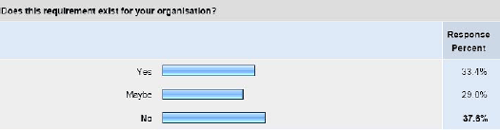
The minority of respondents, who answered "Yes" or "Maybe", were then asked "why was this important?" The majority there responded with "Efficiency and Choice" as the predominate reason for having the ability to choose multiple suppliers within the same system. So having a way to open a once "captive" TMS from an LSP would be something a significant group would need. We believe that Translation Management Systems therefore should come with an option to manage other suppliers, albeit for fee, in a similar way to the way financial services portals and salesforce.com can add features and functions in a modular way. There needs to be a shift in thinking from the existing "captive" TMS solutions that are widely used to a belief that solutions should provide users with a flexible way of incorporating multiple suppliers AND provide the best result for the user. BRAINLESS, PAINLESS AND SIMPLE One of the biggest problems with the TMS systems you see today is how complex they are to configure and use. While they work in the end, getting there is not the most intuitive path for the most common user of these systems: a translation requestor on the client- side. Many TMS are a patchwork of various systems cobbled together to create a whole. Most do not have a single, cohesive design – from a user’s perspective. Exacerbated by increased M&A activity, this is already happening in the industry with various degrees of complete cohesive functionality. MORE THAN TECHNOLOGY: IT’S ALL ABOUT THE SERVICE Perhaps I’ve put too much emphasis in this discussion on the actual TMS system that LSP’s provide – so allow me to put things in perspective. Regardless of how fantastic the TMS solution is, any time anyone in the human component of the translation process doesn’t do what they should be doing, when they should be doing it - is the moment the whole translation process comes to a screeching halt. Nothing happens. So however enamoured we become with the features, functions and backbone technology of any TMS system, it is critical to remember that without using the right people and having applied or configured the right process to the system you have, the most grand web globalization plans will fail. We believe that there is NO replacement for the human touch in content management in order to support clients with what they need in creating their localization strategy, mapping their workflow, and enrolling all their global stakeholders in a process which a new system will support. Additionally, not enough can be said about the importance of project management in the success of any translation project – using any technology. Experienced buyers of translation know that the success of their projects (or the failure) rests on how their project manager sets expectations, communicates throughout the project, and accommodates change as it hits the process. So in the end, it’s really the people and the process which give life to the technology – not the other way around. It is easy to forget that fact as we compare the features and functions of TMS systems taking for granted the fact that someone has to stop, think, and translate something accurately – all at the right time in the process. While M&A activity generally indicates a consolidation in an industry and a translation of better products for users, we believe that when it comes to TMS and content management, bigger isn’t always better. Bigger, in the case, means less flexibility, less human touch, and less choice. The good news is, in the end, the customers always get what they want. In the next few years, these new, merged solutions will bend to customer demands and we will see flexibility and intelligence emerge in a new form of TMS. ClientSide News Magazine - www.clientsidenews.com
E-mail this article to your colleague! Need more translation jobs? Click here! Translation agencies are welcome to register here - Free! Freelance translators are welcome to register here - Free! |
|
|
|
|
|
|
| |||
Legal Disclaimer Site Map |
 For
people who are deciding on a Language Service Provider (LSP)
or which software is needed to manage translation projects
within their organization, there are mounds of data and
hype to wade through before you are able to make your choice.
Not unlike buying a "Green car", where your choices in the
U.S. today range from Hybrid cars, to FlexFuel (E85) vehicles,
to converting your dad’s old Mercedes to run on restaurant
fryer-fat; each of these solutions come with a heap of marketing
messages, facts as well as fiction which you need to pick
through when making your choice.
For
people who are deciding on a Language Service Provider (LSP)
or which software is needed to manage translation projects
within their organization, there are mounds of data and
hype to wade through before you are able to make your choice.
Not unlike buying a "Green car", where your choices in the
U.S. today range from Hybrid cars, to FlexFuel (E85) vehicles,
to converting your dad’s old Mercedes to run on restaurant
fryer-fat; each of these solutions come with a heap of marketing
messages, facts as well as fiction which you need to pick
through when making your choice.