|
 |
 |
 |
|
|
Home | More Articles | Join as a Member! | Post Your Job - Free! | All Translation Agencies | |
|
|||||||
|
|
|
|
Written and Electronic Resources for Self-Training Translators: An eye-opening for translator trainees in Jordan
مصادر التعلم الذاتي في الترجمة المكتوبة والالكترونية لخدمة المترجمين المتدربين في الأردن محمد يحيى أبوريشة ملخص البحث В В В В В В В В في حين يزداد الجدل حول ما إذا كانت الترجمة موهبة أو علما ومهارة تكتسب بالدراسة، ترى هذه الدراسة أن المتدرب لا بد له من الرجوع إلى مصادر خاصة لتساعده على عملية الترجمة وتعلمها، وقد ارتأى الباحث هنا أن يدعوها بمصادر التعلم الذاتي، والهدف من هذا البحث عرض ثمار خبرة عملية في مجال تدريس الترجمة في الجامعات الأردنية تمثلت في الكشف عن نقاط الضعف عند المتدربين وطموحاتهم غير الملباة، حيث أن المتدرب يميل إلى الاعتقاد بأن اتقان الترجمة أمر بعيد المنال، لكن الترجمة، باعتقاد الباحث، تستلزم من طلبتها الانخراط في عملية تعلم ذاتي مستمر باستخدام مصادر التعلم الذاتي، وحيث أن هذه المصادر موجودة في الأردن ويمكن الوصول إليها، فقد رأى الباحث أن تكشف هذه الورقة النقاب عن هذه المصادر بهدف تعريف المتدربين عليها لتطوير قدراتهم في هذا الميدان بالذات. Written and Electronic Resources for Self-Training Translators: An eye-opening for translator trainees in Jordan Mohammed Y. Abu-Risha Department of Translation University of Petra Perhaps it would not be far from the truth if we claim that a fresh translation student would likely rely in learning translation skills solely on the instructor and the bilingual dictionary.В This is at least a fact that it seems to be prevalent in many universities where I taught translation courses. Let us put aside the academia for a while and head for the translation market.В Many recruiters of translators in Jordan have complained that applicants, who graduated from translation departments, failed to give an acceptable translation, with the term "acceptable" measured by the extent to which the editor of a translation has to work in correcting the mistakes in that given translation. The present paper addresses self-training resources on the assumption that a student should not expect to get everything from the university.В These resources will be tackled for the purpose of this paper and will be divided into two types: electronic and written.В This is therefore an “eye-opener” exercise, which, once mastered by the translation student, he will be able to translate. I will kindly ask you to pardon my resort to personal experience here and there in this paper.В While research papers are supposed to be made under rigid measures, somehow disregarding subjectivity, it is necessary to point out that personal experience is the touchstone upon which the validity of all research is gauged. 0. В Initial Remarks [1] I wish from the outset to express my thanks to Atlas Global Centre represented by Mr. Ghassan Al-Deeb, Chairman of the Board of Directors, for their initiative and unprecedented blessed move in holding this series of conferences to discuss matters pertaining to translation and lexicography.В I thank also Dr. Suleiman Al-Abbas, Atlas"s Manager General for steering the organization of this remarkable event and for inviting me to present a paper on translation. It is good here, I feel, to underscore and hail the essential role that the private sector can play in developing translation as a discipline and as a career.В In fact, the promotion of translation studies and profession requires us academicians to cooperate with the private sector in building up efficient translators.В Unfortunately, the present position of translators and translation is so gloomy and with many failing attempts to regulate the translation profession due to two main reasons.В First, students of translation, who, supposedly, later on become translators, do not seem to fully understand that translating a document or even a simple phrase is not a dictionary work alone.В The second factor is that our universities seem to have few connections with the translation market and corporations, if at all.В What raises the eyebrow is that in the promotion literature of universities, the overtly expressed goal for offering BAs in translation, is to "supply the market with efficient translators", with the paradox being that such a slogan has not materialised in better relations with public institutions and private enterprises.В Let me therefore from the very beginning suggest that you include in the recommendations the establishment and the boosting of ties of cooperation between academia and the private sector on the one hand, and among translation companies on the other hand. 1. Introduction Once I watched a famous film about the Roman Empire called "The Gladiator" in which the Emperor wants to change the victorious empire into a Republic for fear, as he told his awkward son, that upon his death all Roman victories will be lost because the Emperor"s son was not skilful enough to preserve the nation.В The son who strived for the throne cried and said that he did all his best to make his father happy with him but he was always a failure.В The emperor replied "You don"t understand.В Your failure as a son is my failure as a father!" The same applies to us, translation teachers.В "Their failure as students is our failure as teachers!"В A typical instructor of translation courses may either underestimate or overestimate his students with either practice resulting in misleading the student to what translation is exactly about.В Are there any resources for self-training in translation?В Are there any tangible steps to be used by the trainee that would ultimately secure for him the coveted title "translator" or "interpreter"? The answer is yes.В Translation resources however are not used effectively, and my evidence is the fact that the qualified translators and interpreters in Jordan can be counted by the fingers of the one hand, following the Arabic saying. Translation is not only a talent.В It is a skill that can be learnt, improved and even lost [2].В In order for one to be a good translator, it is imperative that he relies on rich resources.В Without resources, it would be almost impossible, in my opinion, for a trainee translator to practically give an error-free translation. [3] From my experience as a translator, interpreter and instructor of translation courses, it seems to me that rarely do students know anything about translation resources, and the very few who have access to such resources do not use them appropriately.В And, this is the problem to be tackled here. This presentation is intended to complement a previous paper that I submitted at Yarmouk University 17th international conference on literature, linguistics and translation.В In that paper, the main concern was how to teach translation.В Now, it is how to let students develop self-learning strategies of translation.В We need, in this regard, to emphasize that the word “learning” has been intentionally used to denote the on-going process marked by the learning of translation. I will first define translation resources then divide them mainly into two categories: electronic resources and written resources.В Under electronic resources, the discussion is going to be based on dictionaries, encyclopedias and online resources.В As for written resources, MA theses on translation, and economic and legal documents will be examined. 2. Translation Resources 2.1. Definition For the purpose of this paper, I will mean by “the translator’s resources” all the body of knowledge and instruments available for the translator in either media: written and electronic to help the translator perform his tasks efficiently and effectively.В Resources are not restricted to dictionaries and encyclopedias.В They cover any resource that would bring insight into the translator’s task.В A digital camera catalogue, in view of the above account, is an example of a good resource for a translator in charge of doing some translation job on digital photography. For purposes of brevity, the electronic resources will discuss both materials available on CDs and online. 2. 2. CDs and Online Electronic Dictionaries and Encyclopedias A typical Arab student admitted to an English department at some local university (let me say in Jordan, my country, for example) would face a problem in finding the right path leading him to the mastery of the language he/she has chosen to learn.В Typical problems that a freshman, at the English/translation department here in Jordan, faces would be related to learning new vocabulary, guessing the meaning of new words he/she encounters while reading a piece of English written material or translating from English into Arabic and vice versa. I have taught courses in translation, reading, communication skills, paragraph writing and oral skills for a number of years at some Jordanian universities.В All these courses demanded the students to work hard in (1) learning new vocabulary, and (2) using the learnt vocabulary idiomatically in their proper context.В To tell the truth, it seems that the majority of our students, at least at the universities where I taught, were almost all the time astray knowing not how to learn a new word or use it idiomatically.В Worse, they did not know how to make use of technology, beginning with the written dictionary to the computerized translation programs in solving their problem with words. Being a teacher of translation and conscious of this problem, I found it appropriate here to suggest a way that would lead the students concerned to their goal in translation and vocabulary development.В The hope from the present discussion is that students would find learning English and solving vocabulary-related problems both beneficial and entertaining. The vocabulary problem is twofold.В It pertains to the type of dictionary a student should use and the way a dictionary should be used. 2.2.1 Which Dictionary As it is commonly known, a dictionary could be either monolingual or bilingual.В Which dictionary should a student choose: a monolingual or a bilingual?В To answer this question, let us review a number of dictionaries to see how these can be utilized to the best. 2.2.1.2В Al-Mawrid Electronic Dictionary (A computerized version) updated every year since 1999
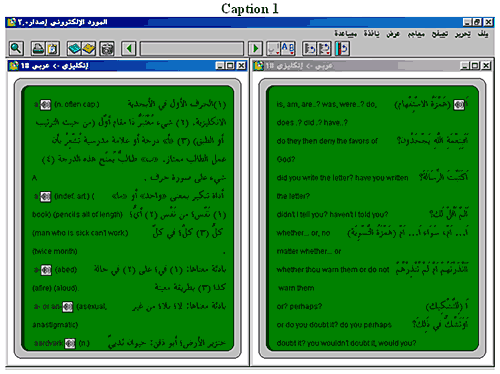
These features are really interesting.В They save much time and make the computerized versions of Al-Mawrid dictionaries far distinct from the conventional written ones:
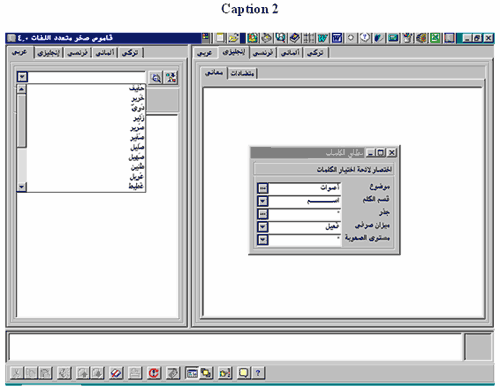
- giving words that have been searched for - opening each of the three incorporated dictionaries - enlarging/reducing font size - changing colors (display, entries etc.) - viewing the illustration index - printing out the results of a search - moving to the first word in a given chapter of each of the dictionaries (example: moving to the wordزائد В when choosing ز , and the word "t" when choosing the letter "t") - adding user words in case these are not available in the original dictionaries.В Such words are colored differently from other normal words.В They can be deleted at any time. - copying an entry to be later pasted (with all its senses) in another application document (like Ms Word). However, there seems to be one major problem in the English-Arabic Dictionary.В An entry is usually given there in terms of a number of senses that may in some cases, as in the entry "set" for example, mislead the leaner when choosing the right meaning of the word in question.В But, there is no need to worry about this problem.В We will suggest a solution for it later on. In fact, we should always keep in mind that a non-perfect dictionary is not necessarily a non-useful one.В Let us suggest here that a good learner is the one who tries to make use of the best features available in a number of dictionaries rather than stick to one dictionary and be vulnerable to failure in understanding a given word. 2.2.1.3.В Al-Qamos, by Sakhr Corporation 1. Components:
2. Information Related Features: В Vowelisation of all Arabic words.
3. Technical Features 4. Disadvantages
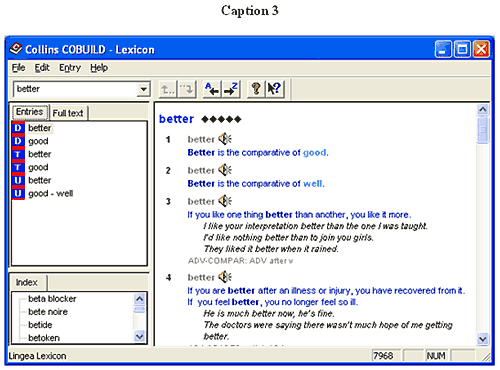
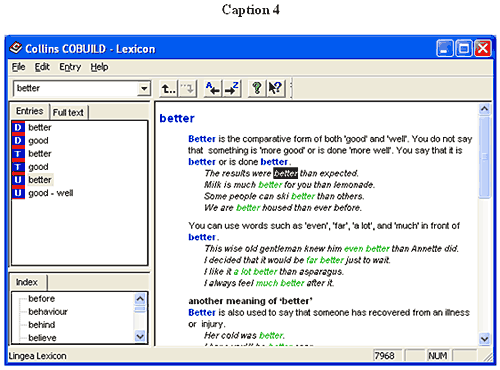
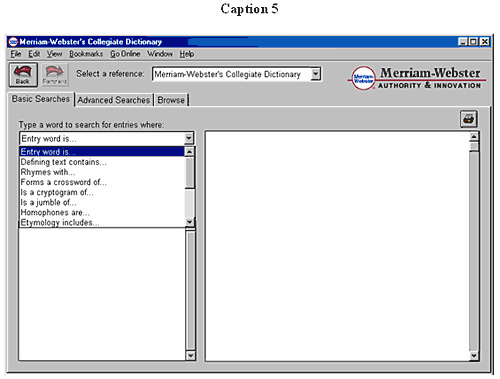
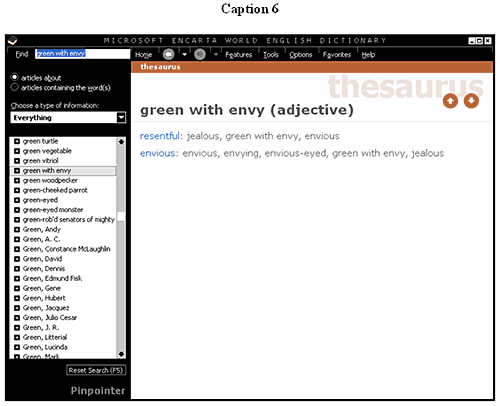
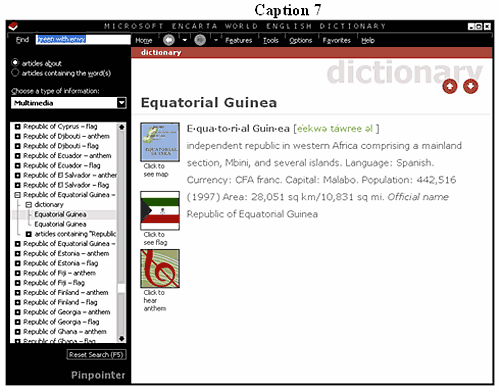
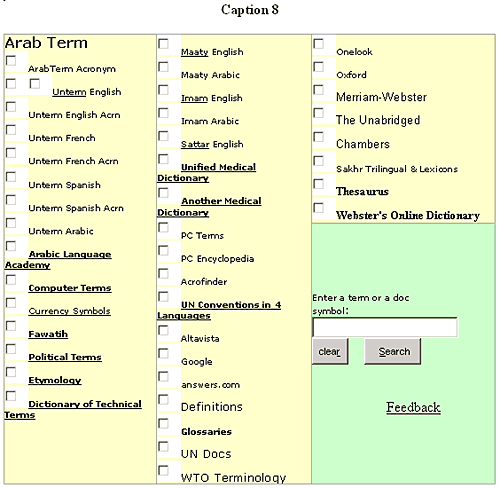
2.2.1.4. Lingea Lexicon, ver 3.1 Lingea Lexicon is a combination of a number of reference books.В These are: 1- Collins COBUILD English Dictionary for Advanced Learners (Year: 2001) 2- Collins Thesaurus (Year 2001) 3- Collins COBUILD English Usage (Year 1992) 4- Collins COBUILD English Grammar (Year 1990) 5- Workbank (Corpus from the Bank of English, year of publication not given) As you can see in the captured images below, Collins Cobuild English Language Dictionary gives the user the chance to form a better understanding of the use of a given lexeme as it enjoys the following remarkable features that are indeed essential for the translator to make sure about his decision in choosing one word or idiom out of a number of very similar ones (see Appendix, Caption 3) 1- Under the label "D", you can check for the meaning of the word, which preserves the standard features of paraphrasing it with adequate illustrations.В It is worth mentioning that the written version of Collins Cobuild English Language Dictionary proved to have used the most efficient features to make a word understandable and easy to learn (Farhan 2003).В Here, the translator can understand the meaning of a new word. 2- Under the label "T", the dictionary lists a number of synonyms of the word "better" (superior, excellent, well, cured, etc.) classified under a number of categories determining the meaning of the word "better".В Here, a translator may have the chance to use other words similar in meaning to the one he is looking for. 3- Under the title "U", the dictionary provides the learner with the grammatical rules of using the word "better" (see Appendix, Caption 4).В Here, the translator can learn some grammar rules of the word in question so that he can use it correctly and grammatically in his translation. As it should be the case in an optimal electronic dictionary, Collins Cobuild English Language Dictionary provides pronunciation and it systematically uses a variety of colors as a part of its overall presentation. 2.2.1.5В Merriam Webster Collegiate Dictionary What most interests me in this dictionary is the filtering device it has.В To the best of my knowledge, this feature is peculiar to it and not duplicated by any other English-English dictionary.В Let us assume that the translator is to translate a line of poetry, in which case he needs a word in English that rhymes with another word.В The filter, (see Appendix, Caption 5), enables the researcher to look for a word that matches another one in rhyme, sound (homophones) or even etymology. 2.2.1.5 В Microsoft Encarta World English Dictionary The Encarta Dictionary does possess the ordinary features of a model electronic dictionary like pronunciation and sense relations.В Peculiar characteristics in this dictionary include: a dictionary of quotations, a thesaurus, a dictionary of computer terms and an almanac.В В The most interesting feature of this dictionary, however, is its powerful simplified search engine.В In other dictionaries, when you want to check the meaning of an idiom like “green with envy”, you should try to find it under either entry “green” or “envy”, a tiresome task indeed.В Encarta Dictionary spares you this effort by enabling you to search idioms as if they were separate entries.В To search for the idiom “green with envy”, just type in the search box “green with envy” altogether and you will promptly find the answer (see Appendix, Caption 6) “Multimedia” is another function provided by the Encarta Dictionary.В Just as some written dictionaries provide in the appendices pictures and information related to a diversity of fields such as geographical locations, by choosing the “Multimedia” function you enter a world made alive by either the picture or the sound or both where you can learn useful information about places, instruments, locations, schools of thought and so forth (see Appendix, Caption 7). 2.2.2. The Role of Encyclopedias An ideal dictionary must provide for the actual use of a word in its natural context as used by native speakers.В Since the dictionary is not an encyclopedia, it is not expected to cover all details of the actual use of a given word, a role assigned to encyclopedias. The Encarta Encyclopedia from Microsoft is marked by both the bulk of information and the powerful search engine it has.В Now, let me assume that I need to teach my students the translation of the word خرج from Arabic into English.В A typical student would simply check the bilingual dictionary and get a similar result to the following (Al-Mawrid 1999): خَرَجَ: طَلَعَ, غادَرَ В to go out, come out, emerge, issue, egress; to walk out, drive out, ride out, move out, exit; to leave, depart, go away В خَرَجَ: نَزَلَ, تَرَجّلَ В to dismount, disembark, alight, get off, get out of, step out of В خَرَجَ: بَرَزَ В to protrude, project, bulge, stick out, jut out Obviously the translation student would be stunned as he now faces more than one “equivalent” to the word خرج.В The problem is how to make sure that the word he is going to use in his translation is correct.В How to use for instance the word “bulge”?В Can you say in English “He bulged from the house”?В What about “protrude”?В And, most importantly, what about you, the teacher of the translation course?В Aren’t you supposed to know how to answer such an anticipated question?В A good solution, or even a perfect one, is to resort to the Encarta Encyclopedia.В Open the homepage of the Encarta and search for the word “bulge” then “protrude”.В The following results are self-explanatory as they show how the words “protrude” and “bulge” are used in aВ sense different from that of the general word خرج. “Frogs have large, bulging eyes and moist skin.” (Encarta 2004: Frog (animal))  “The ears, lips, and brow ridges protrude, and there is no tail.” (Encarta 2004: Chimpanzee) В This encyclopedia is also useful for interpreters.В It is a good resource from which they can seek background information pertaining to issues and abbreviations required while performing the interpreting task.В Once again, it seems appropriate to refer to personal experience.В The first time I was asked to perform simultaneous interpreting was in a seminar related to labor issues.В The theme of the seminar was “Social Dialogue” and relevant issues covered such key points as “collective bargaining”, “labor organizations and conventions”, “social security in Jordan” and the like.В A day ahead of the event, I checked the Encarta Encyclopedia for all this information and benefited a lot and the result was that my first interpreting task was brilliantly performed.В The idea here is that when you do the translation or the interpreting job, especially when it is the first time, you have to be well prepared in order to impress the client on the one hand, and to foster self-confidence on the other hand. 2.2.3. Online Resources Information and sites on the internet can be divided for the purposes of this paper into two types.В The first one is that which has a direct relation with translation training.В An example is www.sattaratun.com, which is a useful resource for legal translators.В By inserting the word you want (English or Arabic), this site opens a search-result page that shows where the word exactly appeared in a number of resources including all conventions of the United Nations.В Caption 8 in the appendix shows how rich these resources are Checking the word “provided” will lead to a search result of 33 documents as shown in Caption 9 in the appendix. The second type of online resources I want to refer to is simply the web various search engines.В The procedure is simple.В Assume that you want to translate an article entitled تعديل قانون حقوق الطبع في الأردن.В What you need to do is simply to open the homepage of a good search engine and enter similar catchwords that can be for example “Jordan” “amendments” “copyright law”.В You will be surprised when you see many results that show similar reports from which you can get the terminology and the style that you need in making the translation. Translation forums are also of importance.В The following I a brief on these forums/newsletter groups and the role they can play for a better translator’s performance: 1. Arab Professional Translators’ Society- Arab Translators’ Network (ATN-APTS) The Arab Society for Professional Translators is a virtual society.В Its address is www.arabtranslators.org.В The newsletter group is http://groups.yahoo.com/group/atn-apts.В The services provided there are as follows:
2. Arab Translation and Intercultural Dialogue Association (ATIDA) ATIDA is a very active association.В Members meet in the forums where they discuss matters pertaining to translation.В New terms are introduced and links to useful sites, dictionaries and glossaries are regularly posted.В Their site address is: www.atida.org 3. PROZ Proz is a website that brings together professional translators.В Briefly, this is very useful and efficient site as it allows translators to post their questions on the translation of a term of phrase.В Amazingly, peer answers begin promptly to appear.В A good feature of this site is that it allows peer translators to give their degree of confidence, and increase/reduce the degree of confidence for other peer answers until a high-point answer is reached.В The site address is: http://www.proz.com/kudoz. 3.2.3. Ancillary Resources 3.2.3.1. WinHTTrak Website Copier 3.33 This is a wonderful program that allows you to copy the whole content of a website with all its links.В It makes the website run smoothly on your PC when you are offline. 3.2.3.2. Virtual PC Al-Mawrid Electronic Dictionary (1999) is better in performance and is much smoother than later versions with one serious setback: it does not run under operating systems newer than Windows 98.В Virtual PC allows you to install a virtual PC system, like Windows 98, from which you can easily install Al-Mawrid Electronic Dictionary. 2.2.4.3 Abu-Risha Online After I graduated from the University of Jordan in 1999, I was asked by many students of translation to help them prepare for their exams.В For that reason came http://aburisha.tripod.com, which includes all terms and expressions that must be learned by a student before he or she graduates from the university.В Frequently asked questions about the theory of translation, a list of 1090 vocabulary items/expressions, and a collection of translated texts are also included in the site. 3.3. Written Resources It is obvious that written dictionaries are among the written resources of a translator, but here I would point out more important resources with special reference to those resources available for the Jordanian trainee.В Once again, for the purposes of brevity, I will just refer to these resources with short explanations. 2.3.1. The Five Year Socio-Economic Plan This is available at the Ministry of Planning both in Arabic and in English.В To translate an economic document, this resource is useful because it is full with economic terms used “undecontextualised”, which means a good understanding of the term to be used in a translation. 2.3.2. The Lower House It is possible for anyone interested to get useful pamphlets from the Lower House Supplies Department (in English and Arabic).В These include the Jordanian Constitution (English and Arabic), the Parliament’s Bylaws (English and Arabic), and other similar documents. Let me here point out to a personal experience with the written resources.В In early 2005, I was assigned to train the Iraqi parliamentary delegation of translators.В Their one-week intensive training proved to be more than efficient with a package that compiled many written materials including the socio-economic plan and the Parliament’s documents. 2.3.2. Nabeel Law Office Online Though www.nabeelaw.com is an electronic website that provides legal information online, I will classify it for the purposes of this paper as a written resource in light of the various important documents it has in Arabic and in English. [4] Let us assume that a translator is asked to translate the trademark law of a given country from Arabic into English.В The quoted website is useful because it provides a good translation of the Jordanian trade mark law.В Now, the translator should find it easy to translate the following terms and expressions: -التعدي على العلامة التجارية - السجل التجاري - الجهات المختصة - يشترط لتسجيل العلامة التجارية أن تكون ذات صفة فارقة - توخيا للغرض المقصود من هذه المادة... - يقتصر تسجيل العلامات التجارية على.... - العلامات التي تدل على صفة رسمية 2.3.3. Atlas Encyclopedic Dictionary A good English-Arabic written dictionary must be encyclopedic because a pocket dictionary or even a big one that just gives the meaning of the word is not enough for the translator.В The editorial of Atlas Encyclopedic Dictionary mentions some features characterising this dictionary.В It says it saves the researcher or the translator the time of checking many reference books to answer many questions in mind related to meaning and grammar.В It incorporates various useful appendices including one for abbreviations.В When defining the meaning of a word, it goes beyond giving the meaning and pronunciation of the various senses of the word as it gives other important features such as: verb regular/irregular forms, countable/non-countable nouns and word inflections.В Giving the semantic domain of a word when necessary is also an advantage for this dictionary. 2.3.4. MA Theses on Translation Students of translation in Jordan are advised to check MA theses on translation, which can be found at the libraries of Yarmouk University and the University of Jordan.В These theses deal with problems of translation in a number of areas such as collocations, intertextuality, pragmatics, Quranic translation, translation criticism, contrastive textology and so forth. В Examining the problems and solutions posited in these studies is very useful for a translator as you can have about 100 pages written about the process of translating a few utterances.В A student who cares to deal in depth with the process of translating would have a plus advantage over any other translator who has never encountered these studies. Besides, all MA theses provide theoretical background, reviews of related literature and lists of bibliography.В This is very useful and would enable the trainee translator to be briefed of translation theories in a way that does not consume his/her invaluable time. 2.3.5. Newspapers How would you use newspapers as a good resource to translate a sentence like: "غادر الرئيس الأمريكي إلى منطقة الشرق الأوسط في رحلة تشمل ثلاث دول."?В В В The answer is very simple: check an English newspaper. В The more challenging question now is “What chance would I have to find the required translation when checking an English newspaper?” The answer is once again simple.В With newspapers, a translator should keep himself in an ongoing self-training process in translation whereby he/she reads an Arabic newspaper and an English one making sure that both were published on the same day.В The Arabic and English versions would most likely highlight the same events.В This means that the expression that you found difficult to translate from Arabic might appear, now, in English in the other version.В Considering our example, by following this way, Abu-Risha (2006) found the following translation: “US president left for the Middle East in a three-leg tour.” The next step now is to build up your own notebook with all these expressions.В This notebook will serve as a dictionary of sentences and expressions.В Consider the following examples (Abu-Risha, 2006: p. 27) وبعد الانفجار لو تعلن أي جهة مسئوليتها عن الحادث. There was no immediate claim of responsibility for the bombing. ورفض المسئولون الفلسطينيون تحمل مسئولية الانفجار. Palestinian officials rejected responsibility for the bombing. في تلك البلاد التي دمرتها الحرب in that war-ravaged country 4. Conclusion The present paper is an attempt to shed light on several important resources that can enhance the translator’s job.В Electronic and written translation resources can dramatically change the way in which a translator does his job, and I do hope that this paper has adequately explained that.В In the translation pedagogy, a lot of efforts are needed to reach a stage whereby a trainee in translation can self-train himself so efficiently to support the Arab translation market, which suffers a lot from a dearth of qualified and ever self-developing translators. [1] This paper was presented in Atlas Seventh Conference on Translation and Lexicography held at Zarqa Private University, Jordan in December 2005. [2] Yes, the skill to translate can be lost if the translator is not keen to keep abreast with developments in all fields and disciplines (e.g. globalization, economics, mathematics, medicine, biology, technology, etc.) [3] There is no exaggeration in this statement.В Personal experience with students of translation since the year 2000 proved that most translation mistakes are due to lack of students’ interest to check relevant resources. [4] This is a resource from which you can get written material.В Therefore, it cannot be considered as an electronic resource because it does not employ any electronic feature for the retrieving of information. References
Online References:
Appendix
ARABTERM Search Results: 33 documents for '[en]=provided'
This article was originally published in Atlas Journal for Studies and Research. Vol1 No. 2, June 2006.
E-mail this article to your colleague! Need more translation jobs? Click here! Translation agencies are welcome to register here - Free! Freelance translators are welcome to register here - Free! |
|
|
|
|
|
|
| |||
Legal Disclaimer Site Map |
 Some
say translation is a gift while others assert it can be learnt by assiduous students. The idea of this paper is to open the eyes of the translator trainees to the fact that one can learn even master the craft of translating by skillfully using translation resources. The paper is based on personal experience with translation students at Jordan universities, public and private. For them, to be a translator is an unachievable dream. Translating, however, as this paper asserts, requires its students to use certain resources skillfully in their ongoing process of self-training. These resources are available and accessible in Jordan and the main purpose of this paper is to shed light on them.
Some
say translation is a gift while others assert it can be learnt by assiduous students. The idea of this paper is to open the eyes of the translator trainees to the fact that one can learn even master the craft of translating by skillfully using translation resources. The paper is based on personal experience with translation students at Jordan universities, public and private. For them, to be a translator is an unachievable dream. Translating, however, as this paper asserts, requires its students to use certain resources skillfully in their ongoing process of self-training. These resources are available and accessible in Jordan and the main purpose of this paper is to shed light on them.