|
 |
 |
 |
|
|
Home | More Articles | Join as a Member! | Post Your Job - Free! | All Translation Agencies | |
|
|||||||
|
|
|
|
Meeting Students’ Expectations in Undergraduate Translation Programs
Abstract
As Sewell and Higgins (1996: 9) stated, in recent years universities have been increasingly aware of the needs and practices of professional life, and much of this awareness has been generated by teachers who actively seek to realign their teaching so that it opens its doors to new ideas from outside the university.
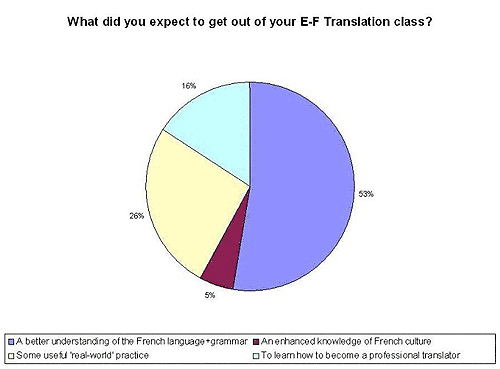
According to them, the teaching of translation is usually studied for two main reasons, or approached from two different angles. The first is the idea that translation can be taught as an end in itself, and resulting studies focus on the L1 (i.e. translating into the mother-tongue) as this is how professionals earn their living. The second is the idea that translation can be used as a tool, a way to learn another language, and this type of study therefore focuses on the L2. Indeed, in this case translating into the foreign language is believed to be beneficial as a language-learning device. These two theories have generated plenty of literature, and it is generally accepted that on postgraduate translation programs, where the aim is to 'teach the trade' and produce professionals, translation is—and should be—taught as an end in itself, whereas it should be used merely as a language-learning device for undergraduate students studying languages. However, this dichotomy can be difficult to achieve when a translation class at undergraduate level is made up of students taking different, more or less language-based, degrees. In the context of my current employment, I teach translation to first- and second-year students registered for various academic degrees. For example, some can be studying for a BA in 'Business Studies with French' while others can be part of the School of Languages and studying a BA in 'Modern Languages with Translation and Interpreting Studies.' In the first case the focus of the degree is Business, with French as a side-dish, whereas in the second case, the degree is entirely focused on the professional study of language(s). This means that in the translation class, students' interests and aims differ, as do their expectations of the outcomes of the class. Although there is still a majority of students in the class studying for a language degree, at this stage few have seriously considered translation as a career and they do not all perceive the class as a way to becoming a professional translator. This naturally implies that the aim of the class cannot be to prepare them for a career as a translator, although there are some students in the class who may be considering this career path. After teaching these students for a year, I designed a questionnaire in order to gather an understanding of student expectations at this early stage of their academic studies, and to see whether the class I had taught had lived up to expectations and met their varied needs. Fourteen students returned completed questionnaires to me. In the questionnaire, the students were asked what they expected to get out of their French to English translation class when they embarked on their course. As Figure 1 clearly shows, the students were quite split in their answers. However, at this early stage, it seemed that most students expected to gain a better understanding of the French language and grammar. Hence, they considered translation to be a tool, a way for them to improve their knowledge of French.
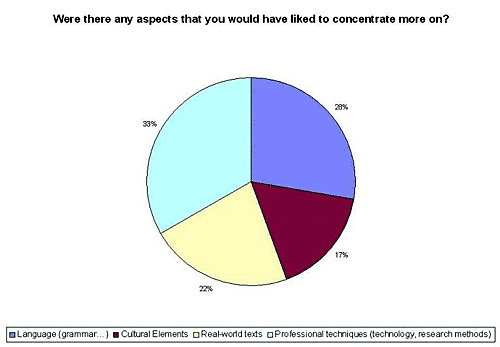
Nowadays, it is increasingly essential that educators be sensitive to students' career needs when structuring their curriculum offerings, and I believe they must learn to reconcile the varied expectations students have with the intended aims and objectives of a translation class. While it can be difficult to keep motivation levels up if all of the learner's needs are not met in each class, it is the educator's responsibility to specify the aims and objectives of the course and of each class to their students, and to ensure that all gain skills useful to them in their respective career choices. There are certain practical methods one can use in class in order to achieve this, for example something as simple as using a variety of text types. Indeed, not surprisingly, in answer to the question: 'What did you find particularly useful in the class?' a great majority of students (twelve out of fourteen) answered 'the variety of texts used', and one of them even commented on the fact that there was something for everyone. In a lecture given at the University of Bath, Dolan (2005) stated that learning is a natural drive and that individuals are naturally curious. When they are in a new situation they will explore it and want to discover and master the environment. But when this is done, they become bored with the familiar situation, especially if it never changes. When it does change, the natural drive to explore is awakened again (Dolan: 2005). This applies to all types of learning activities, including translation classes and training. Students constantly need to be motivated and their curiosity aroused if they are to do well. I believe that putting them in new and different translating situations is the way they can make progress and that they are more likely to enjoy a class if it constantly presents new experiences and new challenges. One must also keep in mind the fact that students learn in different ways; some are more receptive to hearing, others to seeing or to experiencing (Dolan: 2005). So a constant change of learning methods can enrich the students' experience and stimulate their minds, as well as teach them a variety of skills which will serve them well in their future careers. I would like to draw attention to the fact that, as Jones and Creswell (2003: 29-31) remind us: 'A mixed-method approach [also allows] the advantages of one method to compensate for the drawbacks of another'. In Translation Studies, valuable training and evaluation methods are currently being used and developed, which aim to improve translation pedagogy by focusing on the student and on his needs. It is not my intention to advocate an eradication of currently used methods, but rather to view some of them from a different angle, show how they can be used innovatively and encourage their development. As Gonzáles Davies states in the introduction to her book (2004: 5), there is room for more than one approach to teaching translation. One such approach is the use of translator interviews and diaries. They are typical methods used in research, which are still rare in classrooms but which, if used regularly, encourage students to reflect on their work, thereby giving the trainer an idea of the progress made and eliciting introspective information. With diaries, students get a chance to write down thoughts either during a translation or after it. This individualistic approach gives them the chance to reflect on the process and generally appeals more to introverted types. There is a risk that some students may feel self-conscious, as they know the diaries will be read by the teacher, but they also often like the idea of their being read, and therefore listened to, and that their experience and feelings are taken into account by their trainer. I believe this method should be used more widely in class, and be the object of further research as well. Indeed, personal and individual aspects of the student's experience would surely be reflected in a diary (Fox 2000: 127) and, I believe, in oral interviews as well. Interviews, diaries, and questionnaires disclose valuable information on process-investigation and end-product evaluation, thus enabling trainers to monitor the student's experience. Another popular method used in class is splitting students into small groups and asking them to translate something together. It remains, I believe, an effective method of learning, although only four students in my study stated that they found group work useful. However, studies have shown that working in groups during a translation class is perceived as beneficial to students' learning experience in terms of reader expectations and development of responsibilities as a translator (Fox 2000: 129). Students are encouraged to discuss and defend their translations, think about decisions, and serve as guides and critics to each other. It is argued that students learn best through social interactions which allow them to work toward a common goal, by sharing information and solving the same problems (Zeng and Lu-Chen 2002: 59) Students have the chance to bounce ideas off each other, debate meanings and contexts, and they are generally more comfortable working with 'equals' rather than with a teacher. It is generally accepted that working in this way is a good idea, as long as students learn from working together as a team, and one or two do not monopolize the conversation while the others are bored and/or silent. The teacher needs to monitor the situation carefully. One efficient way to avoid negativity is to change the groups at every class and for the trainer to move quietly from group to group checking the dynamics and making notes of different attitudes and behaviors. I believe this versatile training method can still be developed and adapted. Observing the group work (or pair work) regularly is an excellent way to monitor progress in different areas of students' work, and learning how to work in a team is an important skill to have, whatever career one aspires to. Moreover, working this way helps develop an understanding and awareness of decision-making processes. In class, I also believe it is particularly important to encourage the students to focus on the different phases of translating a text (for example decoding the source text or en/recoding it into a target text) rather than undertaking exercises where an end-product has to be handed in after an hour's time. In fact, Daniel Gile (2005) and other researchers promote the use of evaluation exercises which incorporate two phases in the training: a process-orientated one and a product-orientated one. As there are different phases in the act of translating, it seems necessary to have a specific training time for each one. This dichotomy allows for the development of appropriate strategies for each phase, and gives the students time to reflect on different aspects of their performance and progress. The American Translator's Association advises institutions to provide students with as much 'real-world' practice as possible so they can become competent professionals (Tinsley 1973). Although they may want to become professionals in areas other than translation, first- and second-year students do appreciate the importance of gaining 'real-world' practice. At the end of their course, students were asked if there were any aspects on which they would have liked to concentrate more. As Figure 2 clearly shows, the students were much more divided in their answer to this question than they had been when asked about their expectations. This shows how difficult it can be to please every student, but more importantly, the answers reveal that a great majority would have liked to learn more about professional techniques and to translate more 'real-world' texts. This indicates a shift in student expectations and how much more important it has become to them to study translation as an end in itself, and not only as a means to learn French. Students gained a new awareness of the need to be prepared for the market, and a new understanding of how activities done in class can help them build skills for their future careers.
More than anything else, Figure 2 reflects something which has come across very strongly in the questionnaires, and that is the desire to learn 'professional techniques such as technology and research methods'. Technology is another element of training which is gaining in popularity because of its increased use in the 'real world'. The place of technologies in teaching and practicing translation is increasingly significant and something that students generally relate well to. Although some trainers are reluctant to adopt language technologies as they can completely transform the way teaching is carried out, and shift the dynamics in a classroom, the rapid developments in this field mean that students need to have some knowledge of how online tools for example can help them and benefit their work. There is a risk that technology will alienate a few students, and this field certainly requires further research, but technology has been shown to improve translation evaluation, and generally motivate students in their task. As the questionnaires showed, a majority of first- and second-year students are already expecting to learn how to use new technologies and it is up to the trainer to show them how. As Gonzáles Davies (2004: 3) aptly puts it, perhaps the time has come to adapt to the new generations by including texts and activities in our classes not only in the written form, but also in the oral and non-verbal and, what's more, in those that integrate both, in consonance with the culture the students have grown up with and in which they will be working: these include TV and radio talk shows, e-mail and cell phone messages. It is my contention that oral activities are particularly useful. As can be seen in Figure 1, a great majority of students wished to gain a better understanding of the French language. In my previous studies, I investigated student performance with the help of TAPs, or Think Aloud Protocols. This type of experiment consists of students translating aloud, saying everything that goes through their minds while they translate. I discovered that a great majority of students enjoyed this type of experiment and reported that they were happy to work in this way. Most deemed the verbalization helpful and believed it had a positive impact on their work, making comments like: 'it helped to put my thoughts in order', 'it helped me to understand more clearly', 'it helped me think better' and qualifying TAPs as 'a good practice for qualifying my linguistic decisions'. I believe this overwhelmingly positive reaction to a training method clearly deserves further attention, as the translators' approval and acceptance of a method is of paramount importance to its potential success as a training tool. My research confirmed not only that TAPs are a valuable method of investigation into translation processes, but also that most students would welcome its introduction in the curriculum. Designing some oral activities for classes by drawing on this method would, I believe, improve students' confidence levels and their understanding of the foreign language. In this paper I have aimed to gather and understand some students' expectations when they embark on a translation course early in their academic career and on what they wanted to concentrate more once the course was over. Although it is difficult to meet every student's expectations, and not always possible to adapt all of one's teaching methods in a short time, the students—as well as the teachers—need to be listened to, and mutual feedback and communication need to be a feature of the training process so as to ensure student satisfaction. A combination of methods can be used in translation to give students different skills, but above all I believe trainers need to be open-minded, as using varied learning methods has been shown to benefit students and to promote their success. As Gambier (2004: 67) rightly argues, publications in Translation Studies have been repetitive in their choices of subject and conclusions drawn. He adds that the emerging identity of translators and the new demands made on their skills and behaviors certainly make it necessary to renew our efforts at description and explanation, but that research in translation should be more than an academic pursuit and purpose (which limits its scope), and that it needs to be more far-reaching, with long-term goals and a clearer purpose. By supporting further investigations into active, innovative, cooperative, and inclusive teaching methods, trainers are contributing towards an improvement in the success rate, academic performance, and satisfaction of their students, which is no small feat. Bibliography
E-mail this article to your colleague! Need more translation jobs? Click here! Translation agencies are welcome to register here - Free! Freelance translators are welcome to register here - Free! |
|
|
|
|
|
|
| |||
Legal Disclaimer Site Map |