|
 |
 |
 |
|
|
Home | More Articles | Join as a Member! | Post Your Job - Free! | All Translation Agencies | |
|
|||||||
|
|
|
|
Customer Elements within Glocalization
The desired result of these elements is to attain a level of predictability in customer behavior and acceptance of marketing or product design offerings. This challenge is compounded by its localization characteristics including socio-linguistic, geopolitical and ethnographic considerations. Nevertheless, the intricacies are manageable so long as an inherent appreciation for the local market is coupled with meticulous research to secure predictable business results. II. Glocalization vs. Globalization Although the term "Globalization" has been used for over the past 30 years, global markets have matured to a point that the term now produces divergent interpretations. Positive impressions include marketing professionals selling products overseas, product developers customizing features for local clientele, and IT colleagues optimizing worldwide technical talents. Negative impressions include top-down monolithic global trading blocks, forced competitive labor pools, and concentrated financial resources. These examples show a few of the many ways the term can create skewed perceptions and emotional reactions among the public. Alleviating this dilemma, "Glocalization" (pronounced G-Localization, a neologism of Globalization and Localization) has emerged as the new standard in reinforcing positive aspects of worldwide interaction, be it in textual translations, localized marketing communication (marcom), socio-political considerations, etc. Its decorum is to serve a negotiated process whereby local customer considerations are coalesced from the onset into market offerings via bottom-up collaborative efforts. Cultural, lingual, political, religious and ethnic affiliations are simultaneously researched and integrated into a unified holistic solution. In this manner, the intended market is given a stake in the overall process and not just the mere end result.
Figure 1: Glocalization differs from Globalization in being a bottom-up negotiated process incorporating local market sensitivities into the overall marcom offering. Mature world economies are driving the Glocalized negotiation process via local purchasing power, Internet access and customer sophistication. Global Internet Statistics by Global Reach (http://global-reach.biz/globstats/) show an Internet population of over 803 million, out of which 64% are non-English users. This online connectivity grants these users access to cosmopolitan markets and product information, thus increasing their sophistication for campaigns and offerings custom-tailored for local audiences. The momentum for such demands can also be witnessed in a nation's Gross National Income (GNI), as documented by the World Bank (http://siteresources.worldbank.org/DATASTATISTICS/Resources/GNI.pdf). With this combination of market sophistication and purchasing power, Glocalized organizations must incorporate these customer propensities in order to preserve competitiveness. III. Localizing the Marcom The seamless delivery of marketing messages is crucial to creating positive customer elements. Given the increasing importance of international markets, it is a natural progression that overseas customers would prefer marcom tailored to their own cultural and socio-political sensitivities. Failure to observe these traits inevitably risks undermining a good product design with bad marketing composition. For example, when the US insurance company AFLAC initially ported its American-based "AFLAC Duck" commercials to Japan in 2001, the company encountered a series of marcom oppositions. The Japanese audiences felt the commercials violated intrinsic social etiquette such as: 1) It was impolite for the human actors not to look at the duck when it was speaking, 2) The duck shouted "AFLAC" so loudly that it was shrill to the TV viewers, 3) The American duck utters "Quack, Quack", but the Japanese expected the duck to say "Ga, Ga", 4) The English brand tagline "AFLAC, ask about it at work" simply did not convey any clear call-to-action to Japanese consumers. Based on these findings, AFLAC yanked its American commercials from Japan and developed localized versions with great success. The Japanese AFLAC duck caricature now interacts directly with its human actors, speaks more softly when announcing "AFLAC", and utters "Ga" instead of "Quack". Most importantly, a new brand tagline was “transcreated” for Japan via "Yoku Kangae yoo, Okane wa Daiji da yo" (colloquially meaning: Use your money wisely, it's a precious resource), which emphasized an excellent customer call-to-action promoting family security and long-term financial stability. More information on “transcreation” of global branding can be found in MultiLingual and Computing Technology #69 Volume 16 Issue 1 "Creating Worldwide Brand Recognition : Lessons from Dell's online global branding and web internationalization project" (www.MultiLingual.com).
Figure 2: Both Dell and AFLAC encountered localization resistance to its American commercials in Japan. US computer manufacturer Dell Inc. encountered similar obstacles when it attempted to port its American "Steven Jackson" commercials to Japan. Commonly known as the "Dell Dude" with the catchphrase "Dude, you're gettin’ a Dell", the Jackson character was a phenomenal success in US markets during the early 2000s. Bolstered by this domestic achievement, Dell USA marketing associates wanted to magnify this success by porting the American commercials directly to East Asia. Fortunately, international leads from Dell's Global Brand Management (GBM) section insisted on localized focus groups to gauge the TV character’s cultural acceptance. The results showed that the Jackson character's brash "know it all" suburban American attitude was perceived at best as awkward to East Asians, while Japanese audiences opposed the character outright due to violations of social etiquette (ex. speaking to strangers without a formal introduction and non-usage of honorific verb tenses when speaking to senior members of society). Faced with this hard evidence, the Jackson commercials were not deployed to Asian-Pacific regions. Product design can also lead to points of global contention. For example, MasterCard once developed a credit card for its Middle Eastern market; however, the card's background was a shade of green which drew criticism from Islamic followers due its religious connotations. Following research, a bluish-green hue was selected as a replacement. This not only placated Middle Eastern religious concerns, but is also considered a color of good fortune among certain Mediterranean cultures, hence achieving a double-win. Finally, knowing when and when not to localize are co-equally important. For example, UBS (Union Bank of Switzerland) created its global brand tagline "You and Us" to harness a "good neighborly" cooperative effort in mutual financial endeavors. However, this simple phrase quickly encountered socio-linguistic barriers when translated into German. Using the formal version of "Sie und Wir" immediately placed a social barrier between customers and bankers. However, relying on the informal version "Du und Wir" is considered quite impolite among German professionals. To balance this predicament, UBS decided to employ only the original English tagline since its meaning, intention and nuance can be uniformly understood across multiple geographic markets. More information on the UBS tagline can be read in the BrandChannel article "Best Global Brands: Focus on UBS" (www.brandchannel.com/features_effect.asp?pf_id=273). IV. Online Site Usability For online transnational corporations, the website is often the first impression bestowed to distant customers worldwide. For example, Dell Inc., as an online build-to-order PC manufacturing company, neither maintains roaming sales staff nor extensive retail showcase spaces. Therefore, the website's presentation and information layout is the de facto corporate brand representative. Adding web glocalization design to the equation, it is paramount that a balance be attained among competing or conflicting localization claims. This is where international professionals with combined disciplines in localized website design, socio-linguistic knowledge, ethnographic inclinations, and socio-political sensitivities of across-the-board market regions are paramount. For Dell's online glocalization project, which spanned from 2000 to 2003, the first step was to identify branding and marketing opportunities within the segmented business model (ex. dividing the product offering and pricing models into customer bases of small business, corporate, government, educational, etc.). Once this metric was established, the second step was to assemble focus groups for each country or region to collect and refine localization requirements. For example, in designing Dell Japan's website, interviews were conducted among sample local customers comprising 10 consumer (home, small business), 10 business (corporate), and 10 public (government, educational) candidates. Through these 30 interviews lasting 60 minutes each, Dell secured direct insights on forming persuasive marcom propositions and E-commerce transactions. Such was the case with national flag icons, which were used across Dell websites as country-language-cultural identifiers. Surprisingly, Japanese audiences actually opposed display of the flag on Dell Japan's website for fear the company might be associated with domestic right-wing malcontents. Striking a compromise, the Japanese flag was retained on Dell's website, but removed from any TV or print marcom usage.
Figure 3: Dell Switzerland with its triple language toggle of German, French and English. Applying this methodology to other Dell regions also produced its share of challenges. For example, Dell Switzerland required the website be displayed in the three languages of German, French and English. German and French are constitutional requirements within the Swiss market. English, though not an official Swiss language, is widely used in international business and thus is granted special importance. Hence, Dell integrated a "Language Toggle" feature on its Swiss website to transition with ease among "Deutsch | Français | English" languages. Complementing the display of language options is the diplomatic usage of localized country names. For example, Dell Taiwan displays the flag of the "Republic of China", while Dell China displays the flag of the "People's Republic of China". Given the 50 years of civil war animosity between rivaling factions, Chinese customers actually lodged complaints within Dell to remove the Taiwanese flag. Fortunately, Dell was able to appease both parties by localizing the country / region names. Dell China selected "Zhong Quo Da Lu" (Mainland China) as its country name, which projected a positive cultural lineage to the Chinese and its Diaspora. Dell Taiwan selected "Tai Wan" as its regional name, which is the island's official provincial name. In so doing, the Chinese segment was placated due to Taiwan's non-political title, while the Taiwanese segment was satisfied by its market distinction from China. Nevertheless, socio-political events often supplant strategic business plans. Therefore, after sporadic controversies over Dell’s use of the Chinese and Taiwanese flags, Dell headquarters decided in Spring 2005 to remove all flag displays from its Asia-Pacific websites (ironically, the exception was Dell Japan, which retained its own flag display since it is considered a separate Asian segment). Additional information on Chinese and Taiwanese localization can be found in the Ccaps newsletter article "Chinese Characters: A Quick Social, Political and Linguistic Survey" (www.ccaps.net/newsletter/10-05/art_1en.htm). On a lighter note, localization for the sake of localization is not a viable business model. When disputes arise over localization requirements, the best course of action is to measure and document market penetration targets and the necessity of localizing each trait in relation to the global brand valuation. Such was the case when the "Dell Blue" (Red-Green-Blue of 0-80-201) was selected as the primary color banner across all Dell websites. A South American representative voiced reservations on this blue color and recommended a pastel shade of "Fusa" as a localized replacement. After a series of inquiries from the Dell GBM team on forecasted website traffic increases based on this local color requirement, the South American colleague finally admitted that he put forth "Fusa" solely because it was his favorite color. V. Vendors, Samples, Free Translators Transnational corporations often have the resources to employ in-house international business talents. This enables the corporation to avoid sole reliance on a particular external vendor on glocalization projects. Nevertheless, a dual-track strategy was followed at Dell Inc. For one, an international business cadre was formed within the Dell Global Brand Management team (GBM) and served as glocalization specialists to all market regions. To avoid internal "groupthink" problems and promote different solution paradigms, external interactive services agencies like Critical Mass (www.criticalmass.com) and Orbik (www.orbik.com) were designated as strategic vendors. Critical Mass handled the online design for the www.Dell.com and Support.Dell.com websites, while Orbik created enriched media presentations (ex. Macromedia FLASH and Apple QuickTime digital movies) for multiple business segments. In preserving a consistent online brand persona and glocalization standards, Dell's GBM team distributed the same information to both vendors.
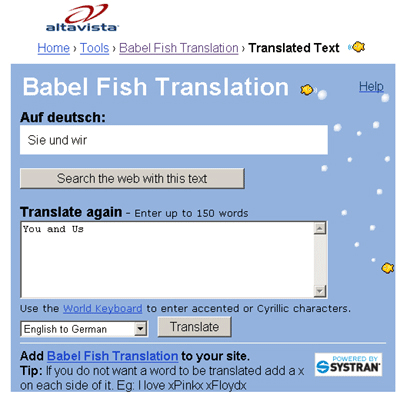
Figure 4: Correct free online translation of UBS tagline "You and Us" into German "Sie und Wir", but it compromised the intended UBS brand nuance of seamless customer-banker interaction. For some overseas Dell markets, limited usability budgets and local cultural assumptions created subtle obstacles to global cooperation. For example, ethnicity and culture are usually homogeneous among East Asian countries as compared to cosmopolitan American society. Therefore, when US associates requested marketing metrics to validate glocalization assumptions, some Asian-Pacific colleagues were baffled as to why the US would even question a "common sense" prerogative be it over China-Taiwan socio-political disputes, Japanese reservations in using the flag icon, or Korean's preference that its localized country name be regally displayed in the official long-format. Dell GBM's international business cadre helped to answer these questions. Serving as regional liaisons between Dell USA headquarters and overseas regions, sensitivities in corporate culture were discussed and project execution phases agreed upon. For example, Dell Japan originally lacked a sufficient usability budget to conduct a full website analysis and relied upon "common sense" glocalization observations since the country is ethnically over 99% Japanese. Dell headquarters countered that its methodology required metrics to substantiate these observations or else the online glocalization model would be at best vague and unsound. Stepping into the fray, the international cadres assisted Dell Japan in creating glocalization questionnaires and submitting it to the 2,000-plus employees at the Yokohama-Japan office. From a "common sense" angle, local employees are also local customers; hence glocalized observations can be converted to hard metrics (ex. brand awareness penetration, web browser usage, font typeface preference). These metrics were then submitted to Dell USA headquarters for review, thus based on these findings Dell Japan was able to successfully petition additional funding from the global usability budget. This funding also enabled Japan to solicit additional local expertise, such as the Japan Market Resource Network (www.jmrn.com). Finally, free online translation tools can provide a quick means of localization for international professionals. However, these services usually translate simple nouns, for simple phrases or idioms can quickly over task the application. For example, AltaVista Babelfish Translation (http://babelfish.altavista.com) translated "Dell Inc." into Simplified Chinese as "Xiao Shangu Gongsi" (Little Mountain Valley Company). Free2Professional Translation (www.freetranslation.com) produced "Easy as Dell" into Spanish as "Fácil como Vallecito" (Easy like a cute little valley). Even when the translation is correct, it may still look awkward or violate one's brand persona, such as UBS tagline "You and Us" translated into formal German as "Sie und Wir" or KVB (Cologne-Germany public transportation group) "wir fahren für sie" into English as "we drive for it" rather than colloquially "we are driving for you". In other words, only if one fluently understands the foreign language can its results be optimally utilized. VI. Conclusion A dosage of common sense and an instinctive appreciation for global cultures are prerequisites for developing robust glocalized Customer Elements. Socio-political sensitivities to overseas markets can have wide implications for information design and graphical asset usages. Therefore, Glocalization professionals must judiciously determine when and when not to localize based on documented business metrics. Only via these metrics can local assumptions be converted into global actionable projects, for the ultimate rationale behind any international endeavor is seamless information delivery across both homogeneous and cosmopolitan market arenas.
This
article was originally published by GALA: The Globalization
and Localization Association (http://www.gala-global.org).
E-mail this article to your colleague! Need more translation jobs? Click here! Translation agencies are welcome to register here - Free! Freelance translators are welcome to register here - Free! |
|
|
|
|
|
|
| |||
Legal Disclaimer Site Map |
 Despite
international initiatives on global branding, advertisement
campaigns, and product features, the linchpin that
transforms a "call to action" into resulting
customer purchases is an understanding of the Customer
Elements: the combined discipline encompassing online
site usability, focus groups, controlled surveys,
market metrics, etc.
Despite
international initiatives on global branding, advertisement
campaigns, and product features, the linchpin that
transforms a "call to action" into resulting
customer purchases is an understanding of the Customer
Elements: the combined discipline encompassing online
site usability, focus groups, controlled surveys,
market metrics, etc.