|
 |
 |
 |
|
|
Home | More Articles | Join as a Member! | Post Your Job - Free! | All Translation Agencies | |
|
|||||||
|
|
|
|
Evolving Localization and its Brand Extension
Parties to this debate are dynamic and numerous. Some claim the products and services among competitors are too close in proximity in price and performance. Others remark that customers simply do not understand that localization is a strategic business process for transcending multi-cultural markets and should not be relegated to mere textual translations. While still others hold the perception that the industry is the victim of its own success, that after a decade of consistent corporate messaging on translational services, translational memory, and translational outsourcing that this image is exactly what the customers have been conditioned to narrowly appreciate and accept. The common denominator to these industry ailments is the lack of differentiation, be it the pricing model, product performances, groupthink among professionals or even corporate personalities. Fortunately, customers are awaiting persuasion to fundamentally identify the localization industry as a single-point of specialization encompassing all international business initiatives including online globalization, international affairs, localized marketing, global branding, translational services & technology, virtual team collaboration, etc. Managing bold steps in this paradigm shift will finally break the cycle of commoditization. In this regard, GALA: The Globalization and Localization Association, is strategically positioned to harness, coalesce and propel the localization industry into this new frontier. II. Expanding the Horizon Following the "frog in the well" analogy, envisioning the industry possibilities is the first crucial step. However, the devil is in the details on precise executable phases and incorporating new market specializations, thereby attracting new customer bases demanding more service offerings beyond the lowest bid price, translation capabilities or technology suite bundles.
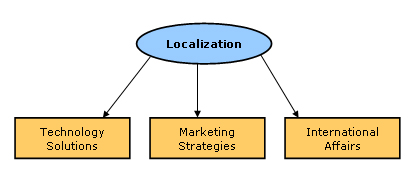
Figure 1: Localization discipline evolving among three inter-locking phases of industry development One vision is to divide the market evolution into three interlocking phases : 1) Technology Solutions, 2) Marketing Strategies, 3) International Affairs. Although each phase promotes its own set of specialization for a particular business segment, all comes under the de facto umbrella branding of the localization industry. Through these expanded offerings, customers will gradually reassess this industry in general and individual corporations in particular. The current phase of Technology Solutions possesses characteristics of cost leadership, automated enterprise workflows and technology integration from corporate consolidations. Nevertheless, its competitive posture has been undermined by the inability to push customer relationships beyond the consideration of purchase cost. This situation has become so dire that some corporate professionals actually toy with the idea of sharing competitive customer portfolios and technology feature sets to forestall this commoditization. The harsh reality is that "sameness" is the quickest means of demise in our discipline. To offset this dilemma, Marketing Strategies is the next intermediary phase to embrace. International marketing is a complementary fit for the localization industry, by offering both technology suites in delivering localized information and comprehensive resident knowledge in designing marketing campaigns for geopolitical and ethnographic regions in areas of print advertisement, online brand valuation, website usability analysis, etc. With this repositioning, customers can evolve their appreciation of localization as a holistic experience in managing multiple points of refinement, thus shift the brand awareness to the industry favor. Despite this good momentum, its subtle drawback is overtly emphasizing "localization" as an industry rather than an "umbrella discipline" capable of multiple solutions in politics, language and culture. To achieve this aim, the final phase is to consolidate International Affairs as an integral localization qualifier. This natural extension is not only logical, but self-evident for it finally propels this industry beyond the traditional customer base into new realms of political liaising, cultural specialization, transnational corporate diplomacy, global trade relations, non-government organizational projects, etc. By attracting non-technical professionals seeking benefits beyond one-off translation services, associations such as GALA can finally break the commoditization impasse and serve as a conduit for seamless global knowledge sharing and resource alignments. To "seed the market" in this manner, one must manage the customer experience to optimally execute market equities. III. Leveraging the Market Equities The interlocking phases above project a broader brand reputation across the entire localization realm. Despite reservations voiced by some in our industry, there is a science behind this marketing "fluff". In 1999, the University of Pennsylvania published the marketing strategy paper titled "Brand Beyond Borders : An analysis of the potential for Brands to extend into entirely different categories". In a nutshell, this research quantified the ability of certain established global brands (represented by corporations or associations) to expand products and services beyond one's original category (such as Apple Inc. and its iTunes Music Store). Success in this arena can significantly increase the perceived brand value, hence elevate related stock prices and strengthen financial coffers (ex. the Dell brand is estimated by Interbrand.com consultancy to be worth over $13 million).
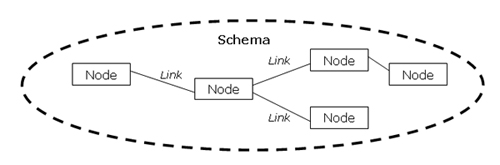
Figure 2: Conception of Brand Extension via customer psychology of nodes, links, schemas This relationship is accomplished by balancing customer psychology with corporate value propositions via memory nodes, links and schemas. Memory nodes store individual words and images. Links forge coherent patterns among these nodes via association or recall. Finally, customers instill schemas onto collections of nodes and links via inference or external stimuli. These schemas can be rudimentary (ex. propensity for price sensitivity) or sophisticated (ex. relating family values to a particular corporate logo).
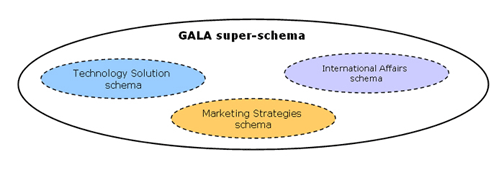
Figure 3: GALA super-schema This interaction among "Nodes" and "Links" is almost a mirror image of the current localization industry, with each competitor offering specific price points, technology consolidation and corporate merger advantages. However, true market resiliency is provided by associations like GALA which are capable of installing an industry-level "Schema" in serving as a conduit for resource & information flow, influence on the evolution of the entire industry, and harnessing the true global branding potential of localization by extension beyond traditional product and service offerings. By reinforcing a single point of accountability to the global customer base, GALA is prepared to take localization into the next higher order of discipline and evolution. IV. Conclusion Price commoditization exists when customers cannot differentiate products and services among competitors. One means of expanding the value proposition is to evolve the localization industry into three inter-locking phases of Technology Solutions, Marketing Strategies and International Affairs. In this manner, localization can extend from being a mere industry to a complete multi-facet international discipline. Integrating marketing psychology into this equation, GALA is strategically positioned to serve as a premier partner in this initiative.
This
article was originally published by GALA: The Globalization
and Localization Association (http://www.gala-global.org).
E-mail this article to your colleague! Need more translation jobs? Click here! Translation agencies are welcome to register here - Free! Freelance translators are welcome to register here - Free! |
|
|
|
|
|
|
| |||
Legal Disclaimer Site Map |
 "Frog
at the bottom of a well" is an old Asian proverb
which states that a frog at the bottom of a well
steadfastly believes heaven is only the size of
a small circle. Only when one climbs out of the
well can heaven's true vastness and magnitude be
comprehended. Ageless as this proverb may be, it
is also an appropriate description of the current
commoditization challenge within the localization
industry.
"Frog
at the bottom of a well" is an old Asian proverb
which states that a frog at the bottom of a well
steadfastly believes heaven is only the size of
a small circle. Only when one climbs out of the
well can heaven's true vastness and magnitude be
comprehended. Ageless as this proverb may be, it
is also an appropriate description of the current
commoditization challenge within the localization
industry.