|
 |
 |
 |
|
|
Home | More Articles | Join as a Member! | Post Your Job - Free! | All Translation Agencies | |
|
|||||||
|
|
|
|
Russian
See also: Russian Contents: 1. Grammar and Spelling Section One - Grammar and Spelling 1. Gender: Russian has three genders - masculine, feminine and neuter. Usually the gender can be recognised from the ending of the nominative case. Here is a list of all the endings in this case grouped by gender:
e.g., *принтер (printer) is masculine - it ends in a consonant in the nominative case. *бумага (paper) is feminine - it ends in '-a' in the nominative case. These endings appear in nouns which are of Russian origin or in nouns of foreign origin which have become 'russified'. Foreign words which have not (yet) changed in form often do not change their endings at all - e.g. такси (taxi), интернет (Internet). 2. Articles: There is no concept of 'definite/indefinite article' in the Russian language. 3. Case: Russian nouns, adjectives and pronouns have 6 cases. This means that words change their endings according to their function in a sentence. The cases are as follows:
4. Aspect: The Russian verb has two aspects, each represented by a separate infinitive: the imperfective to indicate a continuing action, and the perfective to indicate an action already completed or to be completed. 5. Plural: The endings '-ы' and '-и' very often mark a plural (in the nominative case), just as -s does in English. For example, you can easily work out from this that 'пpинтepы' means (many) printers and 'пpинтep_' means one printer. There is a group of nouns which are singular in Russian but plural in English: Certain nouns are used ONLY in the plural: There is a group of nouns which are plural in Russian but singular in English: 6. One-letter words: There are a few in Russian which are relatively common. For example, the conjunction и (and), the prepositions о (about), в (in), к (to, towards), or the personal pronoun Я (I). 7. Capitalisation: As far as mid-sentence capitalisation is concerned, the Russian pronouns Вы (You) and Ваш (Your, Yours) are spelt with a capital letter to indicate polite form of address to one person. Section Two - Punctuation 1. Capitalisation: general capitalisation rules are quite similar to English: - The first word in a sentence is always capitalised. All other words in a sentence are usually lower case. The only exception is bullet points or a list of items in 'sub-sections'. In this instance, lower case is allowed at the beginning of a sentence/phrase. The subsections are usually separated by a semi-colon or a comma. e.g. the following Russian sentence retains lower case in subsections: 2. Пpибop oблaдaeт cлeдyющими фyнкциями: Where question/exclamation marks are used to separate homogenous members in a sentence, lower case may also be used: Proper nouns: there are complex rules regarding capitalisation of various categories of proper nouns (i.e. names - Russian and foreign, religious, mythical names, names of wines, plants, fruit, fictional and historical characters, geographical names, official state names, celestial bodies, geological periods, holidays, red-letter days, organisations, companies, works of art, documents, titles, orders and medals etc.). These rules describe, in detail, capitalisation in every category. In each particular case, according to specific rules of Russian spelling, the results may look different from English proper nouns, e.g.: Лac-Beгac Las Vegas As you can see, some words become lower case and sometimes a mysterious hyphen appears out of the blue! So beware! In official documents - (official reports, treaties, contracts) capitalisation of Russian nouns is also very common: Aвтop, Издaтeльcтвo = Author, Publishing House (in a contract) etc. Capitals in headings/titles: The traditional Russian spelling requires capitalisation of the first word, all the other words in a heading should be spelt with lower case. 2. Speech marks: Russian opening speech marks may be located low (like two commas), e.g. "Mы знaeм вce", - cкaзaл oн. ("We know everything", he said.) Sometimes English speech marks " …" become «…» in a Russian printed text, Direct speech - various examples of punctuation: 2. When direct speech precedes author's words: 3. Author's words embedded within direct speech: 4. When direct speech is embedded within author's words, it is preceded by a 3. Double full stops: There are a couple of very rare cases when a question mark or an exclamation mark may be followed by two full stops. In principle, it is a semantic case of combining a question (or exclamation mark) with an ellipsis: 4. Combining punctuation marks: An ellipsis cannot be followed by a comma in Russian. A comma is 'swallowed' by an ellipsis: Moя paбoтa… нo нe When an exclamation mark and a question mark meet in a sentence, the question mark always precedes the exclamation mark. When a comma and a hyphen meet in a sentence, the comma always precedes the hyphen. 5. Bullet points: Bullet points are usually preceded by a colon, separated from each other by a semi-colon and the last one is usually followed by a full stop. However, due to substantial 'westernisation' of Russian printed materials, it is now common to follow the English punctuation patterns in Russian bullet points (i.e. NO colons, semi-colons or full stop). This has become acceptable in many types of promotional materials - brochures, booklets, leaflets etc. Section Three - Measurements and Abbreviations 1. Measurements: Metric only. A space is usually left between numbers and their measurement abbreviations: e.g. 25 см (25 cm) Tonnes: the Russian abbreviation for 'tonnes' is 'т'. In some Cyrillic fonts (particularly italics), this 'т' may look like an English 'm', e.g., 12 m (12 tonnes). kWh or (kilowatt/hour) looks like : кВт.ч (киловатт-час) in Russian. % and °C usually follow immediately after a number - there is no space between them, e.g., 14,6%; 22°C. Time: 8 am = 8 чacoв yтpa / 08.00 Dates: English - Russian Numerals: Cardinal numerals from one to nine are usually spelt as words with the exception of their use with physical measurements. When used with physical measurements, words are used when the measurement unit is also represented by a word. Please note that use of Roman figures for representing ordinal numbers in Russian is limited to such nouns as 'century', 'Congress', 'Conference', etc. Ordinal numbers, represented by non-Roman figures may have a gender/case/number attachment: e.g. 2-е издание (2nd edition). If these numerals follow in a group, then the attachment is added to the last figure: Note that attachments are NEVER used with cardinal numbers, dates and roman figures: Russian uses a decimal comma. Large numbers: traditionally, large numbers have always been written as a whole: e.g. 1014; 1836603846. However, the current trend is to break them up using a space (especially in tables), e.g. 1 014; 1 836 603 846. Separation by a dot is also quite common these days, e.g. 1.014; 1.836.603.846. All of the described methods should be deemed acceptable. Currency: if abbreviated, the currency unit generally precedes the figure, e.g. £23.50; GBP 3.50; £250 млн. (£250 million); $65.80; USD 65.80, although it can also follow it e.g. 11 500 $. These amounts can, however, also be deciphered in words: 2. Abbreviations: Equivalent abbreviations: Other abbreviations: Section Four - Hyphenation In the Russian language hyphenation is a very widespread phenomenon. Section Five - Miscellaneous Peculiarities When Russian is written in italics, some characters look completely different to their non-italic counterpart. This is correct! Section Six - Geographic Distribution Russian is the most important of the Slavic languages and now one of the major languages of the world. The emergence of the Soviet Union in the postwar period as a major world power, coupled with the impressive achievements in science and technology, has significantly increased the interest in and the study of Russian in recent years. With English, French, Spanish, Chinese, and Arabic, Russian is one of the six official languages of the United Nations. Of the 150 million people in the Russian Federation, about 125 million are native Russians, with many members of other nationalities speaking the language with varying degrees of fluency. About 30 million Russians also live in the newly independent states that were once part of the Soviet Union, with the numbers by country as follows: Ukraine - 12 million; Kazakhstan - 8 million; Belarus - 3½ million; Uzbekistan - 2½ million; Latvia - one million; Kyrgystan - one million; Moldova - 600,000; Azerbaijan - 500,000; Turkmenistan - 400,000; Lithuania - 350,000; Armenia - 50,000. Recent figures also show 250,000 Russian speakers in the United States and 40,000 in Canada. Russian is written in the Cyrillic alphabet, whose origin dates from the 9th century. Its creators were two missionaries from Greece, the brothers Cyril and Methodius, who based it largely on the Greek. Russian is spoken/used in the following countries: Language Family Source: http://www.worldlanguage.com/Languages/Russian - Copyright © Kenneth Katzner, The Languages of the World, Published by Routledge. Section Seven - Character Set [ ] = Alt key codes
Russian
McElroy is continuing this series of interviews that highlight some of the characteristics of languages used in doing business globally. This month, we look at Russian.
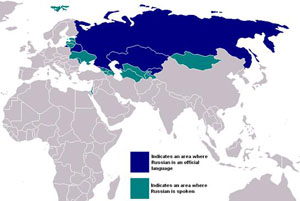
Map courtesy of Wikipedia What are some pitfalls specific to Russian to avoid that a client should be aware of when translating into this language? Transliterations, both in “general” and in special texts. For a well-known example, “killer” should not be translated as “киллер” but rather as “убийца” (an existing Russian word). For another example, “cystic fibrosis” is not “кистозный фиброз” but rather “муковисцидоз” or “фиброзно–кистозная дегенерация.” And for a third example, “mortgage” should be translated as “ипотека” (an existing Russian banking term) rather than transliterated as “мортгедж.” New Russian terms. Sometimes, there is no direct single Russian equivalent of even a well-known English term. It is advisable to explain the meaning of the English term rather than invent or use a Russian semantically different “equivalent.” For example, there is a legal semantic difference between a “refugee” and an “asylee,” while quite often both have been translated as “беженец.” For another example, “claim” (in the context of insurance or in a different context of unemployment benefits) should almost always be explained to a Russian audience. Biblical references. Translation of Biblical references (including names) should be done cautiously and in accordance with the canonical Russian Bible. What are characteristics of Russian that are unique or different from English and/or other languages? Word order in Russian sentences is free, unlike in English. Punctuation rules in Russian (especially the use of commas) are more rigid than in English. Capitalization in Russian is rather limited; usually only the first word in a multi-word name should be capitalized. The English word “you” when referring to one person may mean either a formal polite reference to this person (“вы”) or much less formal (“ты”). These two kinds of reference are semantically very different. The translator should look at the context. It became a bad habit to capitalize “вы” (“you”) and its derivatives everywhere in Russian documents. The Russian grammar permits such capitalization only in personally addressed (private) letters rather than in generic documents. The absence of (definite as opposed to indefinite) articles in Russian requires the translator to find an appropriate way to express the relevant semantics of the English articles in Russian. As an example, consider Hayek’s paper “The theory of complex phenomena” (as opposed to “A theory...”). Relate an example or two where you found a website page or form difficult to use because it was poorly localized. How might a business lose money, prestige, or incur legal risk due to this bad translation? Illiterate translations. Quite a few Russian sites have translated “Duke University” either as “Графский университет” or as“Герцогский университет” - thus ruining their credibility. A simple search using yandex.ru resulted in at least 4 references to “Графский университет” and several hundred references to "Герцогский университет.” These are not just news sites, but, for example, even the site of the famous Moscow “Fiztech” (Moscow Institute of Physics and Technology): Click Here. See also above on the translation of “M.D.” If possible, provide one example of a particular phrase or concept that only a properly qualified, professional translator would be able to correctly communicate. Quite a few metaphors in American English texts (both general and technical) use baseball terms. Since baseball is not well-known in Russia, these terms cannot be translated literally, and the translator has to find an adequate "baseball-free" equivalent in Russian while retaining the semantics. How do these characteristics make it important to use properly qualified, professional translators? A properly qualified translator should clearly understand the semantics of the source text, the source and the target environments (including the target audience), and the linguistic characteristics of both languages. This cannot be automated. Do you know examples where translation or localization mistakes have occurred with Russian, such as problems with text expansion, date/time formats, counting errors, character encoding, etc., or mistakes with the translation itself? In addition to those mentioned above, date formats are different: in Russian DD/MM/YY is used, and this may cause errors. Different character encodings: there are several Russian encodings not all of which are supported by all mailers (such as AOL). I have even encountered an opinion (wrong!) that Russian encodings on a PC and on a Macintosh are different and incompatible. I have edited a few medical translations where the term “contaminated” (e.g., needle) was translated as “infected” (“зараженная” or “инфицированная”) incorrectly narrowing the original meaning. Information on “Sharps containers” (containers for used medical needles (and other sharp medical instruments, such as IV catheters)) was included in a Russian site (http://www.dialand.ru/basik/products/lancet/sharps.htm) under the title “уничтожители иголок” (meaning “needle destructors”). This title is not only clumsy but also clearly misleading because such containers do not destruct anything (“disposal” is not the same as “destruction”). “M.D.” is not the same as "доктор медицинских наук” (Doctor of Medical Sciences) [see the incorrect translation at the popular site multitran.ru] because in Russia in order to get to get the “доктор медицинских наук” degree it is necessary to defend a profound Doctoral Thesis (the PhD is usually a prerequisite for that) and to publish a monograph. In a medical trial document, “a blood clot disorder may be developing” was incorrectly translated as “возможность развития нарушения тромбообразования.” The correct translation would be “возможность развития тромбоза.”
Published in July 2008.
E-mail this article to your colleague! Need more translation jobs? Click here! Translation agencies are welcome to register here - Free! Freelance translators are welcome to register here - Free! |
|
|
|
|
|
|
| |||
Legal Disclaimer Site Map |