|
|
| Advertisements |
|
|
|
Globalisation Management Systems Discussion
By http://www.thebigword.com/
Become a member of TranslationDirectory.com at just
$12 per month (paid per year)
This article discusses the choice
between a vendor such as thebigword and a GMS solution
such as Trados GXT, Globalsight, Idiom, etc.
It aims to be as objective as possible and is written
from the technical and process standpoint. If there
are any questions regarding this article, please do
not hesitate to contact Ian Harris on +44 (0)870 7488000
(ian.harris@thebigword.com).
Using a GMS (Globalisation Management System)
A GMS is designed to allow a company to manage many
parts of the translation workflow themselves. It allows
them to deal directly with translators. It also allows
them to deal with translation vendors but removes
much of the project management, file handling and
memory management resource so allows negotiation of
much better prices, and allows much easier swapping
of vendors.
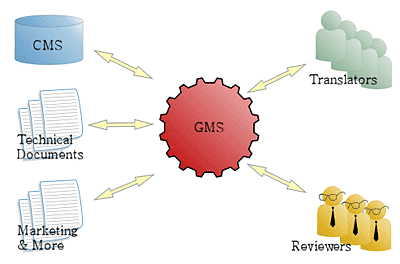
A GMS generally consists of the following elements:
- Extraction
- The GMS is installed and configured to accept
files from a number of sources. Sources could be
content management systems, document management
systems, databases, file repositories and anywhere
else that translatable content exists. The GMS will
generally advertise many pre-built 'connectors'
for standard applications such as standard CMS (content
management system) solutions.
- Filters
- As well as having the necessary technology for
extracting the file out of its source repository,
the GMS also has many 'filters' that, once the file
is in the GMS, will extract the text out of the
file so that it can be translated without breaking
the file.
- Workflow
-
The GMS has workflow capability that enables
the GMS manager to set up a process flow for each
file type, or each file type from each repository.
An example of such a workflow might be:
- Extract File
- Filter File
- Leverage Memory
- Translate
- Proofread
- Back Filter
- In-Context Check
- Return File
Each of these stages is either performed by
the GMS itself or is managed by the GMS. In the
case of translate and proofread, for example,
the GMS cannot perform these stages, but instead
manages these stages by e mailing the relevant
parties, logging any work completed, and on completion,
continuing to the next stage in the workflow.
- Memory
- The GMS has a built-in memory so when translators
log in and choose to translate a file they are generally
pre-leveraged. This means that the translator does
not need any CAT (Computer Aided Translation) tools,
and all translators receive benefit from the memory
the instant a translator adds a new translation
unit (typically a sentence).
- Vendor Management
- The GMS will generally have some translation vendor
management facilities allowing translators or translation
vendors to be added to the system. The system can
hold price information and other details and allow
the system manager to select the best translator
or vendor for the job.
- Review
- Review mechanisms allow the reviewers, as part
of the translation workflow, to log in and make
annotated amendments to the translations.
Given the above functionality, it is possible to
choose the cheapest translator for the job, and not
pay for any of the add-on services of the vendor since
all the extraction, filtering and memory management
is done automatically. The aim of these systems is
that the client only pays for the translation.
Using a Translation Vendor
Using a vendor, such as thebigword, without the
use of a GMS is described as follows.
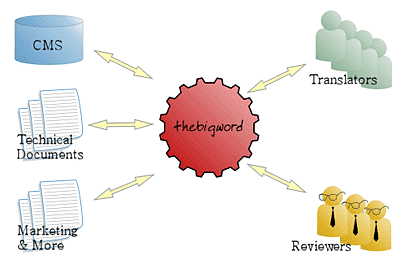
If the translation vendor in the diagram is thebigword,
it consists of the same elements as the GMS. In this
case, the comparable elements are as follows:
- Extraction
- Files can be sent from a number of sources using
thebigword's TranzManager™
suite. This includes connections to content
management systems and databases, user interfaces
that are either web based or integrated with the
Windows desktop, as well as links with eProcurement
systems such as Oracle and Ariba. This allows automatic
access to content repositories where required and
manual submission mechanisms in all other cases.
- Filters
- thebigword employs not only the latest industry
standard filters for common file types, but also
creates bespoke filters for client specific files.
- Workflow
- Workflows for each file and content type are managed
by thebigword. It is our responsibility to ensure
that these are the most efficient for each type.
The client need not be concerned with these, but
they are transparent should the client be interested.
- Memory
- thebigword manages the memory on behalf of the
client. The memory is always owned by the client,
but this is cleaned and maintained by thebigword.
The memory is available as a download at any time
on the translation
portal hosted by thebigword and available to
the client. Translators use this memory with their
own CAT tools.
- Vendor Management
- thebigword manages the vendors that translate
the files. These may be individual translators or
single language suppliers.
- Review
- thebigword manages the review process with specifically
designed tools and file formats.
Comparison
On the face of it, it seems that the decision to
opt for a GMS solution or a vendor such as thebigword
is based on a financial calculation between the up
front cost of the GMS (plus on-going maintenance fees),
against the higher per-word costs of the translation
vendor.
However, there are issues to consider. Below is
our comparison chart of the two options. Note that
this is clearly written by a translation vendor and
is therefore potentially biased towards that solution.
However, we have much experience in competing with
and in many cases replacing such systems and can provide
references to back up these findings.
| |
GMS |
thebigword |
| Extraction |
Out of the box 'connectors'
involve high maintenance, installation on the
client system, and are generally very unreliable.
Very few good case studies or referees exist.
|
Un-intrusive web service based
messaging is compatible with all but the oldest
systems, uses standard SOAP protocols and has
a three year track record of successful implementations.
Case studies and referees can be provided on request.
|
| Filters |
Pre-built filters are excellent
for standard file types that adhere to the standards.
The files must not vary in their formatting or
this part of the workflow breaks down. From 25
years of working with files, thebigword have found
that very few file types in a company's translation
file type portfolio adhere to standards. |
Filtering is our specialism.
If the XML contains encoded HTML that contains
Javascript, we can extract the text. Filtering
is major problem area for out-of-the-box solutions.
Filtering is difficult and needs to be in the
hands of experts that know the issues, both technical
and linguistic. When file types change, as they
invariably do, our filters change at no extra
charge, and they work every time. This is because
they are managed by experts |
| Workflow |
Design of workflows for each
file type or new process is a burden. This creates
large internal costs. Existing GMS users can provide
details of how significant a burden this is. |
Workflow design is removed from
the client. The client sends source files and
receives finished, working translated files. |
| Memory |
Centralised memory is owned
and managed by the client and is used by all vendors.
Swapping vendors is easy. |
Memory is managed by thebigword.
The reality of managing a memory is that each
translation unit that enters the memory must be
good since it will be re-used in future. Therefore
the mechanism of sending out translation packets
then cleaning these into the memory is essential.
Instant on-line memory updating is a mechanism
that thebigword can support, but it leads to instant
perpetuation of any errors. |
| Vendor Management |
Vendors are simply loaded into
the system then used as required. |
thebigword selects, tests, and
monitors all vendors. Disputes between reviewer
and translator are resolved as part of the service.
Management of vendors should not be underestimated.
We have built a 25 year old business on the premise
that selecting and managing translators and vendors
is a specialised job. |
| Review |
Review mechanism is automated.
|
Review mechanism, plus review
scheduling, chasing, dispute resolution is either
automated or managed by thebigword. This process
is at times painstaking and requires expertise.
However, it is completely removed from the client.
|
| Cost of Ownership |
Cost of set up is high, on going
support and maintenance cost is high, but more
significant, the cost of running and managing
the system with its connectors, filters, workflows
etc. is extremely high. |
No up front or maintenance costs,
but higher cost per translation. |
Conclusion
Choosing to employ the services of a major translation
vendor or purchase a GMS is a significant investment
decision. The two approaches are fundamentally different
and involve different levels of cost and internal
management. It is difficult to measure and compare
the ROI on each due to the cost of internal management
in the unknown areas of filter management, dispute
management, vendor maintenance and others.
We would always recommend that when choosing between
the GMS and vendor-based approach that you speak with
actual customers of each. This should help you see
beyond the sales pitch and provide a 'warts-and-all'
view of the investment required.
Submit your article!
Read more articles - free!
Read sense of life articles!
E-mail
this article to your colleague!
Need
more translation jobs? Click here!
Translation
agencies are welcome to register here - Free!
Freelance
translators are welcome to register here - Free!
|
|
|
| Free
Newsletter |
|
|
|
|
|