|
 |
 |
 |
|
|
Home | More Articles | Join as a Member! | Post Your Job - Free! | All Translation Agencies | |
|
|||||||
|
|
|
|
How to Optimize Files for Translation
Prepare yourself for better results When you design a document for print, you consider many details that work together to form the overall look of the end product. One thing you probably don’t look at is the hidden text: all the spaces, line breaks, and paragraph marks that live behind the scenes. The first thing we do when we get your brochure for translation is to flip the switch that shows that hidden text. The finished product of your brochure is our starting place, so we spend time before translation making sure the translated text will behave the way your English text does. We call this “optimizing” the file. It doesn’t look different on the surface, but tweaks made to the file ensure that the translation process is more effective and efficient. A word about modern translation software The work of translation is done in software known as CAT (Computer Assisted Translation) tools. The software separates the text from its formatting, so we translate the information without touching the formatting. Once the text is translated, the software adds the formatting information to the translation and puts it back into the original document. In an optimized file, the translated text requires only tweaking to make the new text fit correctly and neatly. How can this help you? If you design a file with translation in mind, the optimizing is minimal and translation can get underway immediately. This lowers your costs and makes a quick turnaround possible. In the worst case scenario, something that looks beautiful in the original can be so time-consuming to prepare for translation that costs and turnaround time become unacceptable. Here are a few things to consider when designing your brochure for translation. Many of these are things all good designers already know. Some of those good habits save money in addition to creating a beautiful product. Expansion When you translate something, it usually gets longer. This fact is hard to avoid. We must translate the text as it is written. We cannot edit for length the way you might in English. We can decrease the space used by text by several methods (reducing text size, paragraph leading, or text tracking), but the results can be less pleasing the more methods we have to use to fit the text. For the best result, leave room for expansion. If text must remain on a certain page, make sure there is plenty of white space surrounding it. Flowing text If your text does not need to stay on a certain page, make sure you have your text flowing anywhere it can flow. Connecting text boxes whenever text can flow makes it much easier to figure out where text can expand and where it must stay on a certain page. Line breaks If you want a paragraph to look neater or fit within a certain space, a quick way to do that is to put line breaks where you want the text to end.
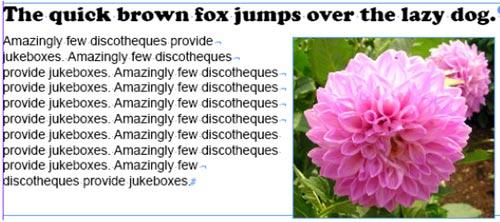
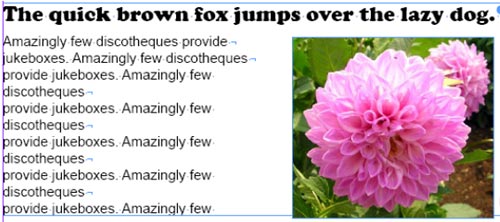
This is fine if you never plan to make changes. Since the nature of translation is change, using artificial line breaks makes a nightmare for translation.
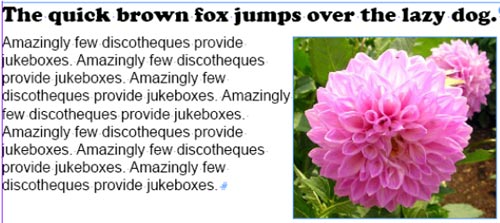
Every artificial line break must be removed so that the translated sentences flow naturally in paragraphs. The best ways to avoid using artificial line breaks are resizing text boxes, using text wrap, or breaking up big text boxes into smaller text boxes.
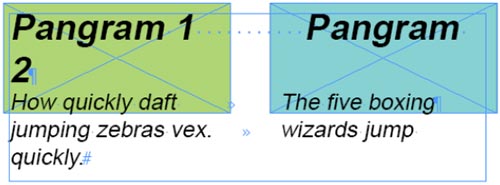
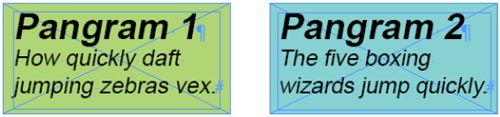
Text boxes Speaking of text boxes, one of the best ways to make your file require less work before translation is for each text box to contain a consistent flow of information.
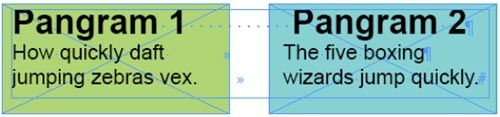
Creating one text box with side-by-side paragraphs is time-consuming for you. For us, it creates text that does not flow sensibly. The file must be fixed or the translation would not make sense.
It also make a mess when the text expands.
To optimize the file before translation, we break the separate ideas into separate text boxes and remove unnecessary tabs or spaces. When the translation is complete, the text stays in place. Making text fit takes only a few seconds.
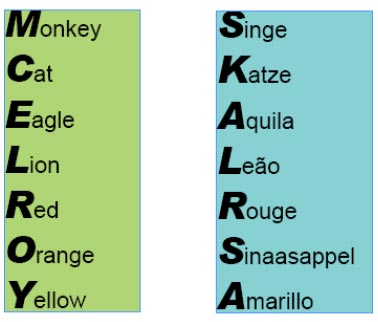
Master pages If you have information that repeats in the header or footer, put it on your master page. Master pages can contain text as well as the design elements that give brochures a consistent appearance. Using the master page for repeating text means that it only has to be translated and formatted once. Abbreviations and acronyms Common abbreviations in English are not common in all other languages. The translation may have to expand them, which can increase the space needed dramatically. If you use acronyms as part of your layout, recognize that the translation will not follow suit. Drop-cap or other formatting for a single letter might not make sense for a translated document.
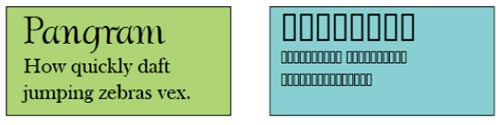
Fonts If your translation language shares the same alphabet as English, the fonts will most likely stay the same. If your brochure is going into Spanish, then you don't need to worry too much about fonts. If it’s going into Russian, an Asian language, or even a language with many diacritical marks, then unusual fonts will most likely have to be changed. The more unusual the font, the less likely it is to support character sets for many languages.
References If you have references, consider in advance how you want them handled. Anything that would need to be looked up in English, such as journal titles, can be left in English. Where you need both understanding of the idea and the ability to find the English, such as organization names, we can provide a translation and the English. Different options make sense in different circumstances. It helps us to know in advance how you want these treated. Getting your file ready for translation When you get your file ready to be translated, take the time to package it so you can find your missing pieces before you send the project to us. Missing image files or fonts may be a snap to fix in-house, but a request from us to you will pass through multiple e-mail inboxes and take up that precious commodity, time. Published - April 2009
E-mail this article to your colleague! Need more translation jobs? Click here! Translation agencies are welcome to register here - Free! Freelance translators are welcome to register here - Free! |
|
|
|
|
|
|
| |||
Legal Disclaimer Site Map |