 |
 |
 |
 |
|
|
Home | More Articles | Join as a Member! | Post Your Job - Free! | All Translation Agencies | |
|
|||||||
|
|
|
|
Towards A More Equitable Pricing Structure: A Translator's Perspective
I have been a professional translator for over 20 years in Canada, one place in this world where translation is regarded as what it really is: transferring messages between different cultures. In Canada, we have two main official languages, English and French. In this article, I take issue with certain claims made by translation memory (TM) and content management system (CMS) vendors. In addition to the lingo of "fuzzy matches" and "exact matches," there is the publicity claiming, "Don't pay twice to translate the same word," and "Save up to 80% on your production costs." I beg to diverge on that last one. My figures are a bit different. First, one must understand what is the target, and what can be obtained from it. How is redundancy billed?What does it imply if it is saved from the translation bill? Most translation work is paid on a per word basis. This system is far from perfect, but all in all, everyone has become accustomed it. Some word combinations can easily be translated easily, while others are tough. Some parts of text are repeated, while others require endless research to solve ambiguity. In fact, it turns out that pricing based on the concept of word count is a sort of package deal that assumes that some parts will pay a lot, while others will hardly pay at all. For translators, reusing parts of text that have been previously translated, either in the same text or in previous texts, has always been part of the price billed to customers. However, TM has radically altered the way in which translators do their work. Yet, pricing schemes and cost structures rarely take this into account. What share of the savings should the customer expect?The customer should expect his fair share of the savings that new technologies bring, but not those very ambitious figures provided by software vendors. The savings should be based on reality, not at the expense of individual translators. To determine what is fair, one needs to understand the nature of texts. Some texts are what we call "narrative continuous," requiring careful attention to grammar, syntax, ambiguity, etc. "Discontinuous" texts are much easier to translate for they are usually parts lists, very standardized technical procedures and the like. They are processed on the basis of terminology rather than translation. Outlined below are three examples that demonstrate how very often translation savings are not value-added by the new technologies.
The customer's project manager (PM) is both technically and linguistically qualified to do a good translation herself. She hopes that the student's manual will cost nothing, since the text is contained in the trainer's manual. The company has recently invested in a TM package.
FINAL RESULT: In this case, the customer will almost certainly be frustrated, since her expectation was a 100% savings on the user's manual. However, her savings has shrunk to 60%, even though the translator has given up 4%, too, rather than paying for her software. There is a "negative added value" for the translator. The overall cost of the process is 44%. An archaic invoice for this project would look as follows: 
A more realistic invoice for this project would look as follows: 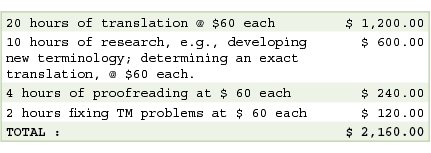
There is only a difference of $785.00 between the two types of invoices: a pittance for most companies, small or large, yet very important to an independent professional translator. Example 1: Course Manuals for Students and Trainers (Scenario 2)The customer expects a 100% saving since he has just bought a new software program that stores phrases in terminological databases and allows him to modify text alignment at will.
The customer expected a 100% saving, which has now be reduced to only 56%. What does it take to save the 70% and more promised by TM vendors? Example 1: Course Manuals for Students and Trainers (Scenario 3)The customer expects a saving of 100% on the student's guide, even though his company has not invested in TM software. Instead, he hires a translator, who is the proud owner of this state-of-the-art new software, and agrees to bill only 10% on the 100% matches, since it is the machine that will do all of the work. The translator assumes that 10% for a few minutes of work is good enough.
FINAL RESULT: The customer is happy, having almost realized his expected 100% savings. He also believes that he has been generous with the translator. He will tell everybody that implementation of such software can generate savings of up to 90%. Of course, the reality is that a large part of the savings has come directly out of the translator's pocket. The added value has been largely overstated and constituted a transfer of expenses from the customer to the supplier. Example 2: Updated Release of a User's Guide (Scenario 1)The customer expects savings of 80%, since the TM software recognizes 80% of the words.
RESULT: The customer is satisfied, but the translator is short-changed, similar to the crow in a Lafontaine tale. Example 2: Updated Release of a User's Guide (Scenario 2)The customer has been told that 80% of the words are the same as in the last version. He believes the text comparison feature in his software and therefore expects an 80% savings.
RESULT: Rather than paying 20% of the total bill, the customer will pay a more equitable 58%. The customer feels a bit of frustration, but in fact, he just paid the right price. Example 3: Updated Office Supply CatalogHere is a glorious exception where the customer can save 70%, 80% or more, especially if there is an item ID that clearly identifies the item. In this case, the translation probably doesn't even need to be proofread since only the prices have changed. But...do we really need TM for such projects? Wouldn't a database containing the description in the appropriate languages, a place for a conversion factor for the various currencies and a price field be a better solution? 
A translator is a language specialist who understands creative uses of language and that sentences can be ambiguous due to neologisms, false friends, etc. He is familiar with and knows how to handle the many other challenges in correctly translating the reality of one culture into another. A translator's compensation should reflect this. A more equitable bill for some of the work described in the examples above would look something like this: 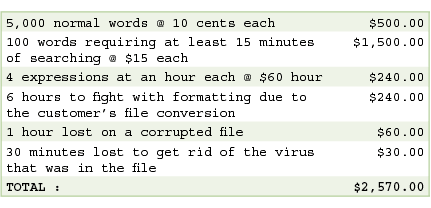
Again, however, the normal bill usually looks as follows:
This is a difference of $1,195… equal to 87% of what the translator was paid! In other words, the translator has been paid a little bit more than half of what he should be! However, everyone seems to find it normal that the parts that are particularly lucrative should be deducted from the translator's wages. Let me be clear, I don't want to say that we should reject TM software. It is clear that these software are here to stay, and that they are very often productivity enhancers. However, the added value must be shared with translators, instead of becoming a pretext to minimize the importance of good work. As a matter of fact, many of the words counted as "saved" by TM tools are, in fact, as easy and fast (sometimes faster) to handle through a good global replacement feature. E.g., when there is a sentence in English instructing a user to do XXX and then to "press Enter," it can easily and quickly be translated into French with the same text every time ["et appuyer sur la touche Entre (Enter)"]. Preprocessing text with Content Management SystemsThis is worst than bad! CMS vendors claim, "You only have to pay for the new content." In real life, that means that the translator receives a few sentences, or a paragraph, and must read many paragraphs to understand the context each time. In addition, language aspects such as gender, formality, etc. are not really handled by these systems that pretend to manage content. In fact, these programs only manage changes, and usually do it right only in English. In some instances, a gender change may imply in a language such as French or Spanish that all other sentences with gender-specific content must also be reviewed and changed. Also, depending on who is speaking, the social conventions may change completely the way things are said in another language. For example, in Canada, if I don't know the person to whom I am speaking, I use the pronoun "vous", while I use "tu" if I am speaking to a friend. To be polite in some countries may mean doing business or not (as in Japan). Elements that should be considered for an equitable evaluation Text Type: Continuous or discontinuousUsually, a translator earns more for continuous text than for discontinuous text. Sentence LengthAs mentioned earlier, headers, footers and titles in general are easy to translate. The fact that a program can match them to their respective translations automatically does not necessarily speed up translation. Even worse is the fact that some tools force translators to confirm each occurrence of a phrase, actually making the job much, much longer. Yet, customers demand rebates for the imagined savings, at the translator's expense. Shame! Customer LoyaltyIf customers always sent their texts to the same translator, at least the investment in TM would make financial sense for the translator. However, reality is a bit different. Large corporations usually have more than one translation provider, while some prefer to handle their own TMs. Far too often, the following happens: a translator translates a text for the first time, inserting all of the translation into a TM. However, when the corporation updates the product, it sends the first TM to a different translator who bid half a cent less than the first translator. Translators should charge to use an empty translation memory, since next time, the company will demand that the price of the translation be lower. Why not be equitable?Some people say that translation is the main cost of some products or services. Then, if it is the main cost, it is probably also the main revenue multiplier. Suppose that a company produces something in English, and then translates into languages that have ten times less people in terms of customers. With each new translation, there is a new market, new opportunities. Butif you consider it only as a cost, then all you want is to lower that cost. Let's look at two examples. A home appliance manufacturer in Canada is able to produce a microwave at an excellent price/quality ratio. The company is proud of its product and decides to include a book of recipes with lots of illustrations on high gloss paper. Making such a book really costs a lot, so they decide to "save" on translation. The book has approximately 150 pages with around 10,000 words. The company provides each customer with two books, one in French and one in English. A very well-paid translator charges 25 cents a word, so the total translation bill is $2,500. At the risk of damaging its image with a poor translation, the company might be able to save at most $2,000 by sending the text to a less-qualified translator. People who view translation only as a cost factor probably think this is great. However, customers reading a poorly translated book will probably think that anyone making such a decision should be fired. Hardly anyone will contest the claim that translation is one of the main costs in the software industry. I say that this is perfectly false! Let us suppose that a good programmer writes an award-winning computer-based training program to teach Java. He sells 1,000,000 copies in English. When he and his editor consider the second release, they want to increase sales by improving the software. However, the real revenue-generating opportunity lies in allowing people who do not speak English access to the software by translating it. Each new language implies a cost, yet generates a certain amount of income… not bad! Eventually, if a good translation always generates 100 or 1000 times its cost, all one can hope is that this type of cost will reach millions. 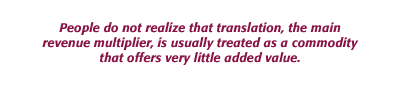
Translation should not be considered only as an expense, but rather as an essential part of development. It should receive as much funding as any other essential activity. A poor translation causes as much trouble as poor writing. And poor writing is like delivering a program made at lower costs, but full of bugs. It is a guaranteed path to bankruptcy. Customers do not buy services that are under a certain level of quality. The translation delivered in high tech industries very often is just on that tiny line. However, trying to reduce translation costs is normal when it is done in the same manner as trying to reduce other costs. Would you change your programmers for a matter of 2% in their salaries? Well, lots of companies do just that with their translation providers, without having the faintest idea as to whether the lowest bidder can actually deliver reasonable-quality translation at a fair price.
Reprinted
by permission from the Globalization Insider,
25 February 2003, Volume XII, Issue 1.4. Copyright the Localization Industry Standards Association (Globalization Insider: www.localization.org, LISA: www.lisa.org) and S.M.P. Marketing Sarl (SMP) 2004
E-mail this article to your colleague! Need more translation jobs? Click here! Translation agencies are welcome to register here - Free! Freelance translators are welcome to register here - Free! |
|
|
|
|
|
|
| |||
Legal Disclaimer Site Map |


