|
 |
 |
 |
|
|
Home | More Articles | Join as a Member! | Post Your Job - Free! | All Translation Agencies | |
|
|||||||
|
|
|
|
Kashubian language
Kashubian or Cassubian (Kashubian: kaszëbsczi jãzëk, pòmòrsczi jãzëk, kaszëbskò-słowińskô mòwa; Polish: język kaszubski, język pomorski, język kaszubsko-słowiński) is one of the Lechitic languages, a subgroup of the Slavic languages.
Assumed originsKashubian is assumed to have evolved from the language spoken by some tribes of Pomeranians called Kashubians, in the region of Pomerania, on the southern coast of the Baltic Sea between the Vistula and Oder rivers. Related languagesIt is closely related to Slovincian and both are dialects of Pomeranian. Many linguists, in Poland and elsewhere, consider it a divergent dialect of Polish, although now it is usually recognized as the closest existing relative of Polish. Dialectal diversity is so great within Kashubian that a speaker of southern Kashubian has considerable difficulty in understanding a speaker of the northernmost dialects. Like Polish, Kashubian includes about 5% loanwords from German (such as kùńszt ”art”). Unlike Polish, these are mostly from Low German and only occasionally from High German. Other sources of loanwords include the Baltic languages,Russian and Polish. In dialects of Kashubian a schwa occurs.
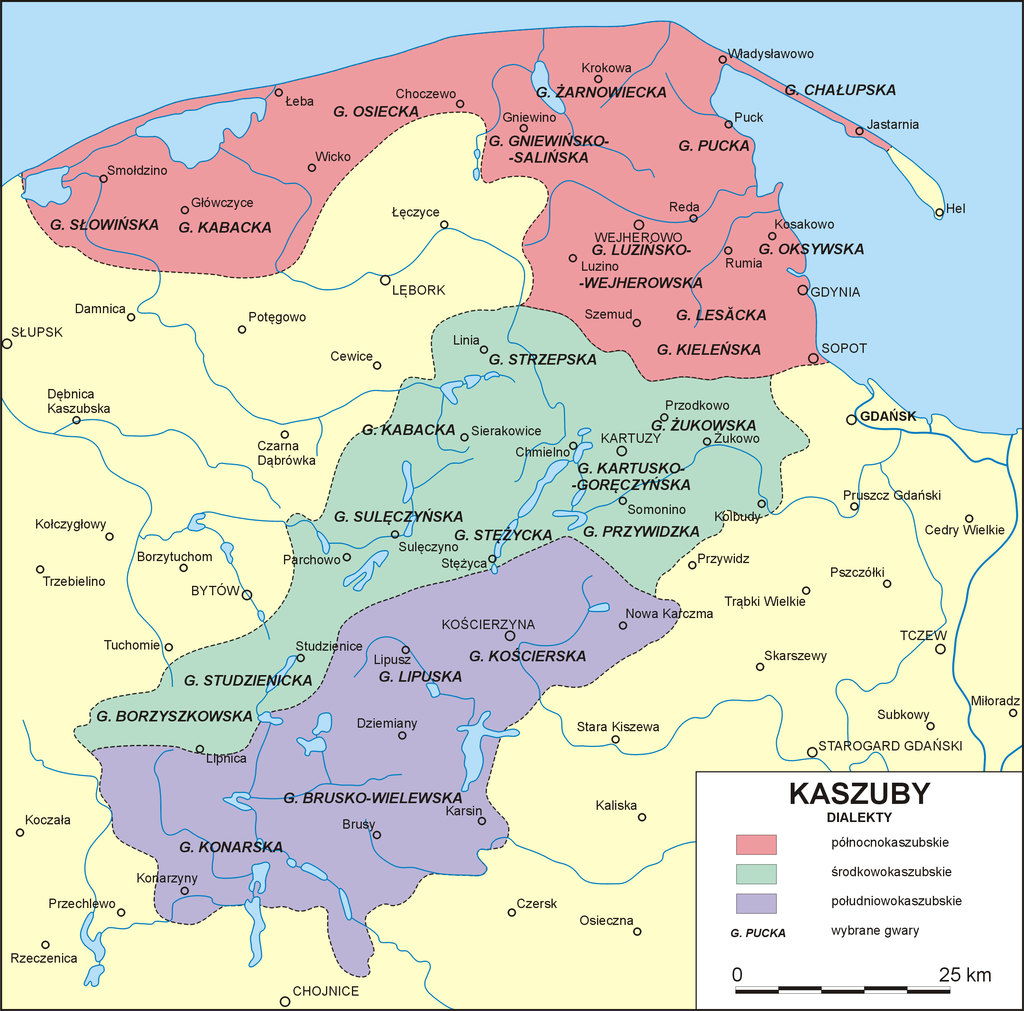
Kashubian dialects area (with ethnonyms groups) The earliest printed documents in Kashubian date from the end of the 16th century. The modern orthography was first proposed in 1879. It is closely related to Slovincian, and both are dialects of Pomeranian. The first printed documents in Kashubian date from the end of the 16th century. The modern orthography was first proposed in 1879. Following the collapse of communism in Poland, attitudes on the status of Kashubian have been gradually changing. It is increasingly seen as a fully-fledged language, as it is taught in state schools and has some limited usage on public radio and television. Today’s speakersIn the 2011 census, 106,000 people in Poland declared that they mainly use Kashubian at home. All Kashubian speakers are also fluent in Polish. A number of schools in Poland use Kashubian as a teaching language. It is an official alternative language for local administration purposes in Gmina Sierakowice, Gmina Linia and Gmina Parchowo in Pomeranian Voivodeship. Kashubian literatureImportant for Kashubian literature was Xążeczka dlo Kaszebov by Doctor Florian Ceynowa (1817–1881). Hieronim Derdowski (1852-1902 in Winona, Minnesota) was another significant author who wrote in Kashubian, as was Doctor Aleksander Majkowski (1876–1938) from Kościerzyna, who wrote the Kashubian national epic The Life and Adventures of Remus. Jan Trepczyk was a poet who wrote in Kashubian, as was Stanisław Pestka. Kashubian literature has been translated intoCzech, Polish, English, German, Belarusian, Slovene and Finnish. A considerable body of Christian literature has been translated into Kashubian, including the New Testament, much of it by Fr. Adam Ryszard Sikora (OFM). Rev. Franciszek Grucza graduated from a Catholic seminary in Pelplin. He was the first priest to introduce Catholic liturgy in Kashubian language. EducationFollowing the collapse of Communism in Poland, attitudes on the status of Kashubian have been gradually changing. It has been included in the program of school education in Kashubia although not as a language of teaching nor as a required subject for every child, but as a foreign language taught 3 hours per week at parents’ explicit request. Kashubian has some limited usage on public radio and had on public television. Since 2005 Kashubian has enjoyed legal protection in Poland as an official regional language. It is the only language in Poland with this status, which was granted by the Act of 6 January 2005 on National and Ethnic Minorities and on the Regional Language of the Polish Parliament. The act provides for its use in official contexts in ten communes where Kashubian speakers constitute at least 20 percent of the population. DialectsAs wrote Friedrich Lorentz in the early 20th century there were three Kashubian dialects.
Kashubian dialects area in the early 20th century Gallery
Percentage of people that speak Kashubian at home (2002) Two bilingual signs in Garcz in Kashubia with the Polish name above and the Kashubian name below
Bilingual sign in Polish and Kashubian in Pogorze, Puck County , Poland, on road from Gdynia to Rewa
Page of Stefan Ramult Pomeranian (Kashubian language) Dictionary 1893
Song: "Kaszëbsczé nótë" Published - November 2014
E-mail this article to your colleague! Need more translation jobs? Click here! Translation agencies are welcome to register here - Free! Freelance translators are welcome to register here - Free! |
|
|
|
||||||||||||||||||||||||||||||||||||||||||
|
|
|
| |||
Legal Disclaimer Site Map |
 Poland