|
 |
 |
 |
|
|
Home | More Articles | Join as a Member! | Post Your Job - Free! | All Translation Agencies | |
|
|||||||
|
|
|
|
Friulian language
Friulian or Friulan (furlan (help·info) or affectionately marilenghe in Friulian, friulano in Italian, Furlanisch in German, furlanščina inSlovene; also Friulian), is a Romance language belonging to the Rhaeto-Romance family, spoken in the Friuli region of northeasternItaly. Friulian has around 300,000 speakers, the vast majority of whom also speak Italian. It is sometimes called Eastern Ladin, since it shares the same roots as Ladin, although over the centuries it has diverged under the influence of surrounding languages, including German, Italian, Venetian, and Slovene. Documents in Friulian are attested from the 11th century, and poetry and literature dating as far back as 1300. By the 20th century, there was a revival of interest in the language, which has continued to this day.
History
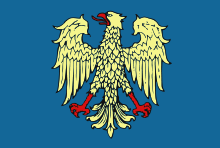
Historical flag of Friûl A question which causes many debates is the influence of the Latin spoken in Aquileia and surrounding areas. Some claim that it had peculiar features that later passed into Friulian. Epigraphs and inscriptions from that period show some variants if compared to the standard Latin language, but most of these are common to other areas of the Roman Empire; often it is cited that Fortunatianus, bishop of Aquileia from 342 till circa 357, wrote a commentary to the Gospel in sermo rusticus, that is, in the language spoken by the people, which therefore should have been quite different from Standard Latin. We[who?] don’t know the language of the text, but it shows a shift between languages that didn’t exist for example in other important communities of Northern Italy. The language spoken before the arrival of the Romans in 181 BC was of Celtic origin, since the inhabitants belonged to the Carni, a Celtic population. In modern Friulian the words of Celtic origins are few, while much influence of the original population is shown in toponyms (names of villages which end in -acco, -icco are an example). Even influences from Longobardic language—Friuli was one of their strongholds—are very few. From this evidence, scholars today agree that the formation of Friulian dates back to around 1000, at the same time as other dialects derived from Latin (see Vulgar Latin). The first written records of Friulian have been found in administrative acts of the 13th century, but these documents became more frequent in the following century, when literary works also emerged (Frammenti letterari for example). The main center at that time was Cividale. The Friulian language has never acquired official status: legal statutes were first written in Latin, then in Venetian, and finally in Italian. The “Ladin Question”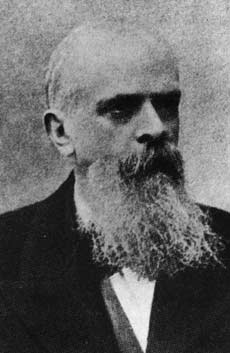 Historical linguistGraziadio Isaia Ascolipresented the theory that Ladin, Romansh and Friulian are from the same family The idea of unity among Ladin, Romansh and Friulian comes from the Italian historical linguist Graziadio Isaia Ascoli, who was born in Gorizia. In 1871 he presented his theory that these three languages are part of one family, which in the past stretched from Switzerland to Muggia and perhaps also Istria. These three languages are the only survivors of this family, and they all developed differently – in particular, Friulian was much less influenced by German. The scholar Francescato claimed subsequently that until the 14th century the Venetian language shared many phonetic features with Friulian and Ladin; therefore he thought that Friulian was a much more conservative language. Many features that Ascoli thought were peculiar to the Rhaeto-Romance languages can in fact be found in other languages of northern Italy. Area of diffusionItaly
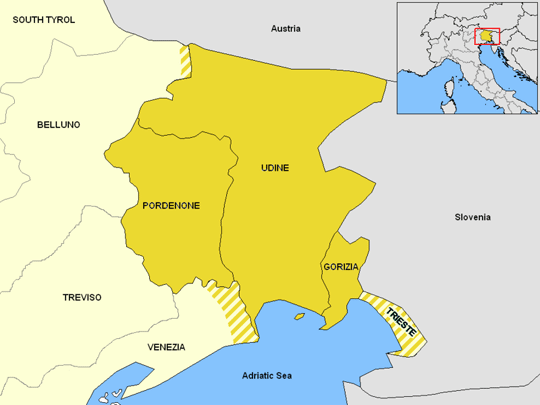
Spread of the Friulian language in Italy Today, Friulian is spoken in the province of Udine including the area of the Carnia Alps, but widely throughout the province of Pordenone, in half of the province of Gorizia, and in the eastern part of the province of Venice. In the past, the language borders were wider since also in Trieste and Muggiaparticular variants of Friulian were spoken—the main document about the dialect of Trieste, or tergestino, is “Dialoghi piacevoli in dialetto vernacolo triestino”, published by G. Mainati in 1828. WorldFriuli was until the 1960s an area of deep poverty, causing a large number of Friulian speakers to emigrate. Most went to France, Belgium, and Switzerland or outside Europe, to Canada, Mexico, Australia, Argentina, Brazil, Venezuela, the United States, and South Africa. In these countries, there are associations of Friulian immigrants (called Fogolâr furlan), who try to protect their traditions and language. LiteratureThe first texts in Friulian date back to the 13th century and are mainly commercial or juridical acts. We can see in these examples that Friulian was used together with Latin, which was still the administrative language. The prime examples of literature that have survived—much from this period has been lost—are poems from the 14th century, which are mainly dedicated to the theme of love and were probably inspired by the Italian poetic movement Dolce Stil Novo. The most notable work is Piruç myò doç inculurit (which means “My sweet, coloured pear”), composed by an anonymous author from Cividale del Friuli, probably in 1380.
There are few differences in the first two rows, which demonstrates that there has not been a great evolution in the language except for several words which are no longer used (for example, dum(n) lo, a word which means “child”, which was used frequently in the past). A modern Friulian speaker can understand these texts with only a little difficulty. The second important period for Friulian literature is the 16th century. The main author of this period was Ermes di Colorêt, who composed over 200 poems.
PhonologyLong vowels are typical of the Friulian language and this has a great influence also on Friulian pronunciation of Italian. Friulian distinguishes between short and long vowels, e.g. in the following minimal pairs (long vowels are marked in the official orthography with a circumflex accent):
The Friulian dialects differ in their treatment of long vowels. In certain dialects, some of the long vowels are actually diphthongs. The following chart shows how four words (sêtthirst, pît foot, pôc (a) little, fûc fire) are pronounced in four dialects. Each dialect uses a unique pattern of diphthongs (yellow) and monophthongs (blue) for the long vowels:
The double consonants (ll, rr, and so on), used frequently in Italian, are nearly absent in Friulian. GrammarMorphologyNounsIn Friulian as in other Romance languages, nouns are either masculine or feminine (for example “il mûr” (“the wall”, masculine), “la cjadree” (“the chair”, feminine). FeminineMost feminine nouns end in -e, which is pronounced. Examples:
Some feminine nouns, however, end in a consonant, including those ending in -zion (from Latin).
MasculineMost masculine nouns end either in a consonant or in -i.
A few masculine nouns end in -e, including sisteme (system) and probleme (problem). These are usually words coming from ancient Greek. However, because most masculine nouns end in a consonant, it is not uncommon to find the forms sistem and problem instead—though this is more likely to occur in print than in speech. There are also a number of masculine nouns which have been borrowed intact from Italian, that is, with a final -o, like treno (train). Many of these words have been fully absorbed into the language, even forming their plurals with the regular Friulian -s rather than the Italian -i. Still, there are some purists, including those influential in Friulian publishing, who frown on such words, insisting that the “proper” Friulian terms should be without the final -o. So despite the fact that one almost always hear treno, chances are that if you see the word in print it will be seen as tren. ArticlesThe Friulian definite article (which corresponds to “the” in English) is derived from the Latin ille and takes the following forms:
Before a vowel, both il and la can be abbreviated to l’.[example needed]. These are the standard forms. In the spoken language, various articles are used. The indefinite article in Friulian (which corresponds to “a” in English) derives from the Latin unus and varies according to gender:
An invariable partitive article also exists: des: des vacjis - some cows. AdjectivesA Friulian adjective must agree in gender and number with the noun it qualifies. Most adjectives have four forms for singular (masculine and feminine) and plural (masculine and feminine), for example brut (ugly):
Note that, in some part of Friuli, the feminine is pronounced with no-standard substituted vowels, i.e. like the plurals brutes, brutas, or the singulars bruta or bruto. To form the plural, normal rules are followed; given a masculine singular form, the corresponding feminine form is not so straightforward:
Rules for the formation of pluralsTo form the plural of nouns ending in -e, whether feminine or masculine, change the final -e to -is.
To form the plural of almost all other nouns, simply add a final s. Note: this final /s/ is always pronounced as voiceless [s], as in English cats, never as voiced [z] as in dogs.
In some Friulian dialects there are many words whose final consonant becomes silent when the +s is added. These words include just about all those whose singular form ends in -t. The plural of gjat, for example, is written as gjats, but is pronounced in much of Friuli as though it were gjas, and that of plat ’dish’, though written as plats, is often pronounced as plas. Other words in this category include clâf (key) and clap (stone), whose plural forms, clâfs and claps, are often pronounced with no f or p, respectively (clâs, clas), so that the longer a in the former is all that distinguishes it from the latter. Note also that a final -ç, which is pronounced either as the English ”-ch” (in central Friulian) or as “-s”, is pluralized in writing as -çs, regardless of whether the pluralized pronunciation is “-s” or “-ts” (it varies according to dialect); an example is messaç / messaçs (message). ExceptionsMasculine nouns ending in -l or -li form their plurals by dropping the -l or -li and adding -i.
Feminine nouns ending in -l are pluralized regularly.
Some masculine nouns which end in -t are pluralized by changing the final -t to -cj.
Nouns ending in s do not change spelling when pluralized (even though some speakers may pronounce the plural -s differently from the singular -s).
The plural of an (year) has several forms depending on dialect, including ain, ains, agn and agns. Regardless of pronunciation, the written form is agns. Clitic subject pronounsA feature of Friulian are the clitic subject pronouns. These, known in Friulian as pleonastics, are never stressed; they are used together with the verbs to express the subject, and can be found before the verb in declarative sentences or immediately after it in case of interrogative or vocative (otative) sentences.
An example: jo o lavori means “I work”; jo lavorio? means “Do I work?”, while lavorassio means “I wish I worked”. Verbs
AdverbsAn adjective can be made into an adverb by adding -mentri to the ending of the feminine singular form of the adjective (lente becomes lentementri, slowly), though it can sometimes lose the -e of the adjective (facile becomes facilmentri, easily). These type of formation is more common in written language; in spoken language people use frequently other forms or locutions (i.e. a planc for slowly). VocabularyMost of the FriulIan vocabulary is derived from Latin. Needless to say, there have been substantial phonological and morphological changes throughout its history. Therefore many words are shared with Romance languages, but other languages have contributed too:
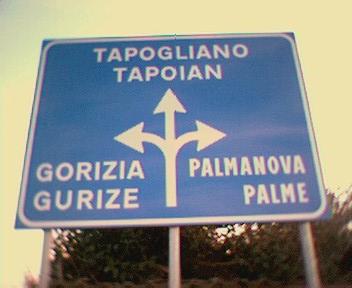
Present conditionNowadays, Friulian is officially recognized in Italy, supported by law 482/1999, which protects linguistic minorities. Therefore, teaching of Friulian has been introduced in many primary schools. An online newspaper is active, and there are also a number of musical groups which use Friulian for their songs as well as some theatrical companies. Recently two movies have been made in Friulian (Tierç lion, Lidrîs cuadrade di trê), with positive reviews in Italian newspapers. In about 40% of the communities in the Province of Udine, road signs are in both Friulian and Italian. There is also an official translation of the Bible. In 2005, a notable brand of beer used Friulian for one of its commercials. The main association to foster the use and development of Friulian is the Societât filologjiche furlane, founded in Gorizia in 1919. Toponyms
Road sign in Italian and Friulian
Every city and village in Friuli has two names, one in Italian and one in Friulian. Only the Italian is official and used in administration, although it is widely expected that the Friulian ones will receive partial acknowledgement in the near future. For example, the city of Udineis called Udin in Friulian, the town of Tolmezzo is called Tumieç, the town of Aviano is called Avian. Challenges of standardisationA challenge that Friulian shares with other minorities is to create a standard language and a unique writing system. The regional law 15/1996 approved a standard orthography, which represents the basis of a common variant and should be used in toponyms, official acts, written documents. These standard is based on Central Friulian, which was traditionally the language used in literature already in 1700 and afterwards (the biggest examples are probably Pieri Çorut’s works), but with some changes:
Standard Friulian is called in Friulian furlan standard, furlan normalizât, or, using a Greek word coinè. Criticism against standard FriulianThere have been several critics of the standardization of Friulian, mainly from speakers of local variants which can differ substantially from the proposed standard; they also argue that the standard could eventually kill local variants. The supporters of standardization refer to the various advantages that a unique form can bring to the language: above all, it can help to stop the influence of Italian language in the neologisms, which pose a serious threat to Friulian’s future development. They also point out that it is a written standard without affecting pronunciation, which can follow local variants. Opponents of the standardization, on the other hand, insist that the standard language, being artificially created, is totally inadequate to represent the local variations, particularly due to differences in the phonetic pronunciation of the words in each variant, which may, in some cases, even require special and different diacritics for writing a single variant. Variants of FriulianFour dialects of Friulian can be at least distinguished, all mutually intelligible. They are usually distinguished by the last vowel of many parts of speech (including nouns, adjectives, adverbs), following this scheme:
For example, the word home becomes cjase in Central Friulian, and cjasa or cjaso in other areas. Pier Paolo Pasolini wrote his works in Western Friulian, since he learned the language from his mother who was from Casarsa/Cjasarsa, near Pordenone. In the 13th century, early literary works in Friulian were based on the language spoken in Cividale del Friuli, which was at that time the most important town in Friuli. These works show endings in -o, which, interestingly, nowadays is restricted to some villages in Carnia. Later, the main city of Friuli became Udine and the most common ending was -a; only from the 16th century on, -e endings were used in standard Friulian. Writing systems
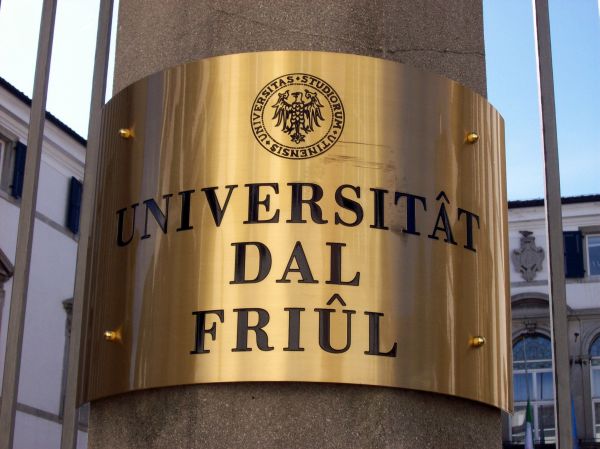
Sign of the Universitât dâl Friûl in Udine In the official writing system, approved by the Province of Udine and used in official documents, Friulian is written using the Latin script, plus the c-cedilla (ç). The letter q is used only for personal names and historical toponyms, and in every other case is replaced by c. Besides that, k, x, w, and y appear only in loan words, so they are not considered part of the alphabet.Sign of the Universitât dâl Friûl in Udine
There are also grave accents (à, è, ì, ò and ù) and circumflex accents (â, ê, î, ô, and û), which are put above the vowels to distinguish between homophonic words or to show where there is stress (the former) and show long vowels (the latter). Other systemsAn alternative system is called Faggin-Nazzi from the names of the scholars who proposed it. It is less common, probably also because it is more difficult for a beginner due to its use of letters such as č that are typical of Slavic languages, but seem foreign to native Italian speakers. Examples
References
Published - August 2014
E-mail this article to your colleague! Need more translation jobs? Click here! Translation agencies are welcome to register here - Free! Freelance translators are welcome to register here - Free! |
|
|
|
|||||||||||||||||||||||||||||||||||||||||||||||||||||||||||||||||||||||||||||||||||||||||||||||||||||||||||||||||||||||||||||||||||||||||||||||||||||||||||||||||||||||||
|
|
|
| |||
Legal Disclaimer Site Map |