Numismatic glossary
By
Wikipedia,
the free encyclopedia,
http://en.wikipedia.org/wiki/Numismatic_terminology
Become a member of TranslationDirectory.com at just
$12 per month (paid per year)
Advertisements:
Use the search bar to look for terms in all glossaries, dictionaries, articles and other resources simultaneously
This article is a collection of concise Numismatic
and coin collecting terms for the beginner or professional.
Numismatics (ancient Greek: νομισματική)
is the scientific study of money and its history in
all its varied forms. While numismatists are often
characterized as studying coins, the discipline also
includes the study of banknotes, stock certificates,
medals, medallions, and tokens (also referred to as
Exonumia).
Sub-fields or related fields of numismatics are:
Exonumia - is the study of coin-like
objects such as token coins and medals, and other
items used in place of legal currency or for commemoration.
Notaphily - is the study of paper
money or banknotes.
Scripophily - is the study and
collection of stocks and bonds.
A [ top ]
Adjustment
The filing down of a blank to the correct weight before striking, shown by file marks.
Alliance coinage Coins minted by two or more state governments in conjunction.
Alloy
Homogeneous mixture of two or more elements, where the resulting compound has metallic properties.
Altered Date False date put on a coin to defraud collectors, usually to make it appear more valuable. Usually easily spotted with the aid of a magnifying glass.
Anepigraphic coin
Coin without an inscription.
Annealing Process of heating and cooling metal in order to relieve stresses.
Assay
Test to ascertain the weight and purity of a coin.
Attribution Identifier of a coin such as date, mint, or denomination.
B [ top ]
Bag Mark
Surface mark, or nick, on a coin usually from contact with other coins in a mint bag. More often seen on large gold or silver coins.
Banker's Mark A small countermark applied to a coin by a bank or a trader indicating that they consider the coin to be genuine and of legal weight. Most often found on ancient and medieval coins, but most commonly on silver coins which circulated in China, where they are referred to as chop-marks.
Base metal Non-precious metal or alloy containing no gold or silver.
Beading Raised dot border along the rim of a coin.
Billon
Low-grade alloy of gold or silver with a high percentage of another metal, usually copper.
Bi-metallic A coin with one type of metal in the center with an outer ring of a different metal, such as the Canadian "toonie" two-dollar coin.
Blank
Prepared disk of metal on which the coin design will be stamped. Also called a 'planchet'. In practice, 'Blank' is also referred to un-struck side of the coin.
Brass
Copper based alloy with zinc.
Brockage
Originally metal wasted in coin production, now coins struck when the previous coin remained stuck to a die, creating an incuse impression in the next struck coin (primarily found in ancient coins).
Bronze
Copper based alloy with tin.
Bullion
Precious metals (platinum, gold and silver) in the form of bars, ingots or plate, or where quantity is considered as a valuation.
Business Strike
A coin intended for everyday use in commerce.
C [ top ]
Carat
Unit measurement of the weight of precious stones. Usually marked 'c' or 'car'. 1 carat = 200 milligrams. Not to be confused with 'Karat' used with gold.
Cast Coins Coins produced by pouring metal into a mold. Used for the first Ancient Roman bronze "As" coins and Chinese "cash" coins, but rarely used today.
Centum One one-hundredth of the basic monetary unit from Latin, English cent, Romance languages centavos, centimos, centesimos or centimes usually one hundredth of a base unit like dollar, euro, peso etc.
Certified Coin Coin that has been graded and authenticated by one of numerous independent grading services.
Circulated Term used to indicate a coin that has wear.
Clad Coinage Issues of coins that contain a center core and outer layer of differing alloys.
Collar Outer ring of the die chamber that holds the blank in place while the obverse and reverse are being stamped.
Contact Marks Minor abrasions on uncirculated coinage from contact with other coins.
Countermark or Counterstamp Partial or complete over-stamping of a coin or token in order to change its value or issuing authority, or to display an advertisement, political slogan or symbol, etc. Stamping may consist of a number (value), symbol (authority), letters (advertisement or slogan), or any combination of the above.
Crown Large coin often struck in precious metal. Modern crowns are usually not highly-circulated. The United States's last crown-sized coin for circulation was the Eisenhower Dollar, last struck in 1978.
D [ top ]
Debase
To lower the silver/gold value of the coin by altering its purity, but with the same market value as the pure coin.
Denticles
Small toothlike projecting points on the inside edge of coins.
Designer
Artist or creator of a coin's design.
Device
Pattern or emblem used in the design of a coin.
Die
Metal piece engraved with the design used for stamping the coin.
Die Clash Caused when a blank coin planchet fails to be placed between two dies during the minting process, causing the empty dies to smash together. The design of one or both may impress into the opposite die, causing a "shadow" of the design to appear on subsequent coins minted with the damaged dies. The impact of the two dies may also result in die cracks or defects.
Die Crack Fine raised line on a coin that was caused by a crack in the die.
Die Defect Imperfection of various sorts caused by a damaged die. May refer to a crack or clash or a chip out of the die, etc.
Die Variety Minor alteration in the basic design of a coin throughout its lifespan.
Dipped, Dipping Chemical cleaning of a coin with a diluted acid. Common in the 1960s and '70's but it was discovered that dipping destroys the surface of the coin, thus dramatically reducing the coin's value.
Double Eagle (U.S.A) United States gold $20 coin.
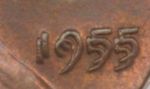 Double
strike coin where a die struck, bounced,
then struck again, offset from first strike (used for
ancient coins where hubs were not used). Double
strike coin where a die struck, bounced,
then struck again, offset from first strike (used for
ancient coins where hubs were not used).
Double Die Die that received two misaligned impressions from a hub; more commonly, a coin struck by such a die.
Doubloon Popular name of a Spanish gold coin originally valued at 4 dollars.
Dump (Australia)
Centre of the holey dollar with a value of fifteen pence.
E [ top ]
Eagle (U.S.A)
United States $10.00 gold coin as well as all bullion pieces made from 1986 through the present.
Edge
Rim of a coin often containing a series of reeds, lettering or other decoration.
Ecu
Large French silver coin made during the end of the monarchy. Also proposed European currency unit.
Effigy
The image or likeness of a person, usually on the obverse of a coin or medal.
Electrotype
Reproduction made by electrodeposition frequently used in museum displays.
Electrum
Naturally or artificially occurring mixture of gold and silver used in some of the world's first coinage.
Elongated coin An oval medalet produced by a roller die using a coin, token or medal as a planchet, usually a cent.
Encapsulated Coins Authenticated, graded and preserved in plastic by an independent service.
Engraver
Person who cuts the image of a design onto a die.
Error Usually a mis-made coin not intended for circulation, but can also refer to an engraving or die-cutting error not discovered until the coins are released to circulation. The mis-made coin errors are usually unique, but the engraving errors appear on all of the coins produced until the error is corrected.
Essai, Essay A trial strike, also in currency a strike intended to test the design.
Exergue A segment of the coin design separated by a line (usually indicating the ground in the design) in which a legend is placed/inscribed.
F [ top ]
Fantasy
Generally a representation of a rare or never issued coin.
Field
Background area of a coin not used for a design or inscription.
Filler
Coin that is very worn but rare enough for inclusion in a collection.
Fineness
Purity of precious metal content expressed in terms of one thousand parts. 90% is expressed as .900 fine.
Flan
Blank metal piece before striking, also called a planchet or blank.
Fleur de coin (FDC) Coin of exceptionally high quality, where quality is determined not just by wear of the coin in circulation but also by the wear and artistic quality of the dies from which it was minted. These factors are crucial for ancient coinage where variability was higher than in modern mints.
G [ top ]
Gem
Coin of exceptionally high condition.
Grade
The condition of a coin or amount of wear that a coin has received. Common grade terms, from worst to best, are About Good (AG), Good (G), Very Good (VG), Fine (F), Very Fine (VF), Extra/Extremely Fine (EF), Almost Uncirculated (AU), Uncirculated (UNC), and Brilliant Uncirculated (BU).
H [ top ]
Hub
Positive-image punch that impress' the coins design onto a die.
Holey dollar (Australia)
Spanish dollar with a hole in centre, stamped with New South Wales 1813 on obverse and five shilling on reverse.
I [ top ]
Incuse
Part of the coins design that has been impressed below the surface (intaglio).
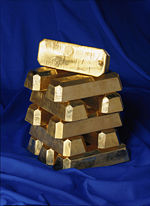 Ingot Mass of pure metal from
a mould with a certain value and purity.
Ingot Mass of pure metal from
a mould with a certain value and purity.
Inscription
Lettering and wording on a coin.
Intrinsic Value Current market value of the raw precious metal content of a coin.
K [ top ]
Karat
Unit measurement of the purity of gold. Usually marked 'K', or 'k'. 24K = pure gold, 18K = .750 fine. Not to be confused with 'Carat' used with precious stones. Note that both originally referred to the seed of the carob tree ('Ceratonia siliqua' or 'Siliqua Graeca'). A Roman coin called the solidus weighed 24 'carats' or 'siliquae', 1/6th of a scruple; this became the standard in purity in western Europe.
Key Coin Rarest or highest valued coin within a series.
L [ top ]
Laureate
Head crowned with a laurel wreath.
Legal Tender Coins or currency which must be accepted in payment of debt.
Legend Principle inscription on a coin.
Lettered Edge
The outside edge of a coin containing an inscription.
Low Relief A coin with the raised design not very high above the field.
Luster Appearance of a coin's ability to reflect light; brilliance.
M [ top ]
Master die
Original die from which working dies are made.
Medal-coin; See also NCLT.
Milled Edge Raised rim around the outer surface of
a coin.
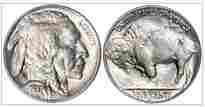 Mint
Error Defective coin produced by a
mint. Mint
Error Defective coin produced by a
mint.
Mint Luster Shiny "frost" on the surface of an uncirculated or mint coin.
Mint Mark Small letter (or other symbol) indicating which mint the coin was struck at.
Mint Roll Uncirculated coins set wrapped by issuing authority of a certain quantity.
Mint Set Set of uncirculated coins packaged and sold by the mint.
Mis-strike Off centre striking of a coin.
Monster Box Large plastic shipping boxes for silver bullion coins, holding 500 coins. US Silver Eagles are shipped in green monster boxes while Maple Leafs are shipped in red monster boxes.
Motto Inspirational phrase or wording. Examples include "In God we Trust" on US coins or "Liberte, Egalite, Fraternite" on French coins.
Mule Coin struck from two dies not intended to be used together.
N [ top ]
NCLT
Non circulating legal tender. 1 commemorative coins, 2 old coins, 3 rare coins, 4 restricted coins.
O [ top ]
Obverse
Front or face side of coin.
Overdate
Shown date made by superimposing numbers on a previously dated die.
Over Graded Coin in worse condition than stated.
Overstrike
Impression with new dies on a previously struck coin.
P [ top ]
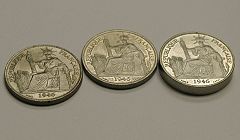 Pattern The term "pattern"
is used in numismatic world, to describe any coin minted
from official dies that is not a regular emission, and
intended to check or try out new metals, way of design
or plan of coinage. Patterns can be divided in three
categories:
Pattern The term "pattern"
is used in numismatic world, to describe any coin minted
from official dies that is not a regular emission, and
intended to check or try out new metals, way of design
or plan of coinage. Patterns can be divided in three
categories:
Pattern: A coin which represents a new design, motto, or denomination, proposed but not adopted, at least for the same year. Most of the unadopted designs fit into this modality.
Die Trials: Coins made with the regular issue dies, in metals other than the proper. Usually minted to verify details of a new coin, value or design.
Experimental Pieces: Very similar process to "Die Trials", but with subtle differences. A coin minted with a die, official or not, to try a new metal, alloy, or shape.
Patina
Surface film caused by oxidation, usually green or brown, mostly found on older silver, copper or bronze coins.
Pedigree
Record of previous owners of a rare coin.
Piefort
A piece struck on a planchet twice or more the normal thickness. The French spelling used in Europe is piedfort.
Planchet
Blank prepared piece of metal on which the coin is struck.
Privy
Small mark, often hidden, on a coin, traditionally to indicate the mintmaster or moneyer.
Proclamation Coins Coins declared legal tender even though they are not issued by the sovereign, but by another sovereign.
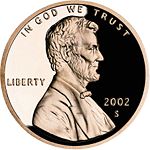 Proof Coins specially struck
for collectors using polished dies and planchets.
Proof Coins specially struck
for collectors using polished dies and planchets.
Proof Set Set of proof coins packaged and sold by the mint.
Punch Mark Coin struck from 'punching' the coin with symbols or seal. Ex: Five Punch Marked coins of ancient India. Punch Marks generally represent animals, tree, hills, and human figures. These coins were issued by royal authority and generally marked with banker's punches on the reverse.
Q [ top ]
Quarter (U.S.A./Canada)
United States or Canada $0.25 coin. Short for Quarter Dollar.
Quarter Eagle (U.S.A) United States $2.50 coin.
R [ top ]
Raw
Coin that has not been encapsulated by any coin grading service.
Reeded Edge Edge of a coin with grooved lines around the perimeter. Also known as a milled edge.
Relief Part of the coin's design that is raised above the field.
Re-strike Coin struck from genuine dies at a date later than the original issue.
Reverse Back side of the coin. Opposite of 'Obverse'.
Rim Raised portion of the design along the edge that protects the coin from wear.
Round Round one ounce silver bullion piece.
S [ top ]
Series
Set of years coin was minted with a specific design and denomination.
Scruple
One Roman scruple = 1/24 Roman uncia; the modern (nominal) estimate of the weight of the Roman scruple is 1.125 g.
Slab
Plastic case containing a coin that has been graded and encapsulated.
Spanish dollar
Coin issued in Spain and its colonies from 1497 to 1864. Equal to 8 Reals. Also known as a 'Piece of Eight'.
Spot Price
Quoted market value of precious metals in bullion form.
Stainless Steel A combination of iron, carbon and another element, usually nickel, to prevent rusting.
T [ top ]
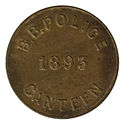 Token Privately-issued piece
that has redeemable value for goods or services, but
not an official government coin.
Token Privately-issued piece
that has redeemable value for goods or services, but
not an official government coin.
Trade Dollar Silver dollar issued specifically for trade with a foreign country.
Truncation Sharply cut off bottom edge of a portrait or bust.
Type Coin's basic distinguishing design.
Type Set One of each coin of a particular design, series or period.
U [ top ]
Uncirculated
Coin that has never been used, thus retaining its original luster.
Uniface
A coin struck with the design on one side only.
Union
A proposed United States gold coin worth one hundred dollars. Only one pattern 'half union' is known to exist. Platinum $100 coins are not technically 'unions'.
Unique
Item of which only one is known to exist.
Upset
A coin struck which the obverse and reverse are at different angles to each other.
V [ top ]
Variety
Coin's design that sets it apart from the normal issue.
Y [ top ]
Year Set
Set of coins for any specific year containing one of each denomination of that year.
This
glossary is available under the terms
of the GNU Free Documentation
Find free glossaries at TranslationDirectory.com
Find free dictionaries at TranslationDirectory.com
Subscribe to free TranslationDirectory.com newsletter
Need more translation jobs from translation agencies? Click here!
Translation agencies are welcome to register here - Free!
Freelance translators are welcome to register here - Free!
Submit your glossary or dictionary for publishing at TranslationDirectory.com
|