|
 |
 |
 |
|
|
Home | More Articles | Join as a Member! | Post Your Job - Free! | All Translation Agencies | |
|
|||||||
|
|
|
|
Formant
A formant is a peak in the frequency spectrum of a sound caused by acoustic resonance.[1] In phonetics, the word refers to sounds produced by the vocal tract. In acoustics, it refers to resonance in sound sources, notably musical instruments, as well as that of sound chambers. However, it is equally valid to talk about the formant frequencies of the air in a room, as exploited, for example, by Alvin Lucier in his piece I Am Sitting in a Room.
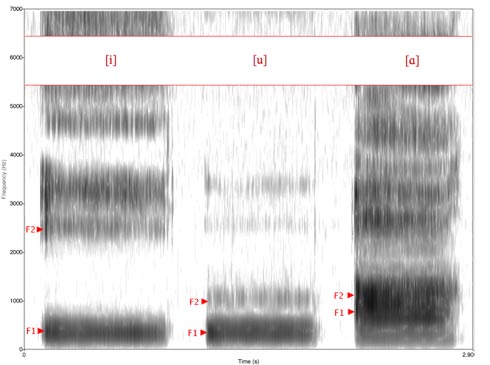
Formants and phoneticsFormants are the distinguishing or meaningful frequency components of human speech and of singing. By definition, the information that humans require to distinguish between vowels can be represented purely quantitatively by the frequency content of the vowel sounds. Formants are the characteristic partials that identify vowels to the listener. Most of these formants are produced by tube and chamber resonance, but a few whistle tones derive from periodic collapse of Venturi effect low-pressure zones. The formant with the lowest frequency is called f1, the second f2, and the third f3. Most often the two first formants, f1 and f2, are enough to disambiguate the vowel. These two formants determine the quality of vowels in terms of the open/close and front/back dimensions (which have traditionally, though not entirely accurately, been associated with the position of the tongue). Thus the first formant f1 has a higher frequency for an open vowel (such as [a]) and a lower frequency for a close vowel (such as [i] or [u]); and the second formant f2 has a higher frequency for a front vowel (such as [i]) and a lower frequency for a back vowel (such as [u]).[2][3] Vowels will almost always have four or more distinguishable formants; sometimes there are more than six. However, the first two formants are most important in determining vowel quality, and this is often displayed in terms of a plot of the first formant against the second formant,[4] though this is not sufficient to capture some aspects of vowel quality, such as rounding.[5] Nasals usually have an additional formant around 2500 Hz. The liquid [l] usually has an extra formant at 1500 Hz, while the English "r" sound ([ɹ]) is distinguished by virtue of a very low third formant (well below 2000 Hz). Plosives (and, to some degree, fricatives) modify the placement of formants in the surrounding vowels. Bilabial sounds (such as 'b' and 'p' as in "ball" or "sap") cause a lowering of the formants; velar sounds ('k' and 'g' in English) almost always show f2 and f3 coming together in a 'velar pinch' before the velar and separating from the same 'pinch' as the velar is released; alveolar sounds (English 't' and 'd') cause less systematic changes in neighboring vowel formants, depending partially on exactly which vowel is present. The time-course of these changes in vowel formant frequencies are referred to as 'formant transitions'. If the fundamental frequency of the underlying vibration is higher than the formant frequency of the system, then the character of the sound imparted by the formant frequencies will be mostly lost. This is most apparent in the example of soprano opera singers, who sing high enough that their vowels become very hard to distinguish. Control of formants is an essential component of the vocal technique known as overtone singing, in which the performer sings a low fundamental tone, and creates sharp resonances to select upper harmonics, giving the impression of several tones being sung at once. Spectrograms
are used to visualise formants.
Singers' formantStudies of the frequency spectrum of trained singers, especially male singers, indicate a clear formant around 3000 Hz (between 2800 and 3400) that is absent in speech or in the spectra of untrained singers. It is increase in energy at 3000Hz which allows singers to be heard and understood over an orchestra, which peak at much lower frequencies of around 500 Hz. This formant is actively developed through vocal training, for instance through so-called "voce di strega" or witch's voice[6] exercises and is caused by a part of the vocal tract acting as a resonator.[7][8] See alsoReferences
External links
Published - December 2008 Information from Wikipedia
is available under the terms of the GNU Free Documentation
License
E-mail this article to your colleague! Need more translation jobs? Click here! Translation agencies are welcome to register here - Free! Freelance translators are welcome to register here - Free! |
|
|
|
|
|
|
| |||
Legal Disclaimer Site Map |