|
 |
 |
 |
|
|
Home | More Articles | Join as a Member! | Post Your Job - Free! | All Translation Agencies | |
|
|||||||
|
|
|
|
Translation Project Case Study: Interpro Translation Solutions & Zebra Technologies Corporation
Producing reference materials, safety guides and user manuals in a timely manner in order to satisfy client demands – as well as comply with legislative requirements – caused Zebra to rethink how it was producing their multilingual documentation. The company’s global requirements presented them with the task of translating its user documentation into multiple languages, and within restricted cycle times. In 2003, Zebra provided translated documentation in thirteen languages using the services of independent translators. Translations were executed without the use of translation memory software, meaning there was no central repository of terminology or previously-translated segments available to the translators. Therefore, there was also no concept of fuzzy matches, repetitions, or 100% match text that all Trados users are quite familiar with. Not using translation memory software presented Zebra with several notable issues:
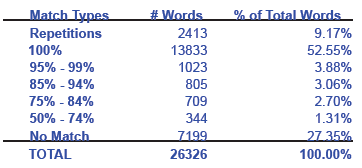
What did this mean in real terms for Zebra? It meant that translated materials were not available until 2 to 4 months after a product was released, and the average per/page price for translation and desktop publishing was approximately $90. When a new Translation Coordinator was hired by Zebra, she reviewed the processes that were in place and found them to be too time-consuming and expensive to maintain, especially as the company was looking to expand its global presence. The first step to managing translations more efficiently was to select a translation provider experienced in translation memory technology and complex multilingual desktop publishing using Adobe FrameMaker, which would decrease the overall costs of translation while ensuring terminological and stylistic consistency. Interpro Translation Solutions was selected as the primary translation vendor based on their expertise and overall value proposition. The second step was to streamline the source content. Without the benefit of a Content Management System, the Technical Publications department revised the source FrameMaker files by making extensive use of conditional text and topical files. In some cases, manuals across product lines shared as much as 75% of content. A dedicated editor ensures consistent phrasing and content reuse across all user documentation, increasing the amount of matches to the translation memory, thus reducing costs and translation times. Interpro provided a dedicated Project Manager and FTP site for Zebra projects, ensuring quick turnaround for quotations, project launches, and final delivery. Translation and post-DTP review are included as part of the translation process, something which was not available when independent translators were used. The use of Trados also means that the desktop publishing process is drastically streamlined. Desktop publishing codes used for the English version of documents are preserved by Trados in the files being translated. These codes are externalized or otherwise “protected”, meaning that they cannot be accidentally modified or deleted during the translation process. Once a document has been translated, edited and proofread, desktop publishing still needs to be done; however the process is much less time-consuming than starting completely from scratch, since the source formatting parameters have been retained in the translated document. In 2007, Interpro began using Trados Context TM technology to process updates of Zebra documentation previously translated by Interpro. Context TM technology distinguishes between in-context and out-of-context 100% sentence matches, and ensures that the 100% matches are within context before they are applied to any given translation project. This feature eliminates days of editing time during final review of large projects and delivers enormous savings in review time and cost. Because 100% in-context matches do not need to be reworked by the translator, there is a significant increase in productivity as they only need to focus on new and/or modified content. And passing the efficiencies of this technology on to Zebra has allowed Interpro to reduce the per page translation costs even further. Since this technology works with all tag-based file types, the update process is simplified for a multitude of file types such as HTML, XML, ASP, PHP, JSP, Java properties, Microsoft Office files, Adobe FrameMaker and InDesign, and QuarkXpress to name just a few. What follows is a real-life example of how Context TM technology made difference in documentation update project executed for Zebra. The project, authorized in June, 2008, was to update the Zebra RZ Series Printer User Guide. The guide had previously been translated in April, 2007, from English into French, German, Italian, Japanese, Korean, Portuguese, Simplified Chinese, Spanish, and Traditional Chinese. Authored in Adobe FrameMaker, the original guide contained 146 pages to be desktop published, with the average word count analysis from Trados showing the following breakdown in % match categories:
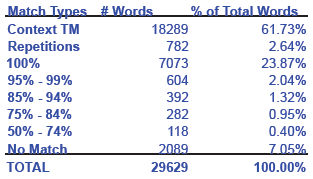
Since the English source files were run against the existing Zebra Trados TMs for each language, we already see significant leveraging (52.55%) in 100% matches due to the translation work done on other Zebra documents. From project launch to delivery, the project took 19 business days. For the June, 2008 version of the guide (still in FrameMaker), we used Context TM technology resulting in the following analysis (numbers are averages across the nine languages):
Almost 62% of the content of the updated user guide requires absolutely no intervention on the part of the translators. An additional 23.87% are 100% matches and 2.64% are Repetitions, leaving a total of on average 3,485 words which are unique through 99% matches. Because of the significant amount of leveraging from previous translation work, the total cost of the update amounted to approximately 55% of the original project cost despite the fact that the source content grew by over 12.5%. Equally important to Zebra, the amount of translation, editing and proofreading time for the update project took anywhere from only 33% to 57% of the time it took to execute the original project, depending on the language(s) translated. Zebra’s Technical Publications department now provides user documentation in as many as 30 languages, available simultaneously at product release. By late 2006, the per page translation and desktop publishing costs were approximately $25 per page, reduced 72% from the $90/page figure from 2003. With the use of Context TM technology, those costs reductions are presumed to be even more impressive, just based on examples such as the project above. In addition to Zebra’s Technical Publications department in Vernon Hills, IL, Interpro provides documentation translation and desktop publishing services to the Zebra facility in Camarillo, CA. Interpro was also selected to provide translation services for Zebra Marketing (Latin America), in addition to having been selected as Zebra’s partner for translating their corporate website into multiple languages. Overall, Zebra has experienced a significant reduction in cost and translation execution times, while increasing the total number of words being translated as well as the number of languages being offered. What is the bottom-line ROI to Zebra based on the solutions-services that Iinterpro has been providing them since 2003: In conclusion, having a partner that Zebra can count on to provide what they need is a critical requirement in today’s fast-paced global economy. Coupling state-of-the-art technology with professional, client-centric talent has allowed Interpro to provide real value-add to Zebra in the way of dramatic cost and cycle time reductions. This has undoubtedly contributed to Zebra’s solutions being used by more than 90 percent of the Fortune 500 and Global 200 companies in 100 countries worldwide. For more information on Zebra Technologies Corporation, please visit their website at www.zebra.com. To learn more about how Interpro Translation Solutions can assist you in overcoming the barriers to doing business in the global marketplace, please visit our website at www.interproinc.com, contact us at +1 630.245.7150 or via e-mail at info@interproinc.com.
Published - November 2008 ClientSide
News Magazine - www.clientsidenews.com
E-mail this article to your colleague! Need more translation jobs? Click here! Translation agencies are welcome to register here - Free! Freelance translators are welcome to register here - Free! |
|
|
|
|
|
|
| |||
Legal Disclaimer Site Map |