|
 |
 |
 |
|
|
Home | More Articles | Join as a Member! | Post Your Job - Free! | All Translation Agencies | |
|
|||||||
|
|
|
|
Generative grammar
In theoretical linguistics, generative grammar refers to a particular approach to the study of syntax. A generative grammar of a language attempts to give a set of rules that will correctly predict which combinations of words will form grammatical sentences. In most approaches to generative grammar, the rules will also predict the morphology of a sentence. Generative grammar originates in the work of Noam Chomsky, beginning in the late 1950s. (Early versions of Chomsky's theory were called transformational grammar.) There are a number of competing versions of generative grammar currently practiced within linguistics. Chomsky's current theory is known as the Minimalist Program. Other prominent theories include or have included Head-driven phrase structure grammar, Lexical functional grammar, Categorial grammar, Relational grammar, and Tree-adjoining grammar. Noam Chomsky has argued that many of the properties of a generative grammar arise from an "innate" Universal grammar, which is common to all languages. Proponents of generative grammar have argued that most grammar is not the result of communicative function and is not simply learned from the environment. In this respect, generative grammar takes a point of view different from functional and behaviourist theories. Most versions of generative grammar characterize sentences as either grammatically correct (also known as well formed) or not. The rules of a generative grammar typically function as an algorithm to predict grammaticality as a discrete (yes-or-no) result. In this respect, it differs from stochastic grammar which considers grammaticality as a probabilistic variable. However, some work in generative grammar (e.g. recent work by Joan Bresnan) uses stochastic versions of Optimality theory.
FrameworksThere are a number of different approaches to generative grammar. Common to all is the effort to come up with a set of rules or principles that will account for the well-formed expressions of a natural language. The term generative grammar has been associated with at least the following schools of linguistics:
Historical development of models of generative grammarGenerative grammar has been under development since the late 1950s, and has undergone many changes in the types of rules and representations that are used to predict grammaticality. In tracing the historical development of ideas within generative grammar, it is useful to refer to various stages in the development of the theory. Standard Theory (1957-1965)The so-called Standard Theory corresponds to the original model of generative grammar laid out in Chomsky (1965). A core aspect of Standard Theory is a distinction between two different representations of a sentence, called Deep Structure and Surface Structure. The two representations are linked to each other by Transformational grammar. Extended Standard Theory (1965-1973)The so-called Extended Standard Theory was formulated in the late 1960s to early 1970s. Features are:
Revised Extended Standard Theory (1973-1980)The so-called Revised Extended Standard Theory was formulated between 1973 and 1980. It contains
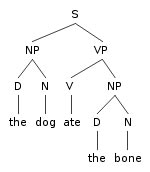
Relational grammar (ca. 1975-1990)An alternative model of syntax based on the idea that notions like Subject, Direct Object, and Indirect Object play a primary role in grammar. Government and Binding/Principles and Parameters theory (1981-1990)Chomsky's Lectures on Government and Binding (1981) and Barriers (1986). Minimalist Program (1990-present)Context-free grammarsGenerative grammars can be described and compared with the aid of the Chomsky hierarchy proposed by Noam Chomsky in the 1950s. This sets out a series of types of formal grammars with increasing expressive power. Among the simplest types are the regular grammars (type 3); Chomsky claims that regular grammars are not adequate as models for human language, because all human languages allow the center-embedding of strings within strings. At a higher level of complexity are the context-free grammars (type 2). The derivation of a sentence by a grammar can be depicted as a derivation tree. Linguists working in generative grammar often view such derivation trees as a primary object of study. According to this view, a sentence is not merely a string of words, but rather a tree with subordinate and superordinate branches connected at nodes. Essentially, the tree model works something like this example, in which S is a sentence, D is a determiner, N a noun, V a verb, NP a noun phrase and VP a verb phrase:
The resulting sentence could be The dog ate the bone.
Such a tree diagram is also called a phrase
marker. They can be represented more conveniently in
text form, (though the result is less easy to read); in
this format the above sentence would be rendered as: Chomsky has argued that phrase structure grammars are also inadequate for describing natural languages, and has formulated the more complex system of transformational grammar.[1] Grammaticality judgementsWhen generative grammar was first proposed, it was widely hailed as a way of formalizing the implicit set of rules a person "knows" when they know their native language and produce grammatical utterances in it (grammaticality intuitions). However Chomsky has repeatedly rejected that interpretation; according to him, the grammar of a language is a statement of what it is that a person has to know in order to recognize an utterance as grammatical, but not a hypothesis about the processes involved in either understanding or producing language. In any case the reality is that most native speakers would reject many sentences produced even by a phrase structure grammar. For example, although very deep embeddings are allowed by the grammar, sentences with deep embeddings are not accepted by listeners, and the limit of acceptability is an empirical matter that varies between individuals, not something that can be easily captured in a formal grammar. Consequently, the influence of generative grammar in empirical psycholinguistics has declined considerably. MusicGenerative grammar has been used in music theory and analysis such as by Fred Lerdahl and in Schenkerian analysis. See alsoReferences
Further reading
Published - November 2008 Information from Wikipedia
is available under the terms of the GNU Free Documentation
License
E-mail this article to your colleague! Need more translation jobs? Click here! Translation agencies are welcome to register here - Free! Freelance translators are welcome to register here - Free! |
|
|
|
|
|
|
| |||
Legal Disclaimer Site Map |