|
 |
 |
 |
|
|
Home | More Articles | Join as a Member! | Post Your Job - Free! | All Translation Agencies | |
|
|||||||
|
|
|
|
Palatal consonant
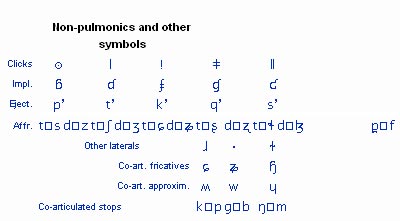
Palatal consonants are consonants articulated with the body of the tongue raised against the hard palate (the middle part of the roof of the mouth). Consonants with the tip of the tongue curled back against the palate are called retroflex. The most common type of palatal consonant is the extremely common approximant [j], which ranks as overall, among the ten most common sounds in the world's languages. The nasal ɲ is also common, occurring in around 35 percent of the world's languages[1], in most of which its equivalent obstruent is not the plosive c, but the affricate tʃ. Only a few languages in northern Eurasia, the Americas and central Africa contrast palatal plosives with postalveolar affricates - the only common ones being Hungarian, Czech, Slovak and Albanian. Warning: the IPA symbols <c, ɟ> are commonly used, not for palatal stops, but for the palatalized velar stops [kʲ, ɡʲ], or the palatal affricates [c͡ç, ɟ͡ʝ], or the alveolopalatal affricates [t͡ɕ, d͡ʑ], or even the postalveolar affricates [t͡ʃ, d͡ʒ]. This is an old IPA tradition. True palatal stops are relatively uncommon, so it is a good idea to verify the pronunciation whenever you see <c, ɟ> in the transcription of a language. Consonants with other primary articulations may be palatalised, that is, accompanied by the raising of the tongue surface towards the hard palate. For example, English [ʃ] (spelled sh) has such a palatal component, although its primary articulation involves the tip of the tongue and the upper gum (this type of articulation is called palatoalveolar). The palatal consonants identified by the International Phonetic Alphabet are:
Notes
References
See also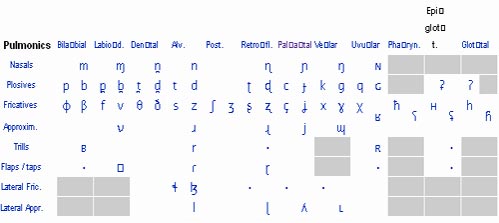
This table contains phonetic
information in IPA,
which may not display correctly in some browsers.
Published - November 2008 Information from Wikipedia
is available under the terms of the GNU Free Documentation
License
E-mail this article to your colleague! Need more translation jobs? Click here! Translation agencies are welcome to register here - Free! Freelance translators are welcome to register here - Free! |
|
|
|
||||||||||||||||||||||||||||||||||||||||||||||||||||||||||||||||||||
|
|
|
| |||
Legal Disclaimer Site Map |