|
 |
 |
 |
|
|
Home | More Articles | Join as a Member! | Post Your Job - Free! | All Translation Agencies | |
|
|||||||
|
|
|
|
World Wide Web

The World Wide Web (commonly shortened to the Web) is a system of interlinked hypertext documents accessed via the Internet. With a Web browser, a user views Web pages that may contain text, images, videos, and other multimedia and navigates between them using hyperlinks. The World Wide Web was created in 1989 by British scientist Sir Tim Berners-Lee, working at the European Organization for Nuclear Research (CERN) in Geneva, Switzerland, and released in 1992. Since then, Berners-Lee has played an active role in guiding the development of Web standards (such as the markup languages in which Web pages are composed), and in recent years has advocated his vision of a Semantic Web. How the Web works Viewing a Web page on the World Wide Web normally begins either by typing the URL of the page into a Web browser, or by following a hyperlink to that page or resource. The Web browser then initiates a series of communication messages, behind the scenes, in order to fetch and display it. First, the server-name portion of the URL is resolved into an IP address using the global, distributed Internet database known as the domain name system, or DNS. This IP address is necessary to contact and send data packets to the Web server. The browser then requests the resource by sending an HTTP request to the Web server at that particular address. In the case of a typical Web page, the HTML text of the page is requested first and parsed immediately by the Web browser, which will then make additional requests for images and any other files that form a part of the page. Statistics measuring a website's popularity are usually based on the number of 'page views' or associated server 'hits', or file requests, which take place. Having received the required files from the Web server, the browser then renders the page onto the screen as specified by its HTML, CSS, and other Web languages. Any images and other resources are incorporated to produce the on-screen Web page that the user sees. Most Web pages will themselves contain hyperlinks to other related pages and perhaps to downloads, source documents, definitions and other Web resources. Such a collection of useful, related resources, interconnected via hypertext links, is what was dubbed a "web" of information. Making it available on the Internet created what Tim Berners-Lee first called the WorldWideWeb (a term written in CamelCase, subsequently discarded) in 1990. History Main article: History of the World Wide Web
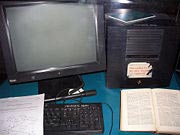
The underlying ideas of the Web can be traced as far back as 1980, when, at CERN in Switzerland, Sir Tim Berners-Lee built ENQUIRE (a reference to Enquire Within Upon Everything, a book he recalled from his youth). While it was rather different from the system in use today, it contained many of the same core ideas (and even some of the ideas of Berners-Lee's next project after the World Wide Web, the Semantic Web). In March 1989, Berners-Lee wrote a proposal which referenced ENQUIRE and described a more elaborate information management system. With help from Robert Cailliau, he published a more formal proposal for the World Wide Web on November 12, 1990. The proposal was modeled after EBT's (Electronic Book Technology, a spin-off from the Institute for Research in Information and Scholarship at Brown University) Dynatext SGML reader that CERN had licensed. The Dynatext system, however technically advanced (a key player in the extension of SGML ISO 8879:1986 to Hypermedia within HyTime) was considered too expensive and with an inappropriate licensing policy for general HEP (High Energy Physics) community use: a fee for each document and each time a document was charged. A NeXTcube was used by Berners-Lee as the world's first Web server and also to write the first Web browser, WorldWideWeb, in 1990. By Christmas 1990, Berners-Lee had built all the tools necessary for a working Web: the first Web browser (which was a Web editor as well), the first Web server, and the first Web pages which described the project itself. On August 6, 1991, he posted a short summary of the World Wide Web project on the alt.hypertext newsgroup. This date also marked the debut of the Web as a publicly available service on the Internet. The first server outside of Europe was created at SLAC in December 1991. The crucial underlying concept of hypertext originated with older projects from the 1960s, such as the Hypertext Editing System (HES) at Brown University--- among others Ted Nelson and Andries van Dam--- Ted Nelson's Project Xanadu and Douglas Engelbart's oN-Line System (NLS). Both Nelson and Engelbart were in turn inspired by Vannevar Bush's microfilm-based "memex," which was described in the 1945 essay "As We May Think". Berners-Lee's breakthrough was to marry hypertext to the Internet. In his book Weaving The Web, he explains that he had repeatedly suggested that a marriage between the two technologies was possible to members of both technical communities, but when no one took up his invitation, he finally tackled the project himself. In the process, he developed a system of globally unique identifiers for resources on the Web and elsewhere: the Uniform Resource Identifier. The World Wide Web had a number of differences from other hypertext systems that were then available. The Web required only unidirectional links rather than bidirectional ones. This made it possible for someone to link to another resource without action by the owner of that resource. It also significantly reduced the difficulty of implementing Web servers and browsers (in comparison to earlier systems), but in turn presented the chronic problem of link rot. Unlike predecessors such as HyperCard, the World Wide Web was non-proprietary, making it possible to develop servers and clients independently and to add extensions without licensing restrictions. On April 30, 1993, CERN announced that the World Wide Web would be free to anyone, with no fees due. Coming two months after the announcement that the Gopher protocol was no longer free to use, this produced a rapid shift away from Gopher and towards the Web. An early popular Web browser was ViolaWWW, which was based upon HyperCard. Scholars generally agree, however, that the turning point for the World Wide Web began with the introduction of the Mosaic Web browser in 1993, a graphical browser developed by a team at the National Center for Supercomputing Applications at the University of Illinois at Urbana-Champaign (NCSA-UIUC), led by Marc Andreessen. Funding for Mosaic came from the High-Performance Computing and Communications Initiative, a funding program initiated by the High Performance Computing and Communication Act of 1991, one of several computing developments initiated by Senator Al Gore. Prior to the release of Mosaic, graphics were not commonly mixed with text in Web pages, and its popularity was less than older protocols in use over the Internet, such as Gopher and Wide Area Information Servers (WAIS). Mosaic's graphical user interface allowed the Web to become, by far, the most popular Internet protocol. The World Wide Web Consortium (W3C) was founded by Tim Berners-Lee after he left the European Organization for Nuclear Research (CERN) in October, 1994. It was founded at the Massachusetts Institute of Technology Laboratory for Computer Science (MIT/LCS) with support from the Defense Advanced Research Projects Agency (DARPA) -- which had pioneered the Internet -- and the European Commission. History in literature The concept of a home-based global information system goes back at least as far as Isaac Asimov's short story "Anniversary" (Amazing Stories, March 1959), in which the characters look up information on a home computer called a "Multivac outlet" — which was connected by a "planetwide network of circuits" to a mile-long "super-computer" somewhere in the bowels of the Earth. One character is thinking of installing a Multivac, Jr. model for his kids. The story was set in the far distant future when commercial space travel was commonplace, and yet the machine "prints the answer on a slip of tape" that comes out a slot — there is no video display — and the owner of the home computer says that he doesn't spend the kind of money to get a Multivac outlet that talks. Standards
Many formal standards and other technical specifications define the operation of different aspects of the World Wide Web, the Internet, and computer information exchange. Many of the documents are the work of the World Wide Web Consortium (W3C), headed by Berners-Lee, but some are produced by the Internet Engineering Task Force (IETF) and other organizations. Usually, when Web standards are discussed, the following publications are seen as foundational:
Additional publications provide definitions of other essential technologies for the World Wide Web, including, but not limited to, the following:
Java A significant advance in Web technology was Sun Microsystems' Java platform. It enables Web pages to embed small programs (called applets) directly into the view. These applets run on the end-user's computer, providing a richer user interface than simple Web pages. Java client-side applets never gained the popularity that Sun had hoped for a variety of reasons, including lack of integration with other content (applets were confined to small boxes within the rendered page) and the fact that many computers at the time were supplied to end users without a suitably installed Java Virtual Machine, and so required a download by the user before applets would appear. Adobe Flash now performs many of the functions that were originally envisioned for Java applets, including the playing of video content, animation, and some rich GUI features. Java itself has become more widely used as a platform and language for server-side and other programming. JavaScript JavaScript, on the other hand, is a scripting language that was initially developed for use within Web pages. The standardized version is ECMAScript. While its name is similar to Java, JavaScript was developed by Netscape and has very little to do with Java, although the syntax of both languages is derived from the C programming language. In conjunction with a Web page's Document Object Model (DOM), JavaScript has become a much more powerful technology than its creators originally envisioned. The manipulation of a page's DOM after the page is delivered to the client has been called Dynamic HTML (DHTML), to emphasize a shift away from static HTML displays. In simple cases, all the optional information and actions available on a JavaScript-enhanced Web page will have been downloaded when the page was first delivered. Ajax ("Asynchronous JavaScript and XML") is a group of interrelated web development techniques used for creating interactive web applications that provide a method whereby parts within a Web page may be updated, using new information obtained over the network at a later time in response to user actions. This allows the page to be more responsive, interactive and interesting, without the user having to wait for whole-page reloads. Ajax is seen as an important aspect of what is being called Web 2.0. Examples of Ajax techniques currently in use can be seen in Gmail, Google Maps, and other dynamic Web applications. Publishing Web pages Web page production is available to individuals outside the mass media. In order to publish a Web page, one does not have to go through a publisher or other media institution, and potential readers could be found in all corners of the globe. Many different kinds of information are available on the Web, and for those who wish to know other societies, cultures, and peoples, it has become easier. The increased opportunity to publish materials is observable in the countless personal and social networking pages, as well as sites by families, small shops, etc., facilitated by the emergence of free Web hosting services. Statistics According to a 2001 study, there were massively more than 550 billion documents on the Web, mostly in the invisible Web, or deep Web. A 2002 survey of 2,024 million Web pages determined that by far the most Web content was in English: 56.4%; next were pages in German (7.7%), French (5.6%), and Japanese (4.9%). A more recent study, which used Web searches in 75 different languages to sample the Web, determined that there were over 11.5 billion Web pages in the publicly indexable Web as of the end of January 2005. As of June 2008, the indexable web contains at least 63 billion pages. On July 25, 2008, Google software engineers Jesse Alpert and Nissan Hajaj announced that Google Search had discovered one trillion unique URLs. Over 100.1 million websites operated as of March 2008.
Of these 74% were commercial or other sites operating in
the Speed issues Frustration over congestion issues in the Internet infrastructure and the high latency that results in slow browsing has led to an alternative, pejorative name for the World Wide Web: the World Wide Wait. Speeding up the Internet is an ongoing discussion over the use of peering and QoS technologies. Other solutions to reduce the World Wide Wait can be found on W3C. Standard guidelines for ideal Web response times are:
These numbers are useful for planning server capacity. Caching If a user revisits a Web page after only a short interval, the page data may not need to be re-obtained from the source Web server. Almost all Web browsers cache recently-obtained data, usually on the local hard drive. HTTP requests sent by a browser will usually only ask for data that has changed since the last download. If the locally-cached data is still current, it will be reused. Caching helps reduce the amount of Web traffic on the Internet. The decision about expiration is made independently for each downloaded file, whether image, stylesheet, JavaScript, HTML, or whatever other content the site may provide. Thus even on sites with highly dynamic content, many of the basic resources only need to be refreshed occasionally. Web site designers find it worthwhile to collate resources such as CSS data and JavaScript into a few site-wide files so that they can be cached efficiently. This helps reduce page download times and lowers demands on the Web server. There are other components of the Internet that can cache Web content. Corporate and academic firewalls often cache Web resources requested by one user for the benefit of all. (See also Caching proxy server.) Some search engines, such as Google or Yahoo!, also store cached content from websites. Apart from the facilities built into Web servers that can determine when files have been updated and so need to be re-sent, designers of dynamically-generated Web pages can control the HTTP headers sent back to requesting users, so that transient or sensitive pages are not cached. Internet banking and news sites frequently use this facility. Data requested with an HTTP 'GET' is likely to be cached if other conditions are met; data obtained in response to a 'POST' is assumed to depend on the data that was POSTed and so is not cached. Link rot and Web archival
Over time, many Web resources pointed to by hyperlinks disappear, relocate, or are replaced with different content. This phenomenon is referred to in some circles as "link rot" and the hyperlinks affected by it are often called "dead links". The ephemeral nature of the Web has prompted many efforts to archive Web sites. The Internet Archive is one of the most well-known efforts; it has been active since 1996. Academic conferences The major academic event covering the Web is the World Wide Web Conference, promoted by IW3C2. Security The Web has become criminals' preferred pathway for spreading malware. Cybercrime carried out on the Web can include identity theft, fraud, espionage and intelligence gathering. Web-based vulnerabilities now outnumber traditional computer security concerns, and as measured by Google, about one in ten Web pages may contain malicious code. Most Web-based attacks take place on legitimate websites, and most, as measured by Sophos, are hosted in the United States, China and Russia. The most common of all malware threats is SQL injection attacks against websites. Through HTML and URIs the Web was vulnerable to attacks like cross-site scripting (XSS) that came with the introduction of JavaScript and were exacerbated to some degree by Web 2.0 and Ajax web design that favors the use of scripts. Today by one estimate, 70% of all websites are open to XSS attacks on their users. Proposed solutions vary to extremes. Large security vendors like McAfee already design governance and compliance suites to meet post-9/11 regulations, and some, like Finjan have recommended active real-time inspection of code and all content regardless of its source. Some have argued that for enterprise to see security as a business opportunity rather than a cost center, "ubiquitous, always-on digital rights management" enforced in the infrastructure by a handful of organizations must replace the hundreds of companies that today secure data and networks. Jonathan Zittrain has said users sharing responsibility for computing safety is far preferable to locking down the Internet. Web Accessibility
Many countries regulate web accessibility as a requirement for web sites. WWW prefix in Web addresses The letters "www" are commonly found at the beginning of Web addresses because of the long-standing practice of naming Internet hosts (servers) according to the services they provide. So for example, the host name for a Web server is often "www"; for an FTP server, "ftp"; and for a USENET news server, "news" or "nntp" (after the news protocol NNTP). These host names appear as DNS subdomain names, as in "www.example.com". This use of such prefixes is not required by any technical standard; indeed, the first Web server was at "nxoc01.cern.ch", and even today many Web sites exist without a "www" prefix. The "www" prefix has no meaning in the way the main Web site is shown. The "www" prefix is simply one choice for a Web site's host name. Some Web browsers will automatically try adding "www." to the beginning, and possibly ".com" to the end, of typed URLs if no host is found without them. All major web browser will also prefix "http://www." and append ".com" to the address bar contents if the Control and Enter keys are pressed simultaneously. For example, entering "example" in the address bar and then pressing either just Enter or Control+Enter will usually resolve to "http://www.example.com", depending on the exact browser version and its settings. Pronunciation of "www"
In English, "www" is pronounced "double-you double-you double-you". It is sometimes shortened to "dub, dub, dub". It is noteworthy, that the English writer Douglas Adams once quipped:
It is also interesting that in Mandarin Chinese, "World Wide Web" is commonly translated via a phono-semantic matching to wan wei wang (???), which satisfies "www" and literally means "myriad dimensional net", a translation that very appropriately reflects the design concept and proliferation of the World Wide Web. See also Source: http://en.wikipedia.org/wiki/World_Wide_Web Published - September 2008 Information from Wikipedia
is available under the terms of the GNU Free Documentation
License
E-mail this article to your colleague! Need more translation jobs? Click here! Translation agencies are welcome to register here - Free! Freelance translators are welcome to register here - Free! |
|
|
|
|
|
|
| |||
Legal Disclaimer Site Map |