|
 |
 |
 |
|
|
Home | More Articles | Join as a Member! | Post Your Job - Free! | All Translation Agencies | |
|
|||||||
|
|
|
|
An Integrated Approach to the Translation of Special Terms
...with Special Reference to the Chinese term lüse shipin (green food) Abstract
Key words: term; terminology; translation; corpus-based investigation; lüse shipin (green food) 1. IntroductionSpecial terms are the linguistic expressions in various disciplines, and they generally correspond to a single concept in the given discipline. Thus, they play an important role in the construction and development of disciplines. Since the 1980s, scholars in China have translated and compiled some introductory books on terminology (Roudeau, 1985; Dubuc, 1990; Feng, 1997); there is even a call for the establishment of a course on terminology in tertiary institutions (Zheng, 2003/2005). All this has shown the importance of terminology. The China National Committee for Natural Scientific Terms was founded in 1985, and in 1996 its name was changed to China National Committee for Terms in Sciences and Technologies, CNCTST. The committee is responsible for the standardization of terms used in various disciplines. After discussions on the nomenclature of scientific and technological concepts, the committee published their agreed linguistic expressions, i.e. terminology in special fields. On the other hand, Chinese terminologists and institutions have established relations with the International Standardization Organization (ISO) and other institutes on terminological research to coordinate certain terms and promote scientific and technological exchange.
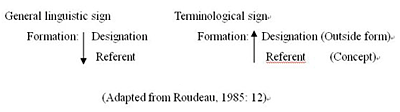
This article focuses on the methodology of translating Chinese terms. Taking the English translation of "lüse shipin", a semi-term1, as an example, we will first discuss the basic terminological knowledge necessary for translators when translating a term and show the mismatch between existing translations of lüse shipin and its referent in Chinese context. Then a corpus-based investigation is carried out to find the usage of the semi-term lüse shipin and a similar concept youji shipin (organic food) in Chinese as well as the expressions green food and organic food in English, which would provide insight into the decision-making process of translators. On the basis of the above analyses, some tentative translations of lüse shipin are given in the hope that this integrated approach in translating terms can be adopted by more translators. 2. A terminological perspective on the translation of terms a) Basic knowledge of terminology for translators First, the formation of terms is different from that of ordinary words. For ordinary words, the meaning is to be defined from an existing form, while terms require the form (nomenclature) to be found for the known referent. This is made obvious by the research methodology adopted by terminologists and lexicologists. The former "start from the concept (referent) to think about the name of the specified concept, and if it has no name, how to name it?" (Roudeau, 1985: 19). By contrast, "the latter pin down the meaning(s) of the linguistic form after they distinguish a linguistic form"(Roudeau, 1985: 19). Thus, terminologists work "on the basic terminological principle of concept prioritizing name"(Roudeau, 1985: 19). See Figure 1 in the following: Figure 1 The formation of terms and general words
Second, terms demand the singularity of meaning and the unique reference of the referent. Ordinary words are often polysemous, and many words often have the same meaning, which shows the richness of linguistic expressions. In contrast, for a term, nomenclature and concept are uniquely matched. Although "there are cases when one term has many meanings or many terms actually refer to one concept, terminologists always try their best to avoid or even erase such phenomena instead of letting them grow uncontrollable as in the case of ordinary words"(Huang & Chen, 2001: 158) Such knowledge provides some methodological hints for translators. First, they can search sources from the same discipline in the target language (TL) for the equivalent term, which is the preferred translation strategy in translating the source language (SL) term with the same concept of the TL term. In many cases, however, translators cannot find the equivalent term in the TL due to the differences between SL and TL disciplinary traditions and development. At this time, they should consider various aspects concerning the translation of the term. Only based on their thorough understanding of the concept of the SL term can they choose the appropriate expression in the TL, or even coin a new TL term corresponding to the concept of the SL term instead of being content with achieving a word-for-word correspondence. Furthermore, the translated term should look like a term itself, that is, conforming to the reading and cognitive habits of the TL readers so that they will accept it as a term with a unique referent. b) The application of terminological knowledge in translationFor a translator, the first task in translating a Chinese term into other languages is the attainment of an accurate understanding of the term in its context and identification of its referent. Only then can the translator begin to search for an accepted term in the TL. This requires that the translator know the referent of the similar equivalent terms in the TL, including their intention and extension, and then decide which one can be used as an equivalent term for the SL term. If there is a discrepancy, the translator should carry out research and choose the most suitable from several possible translations. Here, we take the English translation of lüse shipin as an example to see how terminological knowledge can be used to understand the term in translation, that is, the first step of the integrated approach. Nicky Harman (2005), lecturer of Imperial College, London University, translates lüse shipin into Chinese as "organic food." She argues:
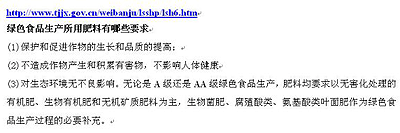
(Our own translation is as follows:) The requirements for the use of fertilizers in the production of lüse shipin are:
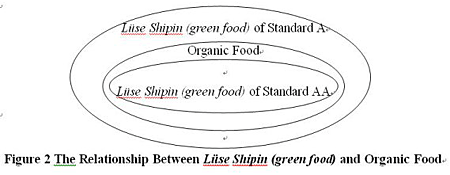
http://www.defra.gov.uk/farm/organic/introduction/ ...... What is the definition of organic farming? The Compendium of UK Organic Standards as described in the above link define organic farming as: "Organic production systems are designed to produce optimum quantities of food of high nutritional quality by using management practices which aim to avoid the use of agro-chemical inputs and which minimise damage to the environment and wildlife. The principles include: Working with natural systems rather than seeking to dominate them The encouragement of biological cycles involving micro-organisms, soil flora and fauna, plants and animals The maintenance of valuable existing landscape features and adequate habitats for the production of wildlife, with particular regard to endangered species Careful attention to animal welfare considerations The avoidance of pollution Consideration for the wider social and ecological impact of the farming system." Harman, 2005 According to the description of lüse shipin (taken from Lüse Shipin Manufacturing Website, Jixian County, Tanjin, China) and the definition of organic farming (taken from the website of Department for Environment, Food and Rural Affairs, abbreviated as DEFRA, UK), Harman thinks that lüse shipin is identical to organic food. Actually, the above two quotations cannot even be compared: the first one is about the requirement for the use of fertilizers in the production of lüse shipin, while the second one is about organic farming. The comparison itself is problematic. On the other hand, New Age Chinese-English Dictionary (2005), a bilingual dictionary compiled by Chinese scholars, directly gives green food as the English equivalent for lüse shipin. Facing such a situation, the translator could resort to the basic terminological knowledge mentioned in Section 2.1 to analyze the appropriateness of the two different understandings of lüse shipin. First, we can examine the formation of lüse shipin in the Chinese context. On December 18, 1991, the State Council, People's Republic of China gave a reply to the request from Department of Agriculture on the situation and problems of developing lüse shipin, in which the State Council pointed out: "The development of lüse shipin (unpolluted food) has a far-reaching influence and real significance in protecting the environment, improving the quality of agricultural products, promoting the development of the food industry, enhancing people's health, and increasing the export volume of agricultural products to earn foreign currency. This is a new task, and our country is just at the beginning stage. Effective measures must be taken to further this initial task, and all departments concerned must give their full support. (Accessed online: http://www.greenfood.org.cn/lsspfg/pifu.htm <January 7, 2007>) After more than ten years of development, lüse shipin now has a complete set of standards (cf: http://www.greenfood.org.cn/lsspbzh/wen1/yj05.mht). Therefore, "the standards of lüse shipin are based on China's own standards with a reference to advanced international standards. Chinese enterprises, by adopting the standards of lüse shipin, can use technical innovation effectively, improve quality control in production and promote the level of management and performance of their staff. The standards of lüse shipin also provide technical support for the unconditional exchange with sustainable food and organic food after China's entry into the WTO. It creates a favorable condition for the self-protection and independent development of our agriculture, especially ecological and sustainable agriculture in the process of opening up to the outside world." ("A general introduction to the standards of lüse shipin," accessed online: http://www.greenfood.org.cn/lsspbzh/lsspbzh.htm <January 6, 2007> ). Therefore, "lüse shipin refer to those agricultural and processed foods which are produced in a sound environment and under stipulated technical standards. Their quality is under control during the whole process of production, so they are without pollution, of proven quality and provided with a special logo to designate their quality. " (Conceptual features, from the official website of the Chinese Green Food Development Center, accessed online: http://www.greenfood.org.cn/sites/MainSite/List_2_2444.html <February 20, 2007>) In contrast, organic food is defined as the following: Organic food is food produced according to organic standards, which means crops grown without the use of conventional pesticides, as well as artificial fertilizers or sewage sludge, animals reared without the routine use of antibiotics and without the use of growth hormones and food processed without ionizing radiation and without the use of a wide range of food additives. It is produced on all levels without the use of genetically modified organisms. Historically, these farms have been small family-run farms. There is evidence that these organic farms are more sustainable and environmentally sound, among other benefits. 2 (Wikipedia, http://en.wikilib.com/wiki/Organic_food <January 7, 2007>) If a producer wishes to have his products certified as organic food, they must conform to the standards for the production of organic food and become accredited by an authoritative institution. For example, products in Australia must adhere to the Organic Standard of National Association for Sustainable Agriculture, Australia (abbreviated as NASAA) to be certified as organic food; in the United Kingdom, they must be accredited by the Organic Farmers and Growers Ltd. (OF&G) authorized by DEFRA, UK; and in the United States, they should conform to the National Organic Program set up by the US Department of Agriculture. Now these standards concerning organic food are recognized among most countries of Europe and the Americas. Organic food is closely related to organic farming, which was developed in industrialized countries as a response to the damage brought by the industrialized agriculture. In 1972, International Federation of Organic Agriculture Movements (IFOAM) was founded in Versailles, France with the aim to exchange practices and standards of organic farming among different countries. Therefore, the two terms have their respective origins and their referent is fixed in their own linguistic contexts. If their standards are the same, it can be argued that the two terms, lüse shipin and organic food, are equivalent terms and they can be mutually substituted in different languages. However, they are not the same. China has set up two general standards for lüse shipin, i.e. Standard A and Standard AA. According to the research of Xie Yongping from Nanjing Agricultural University, "Lüse shipin of Standard AA is organic food, but not vice versa. Only those organic foods whose productive environment, operations in the production, product quality and packaging all conform to the Standard AA of lüse shipin can be certified as lüse shipin of Standard AA. In other words, organic food is the quasi-lüse shipin of Standard AA" (1998: 7). Standard A of lüse shipin is less strict than that for organic food. Thus, the two concepts are related but different. Their relationship could be shown in Figure 2:
Therefore, from a terminologist's perspective, Harman's view is incorrect. Organic food does not correspond to lüse shipin, and their referents are not the same, which violates the terminological principle that name and concept should be the same. As for the translation of the term green food provided by the New Age Chinese-English Dictionary, we have carried out a corpus-based research to see its usage in English as well as the reception of youji shipin (organic food) in the Chinese context, and then evaluate this translation. 3. A corpus-based research of the reception of the terms a) A corpus research of terms in the SL By investigating the usage of some words in the modern Chinese corpora, translators would obtain some unexpected hints in the process of translation. As the case study is concerned, we examined the frequency of lüse shipin and its similar term youji shipin (organic food) in Modern Chinese. For this purpose, the online queries of the Modern Chinese Corpus managed by the Center for Studies of Chinese Language and Linguistics, Beijing University (abbreviated as CSCLL in this paper)3 and the Modern Chinese Corpus managed by the Institute of Applied Linguistics, Ministry of Education (abbreviated as IALME in this paper)4were made use of. The search results are as follows: Table 1 The Frequency of the terms Lüse Shipin and Youji Shipin
* Notes:
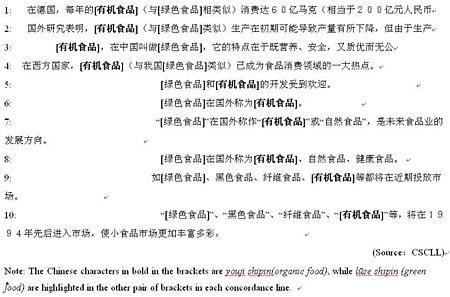
From Table 1, it can be seen that lüse shipin is a familiar term for the Chinese people, while youji shipin is a new term with an obviously lower frequency. In CSCLL, its frequency is as only slightly over 3% as that of lüse shipin, and in IALME, it does not appear. Of course, the scale of the corpus constitutes one factor for this phenomenon, but a conclusion can be drawn that Chinese have not totally accepted the term youji shipin. In other words, youji shipin has not become a semi-term, and it is used most often by those experts in the specified field. In contrast, lüse shipin has invaded the daily speech of the Chinese people. This proves our classification of lüse shipin as a semi-term. Next, we can further examine the concordance lines of the two terms. There are ten co-occurring concordance lines of lüse shipin and youji shipin, occupying 62.5% of the total concordance lines of youji shipin. The co-occurring concordance lines are provided below:
From those materials, we can see that youji shipin is a rather specialized concept, belonging to the category of pure terms, at most a general term. Many writers of the corpus's texts mention it with direct explanation following the term for the convenience of the reader, such as in concordance lines 1, 2, 4. Other writers do not know the difference between lüse shipin and youji shipin, such as concordance lines 3, 6, 7, 8, and there are even some writers consider lüse shipin as exactly youji shipin, such as concordance lines 6, 7, 8. Thus, through the corpus-based research, it can be shown that lüse shipin, due to its concreteness and vividness, is a semi-term in Chinese, for its literal meaning, "green food," produced a favorite association with natural food. In contrast, youji shipin is borrowed from abroad, and those who do not understand the concept of this term are likely to consider it identical to lüse shipin in China. This certainly flouts the terminological principle of unique correspondence between name and concept. The way of saying that organic food is similar to lüse shipin in China, however, provides a hint for translators when they translate the Chinese term into English. 4. A corpus research of terms in the TL During the translation process, the research of TL corpora and the use of Internet search engines6 can provide important information for translators about the usage of certain words and inspire tentative translations into the TL. As for the two proposed versions of lüse shipin--green food and organic food, we also need to investigate the British National Corpus, BNC7 and the Collins WordbanksOnline English Corpus (abbreviated as Collins in this paper) 8 to find their respective usage. The results are as follows: Table 2 The Frequency of Organic Food and Green Food
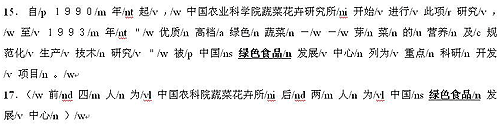
* NOTE: MW means million words. From Table 2, it can be seen that the frequency of organic food is almost three times as that of green food, which suggests that organic food is relatively common. This is closely connected with the fact that the term organic farming originates from Western countries. Next, we further check the infrequent occurrences of green food, and find that it often co-occurs with the word colouring(s) and colour on the right, among which, BNC has 9 concordance lines of green food colouring(s) and Collins has two concordance lines of green food coloring and two concordance lines of green food colour (powder). All the concordance lines of green food are listed below: 1 through a near-famine when a plague of caterpillars ate most of the green food. It was recorded by a convict who was on the 2 the green tops remain, pastures, and indeed anywhere where green food is evident. The Netting Operation With your preparation and your 3 icing sugar 2 egg whites 2 tsps lemon juice Almond essence Green food colouring Method 1 Beat the icing sugar, egg white and 4 plants, SHE's cookery editor Clare Ferguson will talk about Green food and show you how to make it. Colin Shawyer of 5 icing sugar, 1 small egg white, Peppermint flavouring, Green food colouring. 1 Sieve the icing sugar into bowl 2. 6 for a few minutes. 4 Colour the desiccated coconut with green food colouring for grass. Spread a little royal icing, first coloured 7 To finish the dragonflies, paint the bodies with brown and green food colourings, including green heads and dark eyes. Cut out 8 more fondant, about the size of an egg, with green food colouring and reserve, tightly wrapped, for the space creatures 9 on the cake drum. 5 Colour the remaining fondant with green food colouring and roll out to a triangle, about 32•5cm ( 10 on top of the cake. Brightly paint the towel using blue and green food colourings and a fine paint brush. Leave the fondant to 11 the toadstool roof. Colour the desiccated coconut with a little green food colouring and scatter on the cake drum around the toadstool, 12 yeah twenty P yeah, peppermint flavouring, artificial cochineal, green food colouring cochineal, er that comes from beetles I know, (Source: BNC) 1 [/h] [p] 300ml 1/2pt) water · 450g (1lb) Tate & Lyle granulated sugar 125g 1/4lb) liquid glucose · green food colour powder (available at sugarcraft shops) mixed with a few drops of water. [p] Put the water and sugar into a 2 5oz butter, 2oz sugar, 10oz digestive biscuits. Green layer: 2fl oz lime juice, 7oz can sweet condensed milk, 2 eggs, dash green food colour. Orange layer: lime and orange juice to make 2fl oz, 7oz can sweet condensed milk, 2 eggs, dash red food 3 it around the elf's neck. [p] Christmas Wreath Cookies [p] 1 teaspoon vanilla [p] 3 cups corn flakes cereal [p] green food coloring [p] red cinnamon candies [p] frac12; cup butter [p] 30 large marshmallows [p] a saucepan [p] waxed paper 4 to help you melt the vanilla, butter, and marshmallows together in a pan on low heat. Once the mixture is creamy, stir in green food coloring until it is the shade you want. Remove the pan from the heat and add cornflakes. Mix well. Wait for the (Source: Collins) From these concordance lines, we can be certain that the first reaction of English speakers is that green food is the green leafy food or food treated with some kind of green food colouring, for green food, in many cases collocates with colouring(s), such as in concordance lines 2, 5, 6, 7, 8, 9, 10, 11, 12, 13 from BNC, and all the concordance lines from Collins. If we take green food as the translation for lüse shipin, it may violate the terminological principle that the term and the concept should have the unique correspondence because we intend to use green food to refer to some unpolluted food adhering to the standards of lüse shipin. Therefore, in translating such a term, the translator must be very careful; otherwise the translated term may not refer to the concept in the SL and bring misunderstanding towards the TT readers. 5. The translator's linguistic choice in translating lüse shipin After the above careful analyses, the translator can propose some translations for the terms in question. This, of course, involves the consideration of different registers, for different registers may require different translation strategies. In our study, we attempt to propose the following strategies for the translation of lüse shipin: (1) In non-academic discourse, we could use quotation marks to deal with this term, that is, to use 'Green Food' to indicate it is not a common phrase (not leafy or artificially colored food). If a careful reader encounters it, s/he may surf the Internet and try to find more information about it from Chinese governmental websites (English Version). Moreover, if the space of the text permits, we could use an explanation to provide foreign readers with an easier understanding. For example, "Green food, similar to organic food in western countries, has already shown great potential in the market". Because people in western countries are familiar with organic food, the connection of lüse shipin with organic food, a semi-term in their daily life, will certainly help them get a rough idea about this concept. This strategy is suitable for the public. (2) In more academic discourse, we should be more accurate, and use notes to supply more information about this term, such as "The requirements for the Chinese 'Green Food' of Standard AA are stricter than those for organic food." (3) As for the brand of those products, we think that Grefod, due to its succinctness, could be a good choice. However, it needs the support from the related departments of the Chinese Government by providing necessary information about Grefod. Meanwhile, they should also publicize this expression for people in other countries. Then, the foods containing the mark "Grefod" will be gradually accepted by foreigners. Another advantage lies in that it is easy for TL readers to associate with the expression, "Green Food" because of their similar pronunciations. We had originally thought of using capital letters and translate the semi-term as GREEN Food to provide English speakers with a visual clue, thus making them realize that it is not an ordinary phrase. However, Ms. Harman suggests that capitalization means shouting in English and is considered impolite in some contexts. Thus, this way is not suitable to be adopted. Conclusion In this paper, an integrated approach to the translation of terms has been explained by using the English translation of lüse shipin as an example. When translating terms, a translator must acquire some basic knowledge about terminology, such as (1) how terms are formed by tracing its real-world referent; and (2) be aware of the fact that concept and term have a unique correspondence in domain-specific texts. Then the translator should resort to the corpus-based research (whether using corpora or the web as reference) to check the usage of SL terms and possible TL terms in their own linguistic environment. Only after careful analyses and thinking can the translator propose the appropriate translations for those terms which have not been confirmed by authoritative institutions. With the increase in the volume of translation, more and more translators are facing the task of translating in specific domains. "... it is well known that the search for interlingual equivalents is a time-consuming activity, occupying in some cases up to 60 per cent of total translator time"(Nkwenti-Azeh, 2004: 249). Hence, we look forward to more cooperation between countries, and establishment of more universally recognized term banks to promote the exchange in the international community. Notes: 1 According to their scope of use, Liu Yongquan (2000) classified terms into three types: the most technical ones are the pure terms, such as plasma; the moderately technical ones are the general terms, such as pressure; while the semi-terms refer to those that are used in ordinary speech, and form part of the general vocabulary. (Our own translation from Terms in Encyclopedia of China, Vol. Languages) 2 We choose the definition from the online encyclopedia Wikipedia because in many other more widely known encyclopedias (so far as we can find), organic food is under the entry of organic farming, and in some of which organic food is not even mentioned as a fixed expression. For example, in Encyclopædia Britannica (retrieved from Encyclopædia Britannica 2006 Ultimate Reference Suite DVD), there is no occurrence of the term organic food in the entry organic farming and no entry for organic food. We can only infer that organic food is the product of organic farming. However, it suggests the close relationship between organic food and organic farming. 3 The Modern Chinese Corpus managed by the Center for Studies of Chinese Language and Linguistics, Beijing University has 157 files, 23 folders and 229,700,435 bytes (219MB), with approximately 115 million characters. It can be accessed online: http://ccl.pku.edu.cn:8080/ccl_corpus/jsearch/index.jsp?dir=xiandai. 4 The Modern Chinese Corpus managed by the Institute of Applied Linguistics, Ministry of Education provides online access to a corpus of about 20 million characters for research: http://219.238.40.213:8080/CpsQrySv.srf. 5 18 concordance lines are found in IALME, but two lines are exempted from the total number because they are part of a name for an institution. The two concordance lines are quoted as follows:
They should be segmented and tagged as
ni is a tag and stands for the name of institutions. In the two concordances (15 & 17), the institution is Chinese Green Food Development Center. Nonetheless, this does not affect the trend of usage indicated by the corpus. 6 In treating the results of search engines, the translator should be critical about the collocations and frequencies of those results since not all the materials in the Internet are authoritative. 7 The British National Corpus managed by Oxford University Computing Services on behalf of the BNC Consortium has 100 million words (90 million words of written texts and 10 million words of speech) and can be available online: http://www.natcorp.ox.ac.uk/. 8 The Collins WordbanksOnline English Corpus has 560 million words of written and spoken English materials and can be available online: http://www.collins.co.uk/Corpus/CorpusSearch.aspx. Acknowledgement I am deeply indebted to my supervisor, Professor Ke Ping at Nanjing University for his careful and patient guidance. My gratitude also extends to Nicky Harman in Imperial College London, who carefully read the draft of this article and provided some insightful views concerning the translation of the Chinese semi-term lüse shipin from a native speaker's point of view. However, all the mistakes in the paper are my own. References Baker, Mona, ed. (2004) Routledge Encyclopedia of Translation Studies. Shanghai: Shanghai Foreign Language Education Press. Nkwenti-Azeh, Blaise. (2004) "Term banks". In Mona Baker, ed. Routledge Encyclopedia of Translation Studies. PP 249-251. Harman, Nicky. (2005). "How Useful Is Translation Technology for the 21st Century Translator?"(Lecture given at Nanjing University on April 21, 2005) Accessed online from Ke Ping's site: http://www.iccsl3.com/keping/TOC/LTIT.html <January 9, 2007> Sager, Juan C. "Terminology, Application". In Mona Baker ed., Routledge pp 251-258. Rondeau, Guy. (1981/1985)《Introduction á la Terminologie》. Translated by Liu Gang and Liu Jian as Introduction to Terminology. Beijing: Science Press. Dubuc, Robert. (1985/1990)《Manuel Pratique de Terminologie》. translated by Zhang Yide as Applied Terminology. Beijing: Science Press. Feng, Zhiwei. (1997) Introduction to Modern Terminology. Beijing: Yuwen Press. Huang, Jianhua, and Chen Chuxiang. (2001) Introduction to Bilingual Lexicography (Revised Editon). Beijing: The Commercial Press. Liu, Yongquan. (2000) "Terms". Encyclopedia of China, Vol. Language DVD(Version 1.1). Beijing: Encyclopedia of China Press & Beijing Dongfangding Electronic Ltd. <Accessed: January 9, 2007> "organic farming." Encyclopædia Britannica from Encyclopædia Britannica 2006 Ultimate Reference Suite DVD . <Accessed: March 1, 2007>. Wu, Jingrong and Chen Zhenqiu, eds. (2005) New Age English and Chinese Dictionary (Compact Edition). Beijing: The Commercial Press. Xie, Yongping. (1998) "The significance of the system of stratification of GREEN food." In Research and Development of food, Vol. 20, Issue 4, pp 6-8. Zheng, Shupu. (2005) Dictionary, Vocabulary and Terms. Ha'erbin: Heilongjiang People's Press. Chinese GREEN Food Net. Accessed online: http://www.greenfood.org.cn/index.htm. Beijing: Chinese GREEN Food Development Center. <January 6, 2007> Corpora used: Data cited in this paper have been extracted from (1) the Modern Chinese Corpus managed by the Center for Studies of Chinese Language and Linguistics, Beijing University; (2) the Modern Chinese Corpus managed by the Institute of Applied Linguistics, Ministry of Education, China; (3) the British National Corpus Online service managed by Oxford University Computing Services on behalf of the BNC Consortium; and (4) the Collins WordbanksOnline English Corpus. All rights in the texts cited are reserved.
E-mail this article to your colleague! Need more translation jobs? Click here! Translation agencies are welcome to register here - Free! Freelance translators are welcome to register here - Free! |
|
|
|
|
|
|
| |||
Legal Disclaimer Site Map |
 The translation of special terms is an unavoidable problem.
This paper attempts to propose an integrated approach to
solve the problem. On the basis of some basic knowledge
about terminology, a translator should search the corpora
of the source language and target language to find the usage
of the term and its possible translation in its own linguistic
context. Then, only after the consideration of the specific
domain can a linguistic choice be made on the translation
of the term. In explaining this integrated approach, we
use the Chinese semi-term "lüse shipin" (green food)
as an example, and propose several tentative translations
of this term.
The translation of special terms is an unavoidable problem.
This paper attempts to propose an integrated approach to
solve the problem. On the basis of some basic knowledge
about terminology, a translator should search the corpora
of the source language and target language to find the usage
of the term and its possible translation in its own linguistic
context. Then, only after the consideration of the specific
domain can a linguistic choice be made on the translation
of the term. In explaining this integrated approach, we
use the Chinese semi-term "lüse shipin" (green food)
as an example, and propose several tentative translations
of this term.