 |
 |
 |
 |
|
|
Home | More Articles | Join as a Member! | Post Your Job - Free! | All Translation Agencies | |
|
|||||||
|
|
|
|
Transformation of Literary Imagery in Translation
Sallust's Personage of Catiline in Bulgarian Translation Context1
Ancient Texts in the Bulgarian Literary Polysystem In comparison with the European tradition in translating ancient literary works, Bulgarian reception of ancient authors in translation has quite a short history. We can trace its beginnings to the period of the nineteenth-century Bulgarian National Revival, which has its own specific features. Bulgaria suffered—and survived—five centuries of Ottoman domination (14.-19. c.). Before the Liberation from Ottoman occupation (1878), translations of ancient authors and works corresponded to the pursuit of Bulgarian writers to shape the Bulgarian people culturally and educationally, contributing, at the same time, to their moral development2. Translations were made exclusively by clerics and teachers who worked mainly with Ancient Greek and, more often than not, used already published translations into a modern language—e.g. Modern Greek or Serbian. Led by their ethical and moral goals, Revival writers chose such authors and texts from which morals could be drawn and which provided instances of exemplary civil behavior. These specific relations, linking source texts, translators and target texts could be represented as follows in Fig. 1. 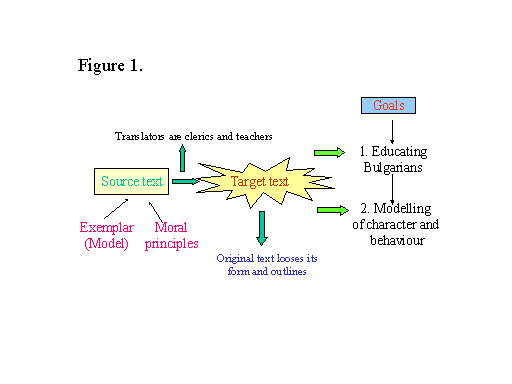
Such objectives in choosing the material to be translated reflected on the quality of translated works. The aim was not an exact translation, faithful to the source text. It was rather to make the source text function in a new cultural environment as if it were a genuine product of that environment. In the terms of Even Zohar's polysystem theory (Gentzler:1993: 105)3, the weak literary framework let through translated writings bearing the mark of so serious an intervention on the part of the translator, that the original model lost its outlines and acquired features of the texts from the literary system in which it was forced to function. The attempt to make a text relevant to objectives quite different from the ones for which it was originally created destroys the very content along with the form of the original. When we deal with descriptions and narratives, it is clearly seen how the translator sought their exact and equivalent rendition into the target language. However, if the ancient text contained moral judgments, the translator felt free not only to adorn the author's style, but also to modify his ideas by adding and changing lexical units, realia or syntactic structures. The insertion of entire stories into the original text points to the fact that the translator saw the source text as a functioning unit in his own contemporary society. The identity of the original text related to its fixed place in time and its linguistic peculiarities was not of great importance. The text's current role in the translator's 'here and now' was the only thing that mattered. In this sense, the translator did not translate the original but created it. After the Liberation from Ottoman domination, Bulgarian society was led by the desire to go back in time and rejoin a model of civilization based on the naturally or artificially supported cultural continuation of European traditions. This enhanced the interest in Antiquity as a pillar and root of European culture in the framework of which young—both literally and figuratively—Bulgarian citizens were just beginning to search for their natural place and space. Ancient literature remained a basic source for morals and principles, a representation of a way of living that should be followed and that could ensure the nation's prosperity. To this picture, however, we could add the arising consciousness that ancient literary monuments have a great significance as a source for the history of Bulgarian lands in Antiquity.4 The new vision of Antiquity in the period after the liberation from Ottoman domination could be represented as follows in Fig. 2. 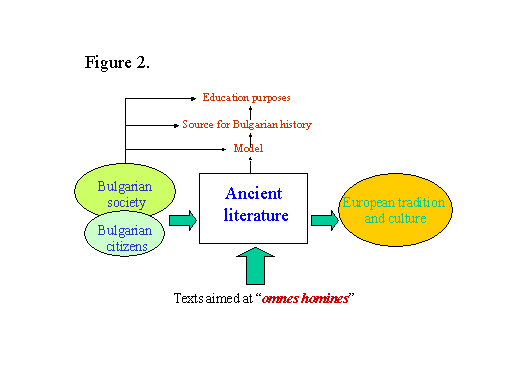 The building of a new educational system also required new, higher-quality translations of ancient literary works already acknowledged in whole Europe. The pursuit of translators now became to produce texts that sounded less parochial and that could help Bulgarians integrate into the European world. At the same time, most of the editions of such translations (quite often published in periodicals and rarely in separate books) were not complete, and translators did not make commentaries concerning the literary or cultural context of the original. Deprived of the context of the source, target texts became a part of the target literary polysystem by entirely dissolving into it rather than enriching it—something that can only happen to a translation aiming at preserving both the form and the content of the original. Thus, the source context—for every text, either translated or original, bears with it a part of its context while being transferred to a different environment—became interlaced with the target context, thereby creating a new contextual system with its own shape and identity. In this sense, it is hard to view translations of ancient authors as an autonomous structure in Bulgarian literary system of the given period. They rather represented a mechanism, through which society searched for its own identity following outside models and imitating them in its own framework. The attitude to translation activity in the period between the First and the Second World War—when the first complete translation of Coniuratio Catilinae was published—changed in favour of ancient source texts. Now they were no longer models detached from their context and artificially imported into a new and alien system, where they were forced to function like the other elements of the system5. The source text now became a mirror reflecting a whole world, that of Antiquity. Ancient texts were put into their original contextual environment which acquired more and more distinct shape differing from the outlines of the target culture. Nevertheless, the search of a wider audience for the ancient works in translation made some translators introduce changes in the source text to a degree that facilitated its natural and unimpeded reception from various kinds of readers with diverging interests. Ancient source texts were still not autonomous entities with their own characteristics in accordance with the cultural environment that generated them. Practical use and moralizing inclinations were still of great importance for translators and played a significant part both in choosing original texts to be translated and in translation approaches. This is why the tendency to produce partial and incomplete translations continued, although such texts were now published in separate editions rather than in periodicals. These fragmentary translations were conceived as self-sufficient models of behaviour to be imitated in the target culture. A series of translations were made for educational purposes, namely the teaching of classical languages in Bulgarian high schools, which enforced the already existing trends for more accurate, though in many cases too literal, translations. The relations in the literary system of the given period are presented in Fig. 3. 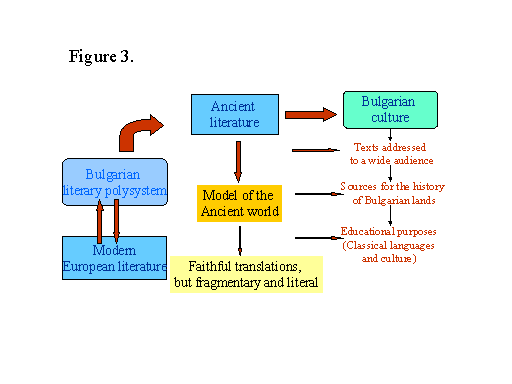 In this period, Latin literature at last caught up with Greek in respect to the number of the works represented in Bulgarian translation. Until then, Ancient Greek literature was naturally more attractive for Bulgarian translators and intellectuals due to our political and cultural affinities with the Greek world. But, during the period in question, Bulgarian reading public was more fascinated with the new searches of modern European authors, which also determined translation trends in Bulgarian literary system. The representation of ancient literary works now had new specific objectives that can be summarized as follows: texts addressed to the general public (or, at least, what the translator saw as the general public); texts with a crucial value for Bulgaria as sources for the history of Bulgarian lands in Antiquity; and texts for the use of those who studied classical languages and culture. In general, however, ancient literature in translation remained detached and separate from the modern literary models of the time to which it should have been connected in the framework of the literary polysystem. The place of ancient literature in this system kept on being rather insignificant. After the end of the Second World War and the establishing of the communist regime in Bulgaria, the fundaments of translating tradition that had been more or less laid down during the periods examined above were undermined for approximately 40 years. During the communist era, studies of classical languages and culture were marginalized at the profit of propaganda and ideological biases of both writers and translators. Bulgarian literary polysystem lost its autonomy and identity and became a part of the political system serving only its purposes. A certain revival of the interest in Antiquity, and a revival of translations of ancient texts in particular, took place only in the 1980's, after a significant period of interruption of the fragile traditions in this field. Sallust's Text in Bulgarian Literary Polysystem The Translation of 1940 The interest in Sallust's works in Bulgaria is relatively lasting, especially seen against the background of the brief Bulgarian translating tradition in comparison to the European one. The first attempt at translating a text by Sallust dates back from before the Liberation of Bulgaria from Ottoman suppression in 1878. This translation was not published. The first complete translation of Coniuratio Catilinae appeared in 1940. Both reading audience and authors in Bulgaria at the time, be it inside or outside the then-existing literary circles, were strongly oriented towards modern aesthetics of the European West. Sallust would hardly attract their attention and become a substantial part of the literary system. That is why it fitted rather into the system of contemporary social relations and politics. Such was the aim of Sallust's translator explicitly declared in the preface of the edition. His motives for translating Coniuratio Catilinae were based on the concept that Sallust's text is "a work that contains rich moral material" (1940: 6) and depicts "a historical event, that is an excellent lesson for Bulgarians, so that they can understand how damaging it is for a government and a state, when the people is wasted away by the bacillus of discord and dissent"(1940: 6). Les morales de l'histoire are the ground upon which the Bulgarian image of Catiline is constructed. The translator draws constant parallels between Catiline's persona and many similar "heroes" that emerged from Bulgarian reality. Thus, a sign of the parallelism between the source and the target text is given yet in the preface. This holds true not only on the level of imagery, but also on the level of the reality in the framework of which the whole narrative is put: "especially nowadays", states the Bulgarian translator further in the preface, "when moral is not stable and notions of honour and virtue, of good and evil, have lost their measures" (1940: 6)—cf. Sallust's statement "Incitabant praeterea corrupti civitatis mores, quos pessima ac diversa inter se mala, luxuria atque avaritia, vexabant. Res ipsa hortari videtur, quoniam de moribus civitatis tempus admonuit, supra repetere ac paucis instituta maiorum domi militiaeque, quo modo rem publicam habuerint quantamque reliquerint, ut paulatim immutata ex pulcherrima atque optima pessima ac flagitiosissima facta sit, disserere." By identifying the contexts of the source text and the target one, the translator aims at a unanimous reader response and a wider audience of the translated text. Then, from the concrete facts of the source context transferred by him without any changes into the target cultural environment, he proceeds to a general statement concerning human beings and society as a whole: "bad morals lead man and society to ruin, and rebellion and opposition to government most of the times achieve nothing"(1940: 6,7). At the end, he expands the circle of readers to all people: the text is "a lesson from which everyone should learn" (1940: 7). Here, both source and target contexts are again parallel: for Sallust's generalizing expression "omnes homines" in the original text points not only to the present, but also to the future. The transformation of Catiline's character in the target context is presented in Fig. 4. 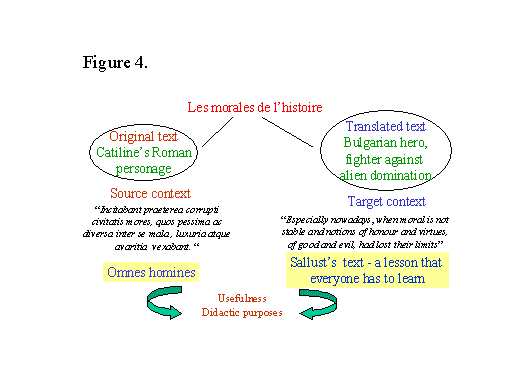 As Ann Thomas Wilkins observes in her study on the image of Catiline (Wilkins: 1994), its meaning is not one-sided. His complex portrayal includes both the aspects of villain and hero. The Bulgarian translator adopts some of the positive aspects of Catiline's image and transfers them into a different context. In Bulgarian context, the identification of Catiline with a fighter against foreign oppression is a more manifest feature of his image than in the original context. Catiline turns from a character on Roman political scene into a peculiar character of Bulgarian reality, where his human behaviour and actions follow different and specific contextual rules set by the new target environment. Although ancient texts were already regarded as literary monuments in their own right by most Bulgarian readers of the period, the translator neglected the purely literary side of the source text, rather emphasizing its importance as a model from which everyone could draw a moral. Using historical events for didactic purposes is precisely the point where original and translated contexts have the most in common. In both cases, readers of the text are encouraged to act in a certain way in their real lives. The expectations for an identical reader response in both source and target contexts are based on the idea that history edifies and provides examples to be imitated. The practical usefulness of history for society is the common point where the audience of the source text could be identified with the audience of the target text6. Speaking in rhethorical terms—for we know historiography is a rhetorical genre and therefore has three main purposes: docere, movere, delectare—it is precisely in the sense of movere that the reading publics of original and target texts are connected. This can be illustrated by Fig. 5. 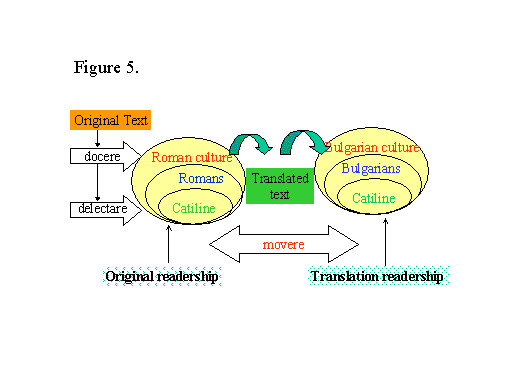 The Bulgarian translator achieved his own didactic task by intentionally robbing and despoiling the source text from its original context (as far as it is possible) and thereby making his translation function in the target culture in the same way any original text would function in it. In order to have impact on the "wide public" which the translation claimed to be intended for, the translator consciously deprived his edition of any historical, geographic or philological commentaries and footnotes. In this way he detached the ancient text from its natural environment in order to transfer it more easily into the new context. He was also concerned about the outer appearance of the edition: he did not mark chapter numbers (as it is traditionally done in editions of ancient texts), because this would be "unusual for Bulgarian readers and for a Bulgarian text" (1940: 10). Therefore, the source text is conceived as entirely identical with the translated one. The original text must be completely hidden behind the target one, in order to accomplish its own objectives in the receiving culture. As a result of the interaction of both contexts and the impact upon the target reading audience, the image of Catiline is transformed into that of a Bulgarian rebel and operates as an integral part of the Bulgarian environment of the 1940's. The Translation of 1982 The second translation of Coniuratio Catilinae in Bulgarian, which is the last so far, was published in 1982. The period we are dealing with saw a remarkable flourishing of translation activities concerning ancient literary works. All of a sudden, ancient texts were as though resurrected as a reaction against the ideological and propaganda biases that had been accumulating for years in the literary system as well as in all areas of life in Bulgaria. They were considered as representatives of a completely alien literary aesthetics. Their translations sought a special place of their own in the Bulgarian literary polysystem and claimed to meet the criteria for a translation act that preserves the literary values of the original in the target culture. The pursuit of equivalence of source and target texts produced new translations of great value. The trend was to make complete translations retaining, as far as possible, both the form and the content of the source texts. Sallust's Coniuratio Catilinae could be best defined, in its own literary and cultural context, as a work of historiography, and more precisely as a historical monograph. The text presents to us only its own version of the ancient world, but a version of an event with a great significance for the writer himself, as well as for his contemporaries in this particular point in Roman history. The immediate significance of the historical context for Sallust's contemporary readers is the first element to be lost in translation. The events Sallust described functioned as history for their contemporary audience. For readers of modern translations, they are rather a literary text that could be classified by the genre labels of 'historiography' and 'monograph,' a model that can be used to create a specific vision of the events having taken place in the remote world of Antiquity. The fact of choosing a specific way of narrating history was significant for the audience to which Sallust addressed his text. The monograph is quite a particular way of telling stories and, since the way a story is told is as substantial as the story itself, there is no doubt that Sallust's reading public consisted of educated people interested both in the events told, as well as in the way they were told.7 Characterizations, be it individual or general (such as in the description of Rome as a background of Catiline's personality and his conspiracy), and their inclination for generalized statements are specific for the genre of monography. The narrative is focused on one event and branches out into many descriptions and digressions of psychological and/or moralizing nature. A literary approach, consisting of analyses of structure, style and theme, is in this case more appropriate than a purely historical one. Furthermore, historiography, as mentioned above, in the context of Roman literature was closer to poetry and oratory, i.e. to literature as we conceive it today. A literary approach is also suitable for the context of translations. Nevertheless, the practical side of the text, however literary, characteristic of any activity or field in Roman cultural context, loses its outlines in the act of translating and transferring the original into a new environment. Actually, the generalizing beginning of Sallust's work, the phrase "omnes homines," bridges in some sense the audience of the original and that of the translated text, and does the same with the practical aspect of its original context. These global specificities of the text are naturally preserved in the Bulgarian translation of 1982.[idáig] The translation, however, does not find any parallels in its new contextual environment. The greater the qualities of a translation of an ancient text, and the more of the original context the translation brings with it in the act of translating, the more separate source and target contexts are. Consequently, the farther readers of the translation are from the ideas of the original. Let me point out here a peculiarity of this new version of Coniuratio Catilinae as opposed to that of 1940: not only are the chapter numbers preserved in it, but at times the years of the historical events are indicated. This, on the one hand, increases the distance between the text and its readers by constantly reminding that the events described happened a long time ago, but, on the other hand, it keeps the readers aware of the original historical framework and does not permit them to see the text as simply a literary work. Actually, the translation expects a specific reading reception situated entirely in the field of history and historiography. Bulgarian reading public is supposed to perceive the text rather as a source for Roman history than as a literary work. Although bearing more contextual elements, the three genre characteristics—docere, movere and delectare—lose their impact in 1982 translation. The audience of the translated text is not seen as parallel with that of the original text, and there are not parallels in the context of the translated text either. The readers of the original text—according to the practical purposes of historiography and literature as a whole in Antiquity - were supposed to be inspired, to be taught by the historian and by history itself. The readers of the translation are not bound to the original context and they do not feel obliged as persons to react in any way to the historical event narrated by the author. The generalizing construction "omnes homines", however, makes the audience expect something referring to them as individuals, to their life and world. In Fig. 6 we can see the differences between the receptions of the original and the translated text. 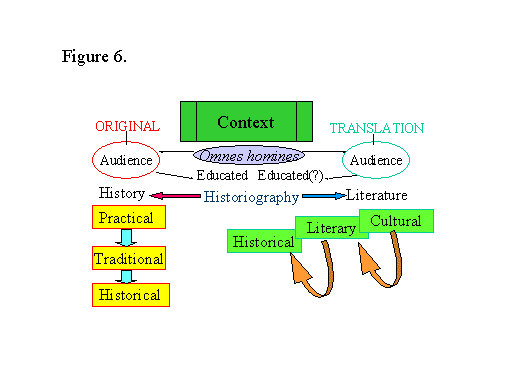 Catiline's conspiracy is an episode of great importance in the given point of Roman history with largely negative implications. That is why, when we examine a text with a historical value, we have to draw a line between facts and events and the way the author perceives them—this means to bear in mind that the author's style is at least as important as the story itself. In the case of Sallust's Coniuratio Catilinae—since Sallust is often accused of anachronical and inaccurate representaion of the facts—style is among the main elements of the work and therefore one of the main elements to be preserved in translation. The significance of the text itself and the events depicted by it are transferred generally - through their repercussions in the course of time, and particularly - through the act of translating, in the Bulgarian literary environment, where the text is of interest mostly for historians and people studying Roman culture and literature, including people involved in the educational system. Linguistic Facts in the Transformation of Literary Imagery in Translation The text of Sallust was intentionally chosen for the specific kind of study presented here because of its distinct sharp style with frequent and imposing use of antithesis, asyndeton and series of historical infinitives; the length, or, actually, the brevity, of sentences; and their rather paratactic than hypotactic structure: all this enables a clear insight into the structure of the text in alignment. The most interesting and substantial element in the monographical narration is beyond doubt the image of Catiline. His first description in chapter 5 is entitely based on the opposition of animus and corpus. The effect of this opposition, a fundamental structural element of Sallust's thought, is completely destroyed in the 1940 Bulgarian translation, since the lexemes "soul" and "body" are removed from the description (see Fig. 7). 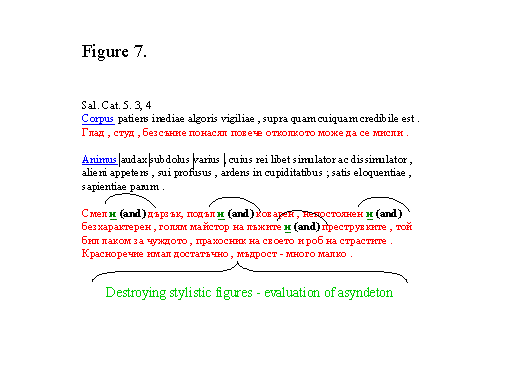 Catiline's persona becomes a generalised figure which enables the reader to identify him with other similar characters in literature and real life. The absence of asyndeton in the Bulgarian text and its substitution with expressions connected through the conjunction "and" softens both Catiline's portrayal and the pejorative meanings of the lexemes through which his description is constructed. The exaggerated translation of the phrase animus ferox in chapter 5.7 with "луда фантазия" ("wild imagination") to a certain extent makes amends for the lost negative connotations in the previous sentences(cf. the parallel sentences in Fig. 8). 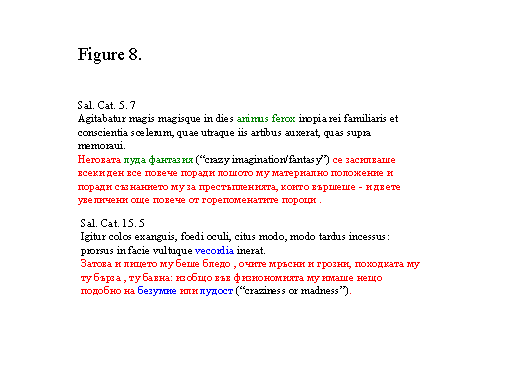 The transformation of Catiline's image goes beyond the depiction of his immediate psychological and physical features. In his quest for identical processes and events in source and target cultures, the Bulgarian translator intervenes also in Catiline's indirect characteristics. Thus, in the circle of Catiline's associates, described as deprave individuals in chapter 14, two kinds of people specific for Bulgarian reality are incorporated in the translated text. One of the additional words ("непрокопсаници") means a man that has not had any success in his life, and the other ("нехранимайковци") means literally a man that "does not feed his mother", i.e. one who does not take care of his parents and family (cf. the parallel sentences in Fig. 9). 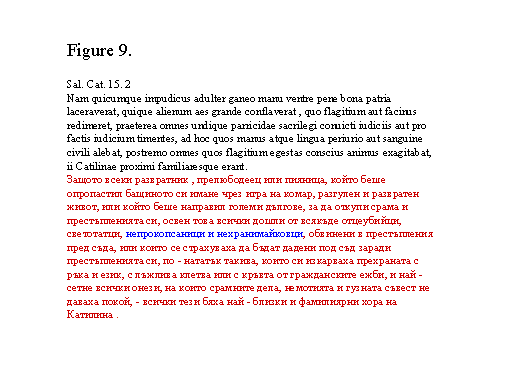 We can also see an attempt on the part of the translator to replace the context of the described events in the way the word tetrarchae is translated in Catiline's speech in chapter 20. In the target Bulgarian text, its equivalent is "князе" ("princes") (cf. the parallel sentences in Fig. 10). 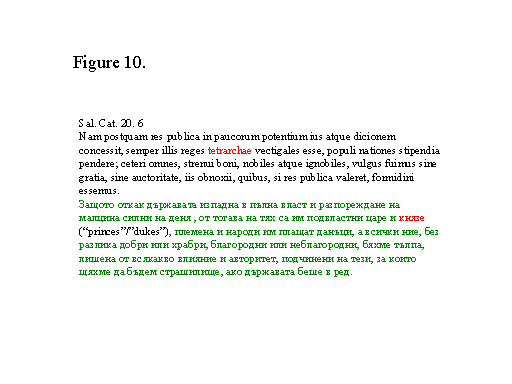 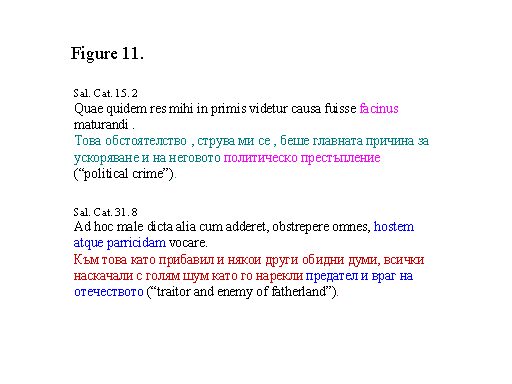 In the original work, Catiline is regarded as a complex figure of the past, with mainly negative, but also some positive features. There are three principal moments in Catiline's personal description contributing to the forming of his portrayal: an introductory character sketch in 5.1-8, a sui generis continuation of it in fragment 15.1-5, and, finally, a passage in 60.4,7 and 61.4. In the introductory sketch—as we already observed - the stress is put on his inner (animus and ingenium) and outer (corpus) personal qualities. The antithesis of animus and corpus, a crucial organizing principle of Sallust's thought and literary structure, is maintained by the connecting expression "magna vi". Thus, a second opposition arises: animus et corpus vs. ingenium. It is to some extent lost in the 1982 Bulgarian translation because of the translation of animus and corpus with two adjectives—"духовен" and "телесен" ("spiritual and corporal"). The change of the structuring elements of the opposition animus and corpus vs. ingenium with the opposition of vis vs. ingenium in the translated text leads the readers in a different direction in forming an image of Catiline's person: he is strong, despite his "bad pesonality" (the Bulgarian equivalent for ingenium, literally equivalent to "character"). On the contrary, the in-depth meaning of the original text original text laying behind the grammatical construction tells us that Catiline is strong and he has a bad character. In Fig. 12 is represented the shift in grammatical characteristics and their impact on author's style and literary image. 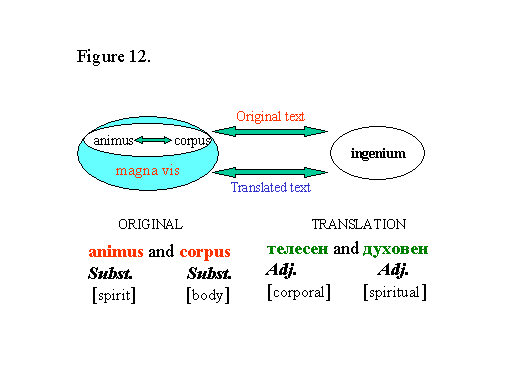 The subtle connection between mental depravity as a fixed feature of the individual character and human behaviour resulting from it remains hidden for the audience of the Bulgarian text. Being strong, that is having great power of body or/and mind, is a static characteristic, and bad personality is a dynamic phenomenon developping in life and society, as readers come to realize in the following passages of the monograph. In this first extended description of Catiline's literary portrayal nouns prevail over verbs. Sallust's strict style, his use of asyndeton and the accumulation of nouns perfectly suit the person depicted. In the translated text we are dealing with, the narrative goes smoother than in the original. Firstly, the length of sentences contributes to this impression of smoothness and continuity: the sentences in Bulgarian are in some cases much lengthier than the Latin ones. In the second place, the contrast results from the specific role of asyndeton. It is through this literary device that Sallust outlines every characteristic of Catiline's animus and corpus: animus audax subdolus varius, corpus patiens inediae algoris vigiliae—every word in this asyndetic construction bears its own closed semantic framework and thus is precisely stressed, which results in quite an evaluative effect on the audience. In the Bulgarian translation the asyndeton is not and cannot be preserved with the same force and emphasis (Fig. 13.). The accord of corpus and the three nouns following the participle patiens is disrupted in the Bulgarian text by a verbal form. 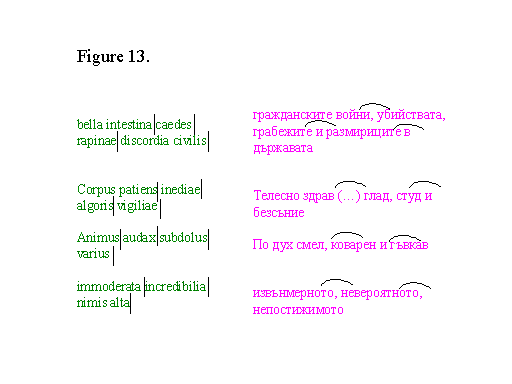 In the following passage, the tone of Catiline's description follows the same direction in two aspects: on the one side, in respect of language, and, on the other, in the relation of actions to external characteristics. Once again built on the opposition of contraries as ius fasque, dis hominibusque infestus, neque vigiliis neque quietibus, modo tardus incessus, the description here puts stress on verbs instead of nouns (Fig. 14). 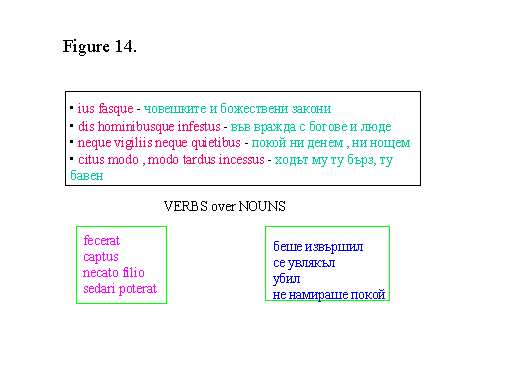 Here, the target text follows closely the source text and the difference in sentence length has diminished. The moral context is equally expressed in both texts as far as Catiline's sexual corruption is concerned. Similarly, the closing descriptions of Catiline at the end of the work are filled mainly with verbal expressions describing Catiline's behaviour as a soldier and his valour at the moment of his death. The strong emphasis on historical infinitives in 60.4 draws the context of the military combat out of its particular historical framework. In Roman cultural space, readers held the opposition domi militiaeque in the back of their minds and, in this sense, the historical infinitives are in Romans' mind really historical, since they put Catiline's military valour in the widely extended context of History, and in the clearly defined context of Roman history and Roman traditional cultural and historical categories. In the Bulgarian text, Catiline's personality is put into the actual environment of the event narrated and its military valour is restricted to his individual person because of the use of the third person singular (as an equivalent to the historical infinitives of Sallust) for the description of his activities. Thus, Catiline's literary persona together with his individual characteristics is preserved, but, in this case, it is to some extent destroyed as a personification of Roman virtues for the readers of the translation. In Fig. 15 the reception of Catiline's character is represented for the original text readership and the translated text audience. 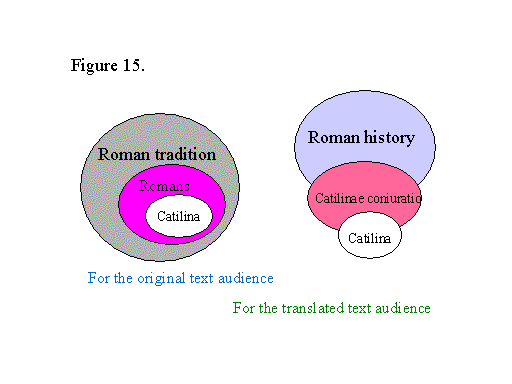 The original text goes back to Catiline's individual features at the end of the passage where traditional Roman values expressed by memor generis atque pristinae suae dignitatis are combined with those of his personality: in confertissimos hostis incurrit ibique pugnans confoditur. The description of his literary portrayal ends with a short phrase depicting his external appearance where the Bulgarian translation text is closely equivalent to the original. Conclusion We have seen that the reception of Sallust's portrayal of Catiline in Bulgarian translation follows closely its source text in particular instances and deviates from it in the general statements where the text requires its own original context and original readership. The readers of the 1982 Bulgarian translation were aware of the importance of the historical event described by it due to their historical and/or philological competence and knowledge of the facts. On the other hand, they could not feel the effect of the literary work on themselves, for it was intended for a tradition and a society quite different from their own. In the context of this translation, Catiline is perceived as a historical figure from a given period that does not have parallels in the framework of modern times. Original and translated contexts do not interact and do not have a common ground. In the reception of the readers, the image of Catiline is, on the one hand, distinctive from the core narrative itself, and on the other hand, is acting in a specific context. Thus, the image, the events, and the context constitute an entity which becomes a part of the target literary polysystem, remaining, in the same time, somehow distinct. Suiting to a great extent the requirements of translation theory and practice, the Bulgarian translation of 1982 makes explicit more contextual elements, which, paradoxically, makes its immediate reader's reception more difficult. The events are faithfully transferred, but remain alien to the wide public. The transformations in Catiline's image are of little importance and are achieved through various linguistic procedures in the act of translation. In contrast, the 1940 translation aims at a reader reception similar to that of the original. In this specific reader reception, past and present historical experiences are connected through the transformation of Catiline's literary portrayal. Through this transformation in the translated cultural framework Catiline becomes a character with typical Bulgarian features and behavioural patterns losing its characteristics of a figure operating in a traditional Roman literary and historical framework. The changes in the contextual elements of his environment raise a specific reader's response, based on the readers' expectation horizon in the target culture. The interaction of both horizons—original and translated—contributes to the aesthetic delight derived from the text and thus to its greater didactic impact, which is one of its main purposes. Here, some questions arise about translated texts whose content refers to remote times and cultures. Is the integrity of the source text the most important thing when a translator seeks for a stronger effect upon the reading audience? Can we intervene in the authenticity of an original whose canonical status is often based on this authenticity and its remoteness in time? Is it worth to deconstruct the source text in every following translation until the point of its complete vanishing? How to conform with both the requirements for preserving the autonomy of the original and for ensuring its adequate reception by an audience that it was not aimed at? Is the authenticity of the source texts more important than their survival, be it in imperfect translations? Does translation means nothing to the original, as Walter Benjamin (1998: 56) puts it? 1 This paper was presented at the Three Years Colloquium of the American Philological Association "Translation in Context" in New Orleans, Louisiana, 3- 6 January, 2003. 2 A detailed overview of the given period could be found in author's article " Prevodnata literatura ot starogracki i latinski u nas predi Osvobojdenieto" (Translated Literature from Old Greek and Latin in Bulgaria before the Liberation from Ottoman Suppression) in: Prevodnata recepcia na evropeyskite literaturi v Balgaria, t. 3 Klasicheska literatura, (Translation Reception of European Literatures in Bulgaria, v. 3 Classical Literature) S., 2002: 6-16. 3 The term is borrowed by Edwin Gentzler in "Contemporary Translation Theories", 1993. 4 For a general survey of the translations edited in this period of time: Gerdjikova, V. "Recepcia na antichnata literatura v Balgaria ot Osvobojdenieto do kraia na parvata svetovna vojna" (The Reception of Ancient Literature in Bulgaria in the Period between the Liberation and the First World War) in: Prevodnata recepcia na evropeyskite literaturi v Balgaria, t. 3 Klasicheska literatura, (Translation Reception of European Literatures in Bulgaria, v. 3 Classical Literature), S., 2002: 17 - 36. 5 A circumstantial description of translation reception of the period could be seen in Gerdjikov, An. "Prevodna recepcia na antichnata literatura v Balgaria v perioda 1918 - 1944" (Translation Rception of Ancient Literature in Bulgaria in the Period 1918 - 1944), in: Prevodnata recepcia na evropeyskite literaturi v Balgaria, t. 3 Klasicheska literatura, (Translation Reception of European Literatures in Bulgaria, v. 3 Classical Literature), S., 2002: 37 - 55. 6 The identification of the source audience and the receptors is characteristic for the so called by Eugene Nida "dynamic equivalence" or "functional equivalence" (Nida & De Waard: 1986: 25) in translation acts, but the ways it is accomplished in the Bulgarian translation are quite different from that, suggested by Nida, e.g. the change of the name of Catiline with a Bulgarian name or other changes of that kind. 7 Kraus and Woodman (1997) in their introduction are citing S. Chatman (1978) "Story and Discourse": "The way a story is told is as important as the story itself". References: Benjamin, W., Zadachata na prevodacha (Translator's Task), in: Lettres Internationales, S., 1998: 56 - 60. Gentzler, E., Contemporary Translation Theories, L., 1993 Gerdjikov, An. "Prevodna recepcia na antichnata literatura v Balgaria v perioda 1918 - 1944" (Translation Reception of Ancient Literature in Bulgaria in the Period 1918 - 1944), in Prevodnata recepcia na evropeyskite literaturi v Balgaria, t. 3 Klasicheska literatura, (Translation Reception of European Literatures in Bulgaria, v. 3 Classical Literature), S., 2002: 37 - 55. Gerdjikova, V. "Recepcia na antichnata literatura v Balgaria ot Osvobojdenieto do kraia na parvata svetovna vojna" (The Reception of Ancient Literature in Bulgaria in the Period between the Liberation and the First World War) in: Prevodnata recepcia na evropeyskite literaturi v Balgaria, t. 3 Klasicheska literatura, (Translation Reception of European Literatures in Bulgaria, v. 3 Classical Literature), S., 2002: 17 - 36. Kraus, C.S., Woodman A. J., Latin Historians, Ox., 1997 Nida, A. E., De Waard, J., From One Language to Another, Nashvill, 1986 Salustiy, Sazaklyatieto na Katilina (Catiline's Conspiracy), S., 1940 Salustiy, Istoricheski sachineniya (Historical Works), S., 1982 ........."Prevodnata literatura ot starogracki i latinski u nas predi Osvobojdenieto" (Translated Literature from Old Greek and Latin in Bulgaria before the Liberation from Ottoman Suppression) in: Prevodnata recepcia na evropeyskite literaturi v Balgaria, t. 3 Klasicheska literatura, S., 2002 (Translation Reception of European Literatures in Bulgaria, v. 3 Classical Literature) Wilkins, A. Th., Villain or Hero. Sallust's Portrayal of Catiline, N.Y., 1994
E-mail this article to your colleague! Need more translation jobs? Click here! Translation agencies are welcome to register here - Free! Freelance translators are welcome to register here - Free! |
|
|
|
|
|
|
| |||
Legal Disclaimer Site Map |
 History
is probably the field where one can find most parallels
between modern and ancient concepts of life and world. Why
history? Because history is a continuous sequence of events,
where context provides images of different individuals that
we can imitate or, on the contrary, try to not imitate.
For the value of history is measured by the possibility
for deducting morals to be applied in every context. Thus,
in the constant change of contexts, some images remain the
same and others change their shapes in order to serve various
purposes. As far as translation theory is concerned, the
reception of history is determined to a great extent by
the strategies chosen by different translators, as well
as their objectives. Two Bulgarian translations of Sallust's
Coniuratio Catilinae, edited in Bulgaria in 1940
and in 1982, provide examples of two different ways of reception
of a particular part of ancient history and ancient literary
models. As a matter of fact, these two texts are the only
complete translations of Coniuratio Catilinae in
Bulgarian.
History
is probably the field where one can find most parallels
between modern and ancient concepts of life and world. Why
history? Because history is a continuous sequence of events,
where context provides images of different individuals that
we can imitate or, on the contrary, try to not imitate.
For the value of history is measured by the possibility
for deducting morals to be applied in every context. Thus,
in the constant change of contexts, some images remain the
same and others change their shapes in order to serve various
purposes. As far as translation theory is concerned, the
reception of history is determined to a great extent by
the strategies chosen by different translators, as well
as their objectives. Two Bulgarian translations of Sallust's
Coniuratio Catilinae, edited in Bulgaria in 1940
and in 1982, provide examples of two different ways of reception
of a particular part of ancient history and ancient literary
models. As a matter of fact, these two texts are the only
complete translations of Coniuratio Catilinae in
Bulgarian.

