|
 |
 |
 |
|
|
Home | More Articles | Join as a Member! | Post Your Job - Free! | All Translation Agencies | |
|
|||||||
|
|
|
|
Maturity Levels for Localization Suppliers
Versão em português Can you tell how mature a vendor you are?
They define five levels:
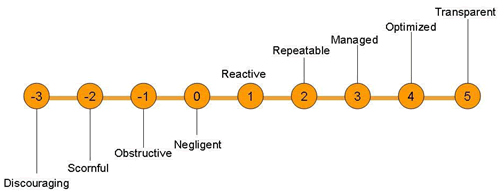
The brief level descriptions I share here reflect my own interpretation. For details, please read the full paper; it is well worth the effort! It is not my intention to discuss their levels, but to offer some additional ideas based on CSA’s concepts. The white paper describes how a localization buyer evolves from ad hoc solutions at Level 1 through more and more advanced processes, to a full integration of localization into production. People within companies buying localization can use the white paper for self-assessment purposes (“Where are my gaps and what do I need to do in order to close them?”) and management education purposes (“Why is localization so costly and what can we do in order to make it cost efficient?”). However, as I represent a supplier, I would like to start with the man in the mirror and ask: What about the supplier side? You could, of course, argue that the progression of the buyer side is the determining factor of success[2], but that would already assume a certain level of maturity on the supplier side. When I take a look around that is not so obvious to me! Localization buyers often seem to have similar doubts, since they tend to ask the larger vendors for their services assuming a higher degree of maturity comes with size. So I would like to propose maturity levels on the supplier side as a mirror image of the CSA levels:
The Localization Maturity Model (LMM) Phases Source: Common Sense Advisory, Inc. I realize these levels need some polishing and thinking. Take them as a first attempt after a brief reflection. Nevertheless, they show that companies on the supplier side have to climb a ladder, too. In the scope of this article, a thorough discussion as in CSA’s paper clearly is out of the question, but here are a few details: Level 1 New companies, often founded by a group of translators, clearly are in Reactive Mode: they need to accept every job they can get from their clients and do what they are told to do with the content. This includes word processors and TMs to be used. This is a typical situation with translation companies serving verticals such as the mechanical engineering industry or with single-language vendors (SLVs) acting as subcontractors to multi-language vendors (MLVs). Level 2 While growing and gaining more experience, these companies introduce the concept of TMs and terminology databases to clients who happen to be at Level 1 and, at the same time, start a specialization process: some of their people focus on project management, some on linguistic issues, and others even take on the daunting task of engineering. At this level, the vendor typically starts to work for larger clients and/or software publishers directly (not only through MLVs). Level 3 Processes become better defined (in writing!) and differentiated (there is not just one process for every localization job). Specialists are brought in from the outside in order to improve certain tasks: PM, DTP, engineering, audio… This is a typical industrialization step: companies, can only grow beyond certain sizes when they introduce more and more specialization. Level 4 Many process steps are automated, at first by macros, scripts and small applications written by employees or freelancers, but then also by workflow tools, database applications, etc. bought for specific purposes or specific clients. At this level, automation of processes is well documented in contrast to the ad hoc use of macros and scripts characteristic of the previous levels. Level 5 Technologies and processes are completely aligned to customer’s needs in order to enable a full integration necessary e.g. to deal with large, frequently changing volumes of content, such as consumer web sites for telecom companies or support web sites (keywords: CMS, GMS, centralized linguistic assets, etc.). Interestingly enough, the role of the localization vendor clearly changes from level to level. In Level 1, there is a distinct master/servant relationship: the buyer tells the supplier what to do. Over the next levels, the vendor’s role increasingly includes consulting tasks leading to a more active role of the vendor. And in Level 5, the localization vendor truly becomes a partner of the localization buyer. So what does it all mean or has it a meaning at all? I believe it does have meaning. Hence, I would like to open up three topics for discussion: A. Is the sum of the maturity levels on both sides a potential measure of success? At first sight, this is tempting: a mature buyer can afford to use a less mature supplier, at least for non-critical projects or projects of lesser scale. On the other hand, a mature supplier can work well with a less mature buyer (at the cost of higher efforts). If you take a closer look, there is a third dimension: the complexity of the project itself. Thus you could ask whether a sum of maturity levels of – let us say - 6 would be sufficient to solve a localization complexity of Level 2 (however that is defined). This seems to be a bit academic, but please take another look after having read topic C. B. Is there a direct link between the size of a localization vendor and its maturity level? Again, the easy answer seems to be ‘yes’. For example, it is virtually impossible for a small company to become truly integrated with the client, at least in scenarios as described above. On the other hand, a small company run by experienced people can easily reach Level 4 (or even 5 in the case of moderately-sized projects). C. Could the maturity levels evolve to something that delivers more realistic metrics for the “quality” of a localization provider than existing ISO or EN standards? This is the most exciting topic to me: ISO 9000 standards are directed towards production companies and thus do not really cover service companies. (Yes, I know, they can be and are applied to service companies, but there is a lot of arm twisting going on in order to get there). And the new EU standard for translation quality contains some rather unrealistic requirements in view of today’s practices and expectations. A maturity level, on the other hand, could give buyers a realistic image of the consistent quality levels they can expect from a certain supplier and probably of the cost level, too. I also see another opportunity that might prove to be even more important. Traditionally, localization vendors like to complain that their role is underestimated, that localization is an afterthought, and of course that the low value attributed to localization leads to an insufficient reimbursement of their labor. Well-defined maturity levels could render it much easier to describe the role, tasks, and processes of localization vendors to ‘outsiders’. So instead of telling a potential client, “We are performing translation plus a lot of additional tasks” or creating a nice marketing story that unfortunately has no real meaning to the client and hence does not explain anything, a reference to established LMMs (localization maturity levels) could make the explanation meaningful and professional at the same time. [1] DePalma, Donald, Beninatto, Renato, and Sargent, Benjamin. Localization Maturity Model 1.0: Applying a Capability Maturity Model to Technology, Product, and Website Globalization. Common Sense Advisory, 2006. [2] Esselink, Bert."Buying Maturity in Localization." GALAxy newsletter. Q4 2006. After finishing his studies in mathematics and physics, Joergen Danielsen founded his first translation company S&D in 1983 and sold it to INTL.com in 1998. He became President of the Enterprise Solutions Business Unit with INTL.com handling all ERP and CRM clients worldwide. When INTL.com was acquired by Lionbridge, he moved to the US as VP Process and Technology working out of the Waltham headquarters. After three more years as Managing Director of Lionbridge Germany, Joergen founded Eule Lokalisierung GmbH, a small, customer-focused localization company based in Kiel, Germany.
|
|
|
|
|
|
|
| |||
Legal Disclaimer Site Map |