|
 |
 |
 |
|
|
Home | More Articles | Join as a Member! | Post Your Job - Free! | All Translation Agencies | |
|
|||||||
|
|
|
|
Exploring Translation Corpora with MkAlign
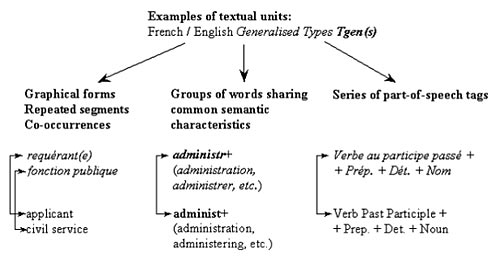
This paper presents a series of experiments devoted to the development of a new tool for multilingual textometric exploration of translation corpora. We propose to use bitext topography to facilitate the study of lexical equivalencies on quantitative bases. The suggested approach opens up new horizons for interactive exploration of translation resources of multilingual texts in a variety of fields of study: translation, foreign language learning and teaching, bilingual terminology, lexicography, etc. Keywords: bitext map, quantitative analysis, translation correspondences. In a constantly changing information society, researchers and practitioners are continually faced with growing volumes of multilingual text data of all kinds: electronic archives of translated texts, multilingual databases, international web sites, etc. Different communities are increasingly interested in multilingual text processing for a variety of reasons. In this respect, development of computer tools for exploring intertextual correspondences between related parts of multilingual texts is an important research issue. Considerable progress has been made in the field of parallel text alignment and bilingual lexicon extraction (Véronis, 2000). Current text alignment algorithms perform quite successfully on the sentence level. However, there is a need to continue research in finer-grained text alignment. At the same time, huge volumes of non-parallel, yet comparable corpora are currently available in almost any field of knowledge. In this respect, the challenge is to discover links between different parts of such corpora on the word level (Déjean and Gaussier, 2002). Automatic discovery of lexical correspondences in multilingual texts is closely connected to empirical study of the translation process. The development of translation description models is an intricate task. In order to deal with the inherent complexity of translation correspondences, current computer systems extend the notion of multilingual text processing to deal with multi-level language structures. Linguistic and/or pragmatic knowledge of different nature is used to identify potential word candidates for lexical alignment which remains quite difficult. Recent developments have shown that quantitative methods used in textometric analysis open up new horizons for identifying translation correspondences in bilingual texts (Zimina 2004ab), (Zimina 2005ab). Most of these methods have not been exploited in the field of multilingual text processing to their full potential. The present article outlines a series of experiments devoted to the development of a new textometric tool for creating, editing and exploring translation corpora: MkAlign (Fleury and Zimina, 2006). 1. Textometric analysis of multilingual texts In a French-speaking community, the term textometric analysis (in French: "analyse textométrique") covers a series of methods that enable the researcher to formally reorganize textual sequences and to conduct statistical analysis based on the vocabulary of a corpus of texts (Salem 1987), (Lebart, Salem and Berry 1997). The vocabulary is a set of distinct graphical forms found in a corpus. A graphical form is a series of non-delimiting characters bounded by two delimiting characters. The occurrences of graphical forms are entirely defined by the list of delimiting characters chosen by the user. Once the list of delimiting characters is established (e.g.: .,:;!?/_\ '""()[]{}э$ and the space character), other characters become non-delimiting characters. Any series of non-delimiting characters bounded by delimiting characters is considered an occurrence (token). A form is then identified as a type corresponding to identical occurrences in a corpus of texts. Abrupt changes that occur in the distribution of a graphical form in different contexts (parts) of a corpus may raise questions concerning the identification of other related graphical units (different manifestations of the same lemma, forms related on the semantic level, etc.). Textometric tools (such as Lexico3 and COOCS) 1 allow the analyst not only to subdivide the text into graphical forms, but also to identify other types of textual units (see Figure 1):
The Tgen(s) selection has been largely implemented in Lexico3 textometric toolbox (Lamalle et al., 2004). In order to facilitate the creation of types that collect occurrences of different graphical forms according to a common characteristic, the user might work with dynamic lexical storage facilities, such as Word-store. This feature allows for the memorization of forms, segments, Tgen(s) for later use.
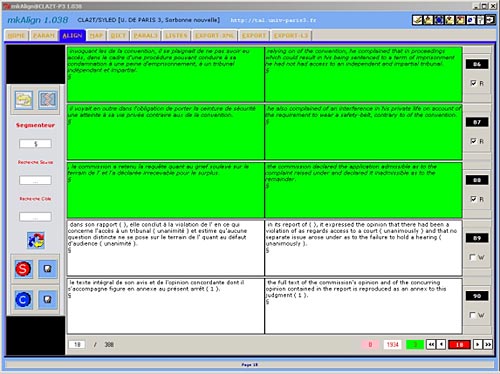
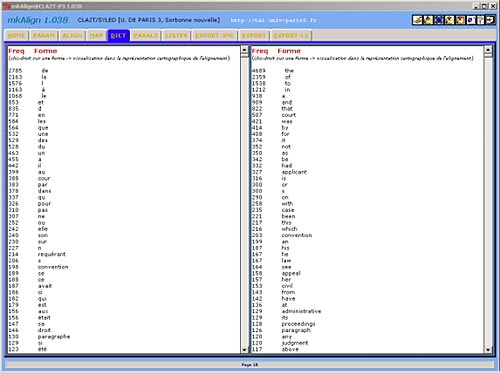
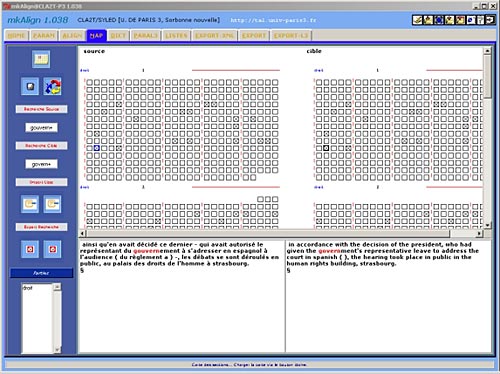
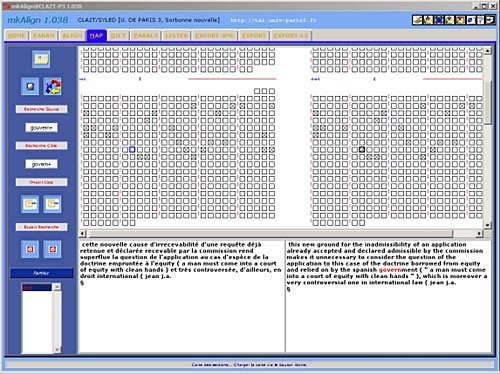
Figure 1: Examples of textual units Tgen(s) 2. Textometric browsing with a bitext map As we have shown in figure 1, the concept of type/token relationship might be extended to provide a much broader definition of textual units or generalized types Tgen(s). By following these principles, it becomes possible to consider a "spatial" approach to localization of textual units within the text corpora. The concept of textometric browsing enables the user to move among the results produced by different quantitative methods and the original bitext (Lamalle and Salem, 2002; Lamalle et al., 2004). In bilingual corpora, it is convenient to visually identify corresponding parts of texts through bitext topography (Zimina 2004ab; 2005ab). In order to visualize corresponding parts, the bitext must include tags that indicate the parallel structure of the corpus. The insertion of keys is crucial in the preparation of the corpus. Such pre-coding permits the study of the distribution of occurrences of a given textual unit within the sections thus defined. The selected keys allow the user to compare corresponding textual fragments (sections, paragraphs, phrases, etc., cf. Figure 2). In parallel text processing, the insertion of section delimiters can be performed through parallel matching of corresponding parts in different languages: logical partitions (author, year, date, etc.) and marks for breathing (sentences, paragraphs, etc.). The MkAlign bitext map allows for the visualization of the corpus cut into corresponding sections by raising one (or several) characters (e.g.: 'э') to the rank of parallel section delimiters. This visualization permits the user to produce an automatic selection of sections in one of the monolingual parts of the bitext where any textual unit under study (word, collocation, repeated segment, etc.) is found. The selected sections of the map are highlighted. At any moment, the user is allowed to reiterate a topographic selection in any corpus part for further investigation of translation correspondences on the word level. In order to describe how textometric browsing works, we shell provide some corpus-based examples. 3. Mapping lexical correspondences in parallel contexts with MkAlign This section illustrates some principles of interactive textometric browsing in parallel contexts. For illustration purposes, we shall use a piece of French-English parallel corpus Convention. 2 Step One (see Figure 3-4):
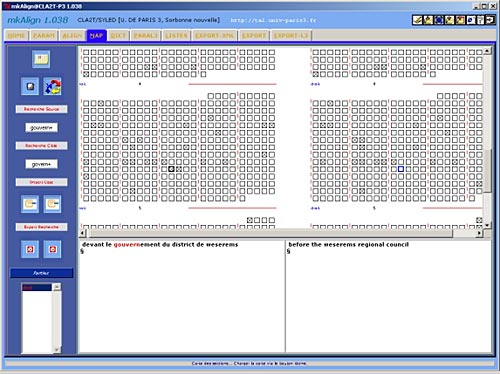
Step Two (see Figures 5-6):
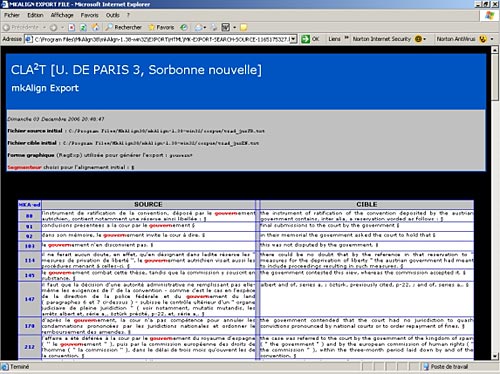
gouvernement du district ~ regional council la législation sur la fonction publique ~ legislation governing the civil service. As a rule, these singular contexts are particularly difficult to reveal through traditional bilingual lexicon extraction methods due to their low repetition frequency and/or unusual semantic or syntactic properties. Our "topographic approach" of translated texts enables to draw the attention of the user to very subtle translation phenomena through a relatively straightforward technique of bitext map exploration based on distributional analysis. The related text is visualized by clicking on the squares representing these sections on the map. It becomes possible to go through the text displayed in the toolbox in order to discover meaning of translation correspondences. Step Three (see Figures 6-7):
Upcoming research will help to extend existing features of MkAlign towards non-parallel yet comparable corpora. We are currently working on contextual vectors identification to capture corresponding areas in related texts. In this respect, MkAlign offers many possibilities of report generation through exporting and importing source and/or target corresponding text zones in different formats: xml, html, txt. In other words, the user "captures" special areas of bilingual corpora according to particular distributional criteria (absence or presence of certain lexical items or word groups). Generated sub-corpora are then re-imported into the bitext editor (ALIGN) for cross-check, editing and alignment. These interactive text management facilities are already available in the currently distributed v. 1.038 MkAlign. Future work will help to identify specific application scenarios and allow for further advances in this direction. Conclusions Bilingual lexicon extraction from translation corpora lacks flexibility when it comes to explore multiple translation correspondences between polysemous lexical units. In this article, we presented a new tool for cross-language exploration of bilingual corpora: MkAlign. This tool is based on quantitative methods of textometric analysis. The concept of textometric browsing is central in corpus investigation. It is unique in that it allows the user to maintain control over the entire corpus exploration, from initial segmentation to the extraction and editing of text resources. The units that are then counted automatically originate entirely from the list of delimiters provided by the user, with no need for outside dictionary resources. The suggested approach offers new means for context-based study of translation corpora and for detection of multiple translation correspondences.
Figures 2-3: Bitext segmentation, alignment and editing with MkAlign
Figures 4-5: Locating distribution similarities and breaking points with MkAlign
Figures 6-7: Browsing in parallel contexts and XML report generation with MkAlign Notes 1 On Lexico3 and COOCS Tools : http://www.cavi.univ-paris3.fr/. 2 The corpus Convention is composed of the European Convention for the Protection of Human Rights and Fundamental Freedoms as well as a series of related protocols and judgements of the European Court of Human Rights. This corpus was used in a variety of methodological studies within the research center SYLED-CLA2T (Paris 3 University). See, for instance, (Zimina, 2005b). References Books: Lebart, L., Salem, A. and Berry L. (1997) Exploring Textual Data (Boston: Kluwer Academic Publishers). Salem, A. (1987) Pratique des segments répétés : essai de statistique textuelle (Paris : Klincksieck). Véronis, J. (ed.) (2000) Parallel Text Processing: Alignment and use of translation corpora (Dordrecht: Kluwer Academic Publishers). Articles in Journals: Déjean H, Gaussier, É. (2002) Une nouvelle approche à l'extraction de lexiques bilingues à partir de corpus comparables. Lexicométrica, no. 'Corpus alignés'. Available on-line from http://www.cavi.univ-paris3.fr/. Articles in Conference Proceedings: Lamalle, C. and Salem, A. (2002) Types généralisés et topographie textuelle dans l'analyse quantitative des corpus textuels. JADT'02, Saint-Malo, 2002, 403-412. Available on-line from http://www.cavi.univ-paris3.fr/. Zimina, M. (2004a)
L'alignement textométrique des unités
lexicales à correspondances multiples dans
les corpus parallèles. JADT'04, Louvain-la-Neuve,
2004, 1195-1202. Available on-line from Zimina, M. (2005a) Bi-text Topography and Quantitative Approaches of Parallel Text Processing. Corpus Linguistics Conference Series, Vol. 1, no. 1 (Centre for Corpus Research, Birmingham University). Available on-line from http://www.corpus.bham.ac.uk/PCLC/ PhD Theses: Martinez, W. (2003) Contribution à une méthodologie de l'analyse des cooccurrences lexicales multiples dans les corpus textuels (PhD Thesis, Paris Sorbonne University - Paris 3). Zimina, M. (2004b)
Approches quantitatives de l'extraction de ressources
traductionnelles à partir de corpus parallèles
(PhD Thesis, Paris Sorbonne University - Paris 3).
Available On-line publications: Lamalle, C., Martinez, W., Fleury, S., Salem, A., Fracchiolla, B., Kuncova, A., Lande, B., Maisondieu, A. and Poirot-Zimina, M. (2004) Lexico3 Textometric toolbox User's manual (Centre of Textometrics CLA2T, Paris Sorbonne University - Paris 3). Available on-line from http://www.cavi.univ-paris3.fr/ Fleury, S., Zimina, M. (2006) MkAlign. Manuel d'utilisation (Centre of Textometrics CLA2T, Paris Sorbonne University - Paris 3). Available on-line from http://tal.univ-paris3.fr/. Zimina, M. (2005b) Equivalencies traductionnelles. Rapports d'analyse : Navigations textométriques avec Lexico3 (Centre of Textometrics CLA2T, Paris Sorbonne University - Paris 3). Available on-line from http://www.cavi.univ-paris3.fr/.
E-mail this article to your colleague! Need more translation jobs? Click here! Translation agencies are welcome to register here - Free! Freelance translators are welcome to register here - Free! |
|
|
|
|
|
|
| |||
Legal Disclaimer Site Map |
 Abstract