|
 |
 |
 |
|
|
Home | More Articles | Join as a Member! | Post Your Job - Free! | All Translation Agencies | |
|
|||||||
|
|
|
|
The Art of Poetry and its Translation
“Poetry must be translated by a poet” Eghishe Charents
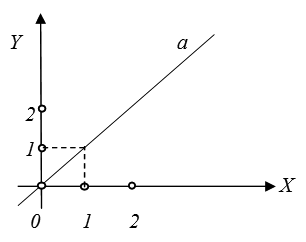
Translation of poetry is one of the most difficult and challenging tasks for every translator. Returning to Robert Frost’s definition, according to which “Poetry is what gets lost in translation”, we can say, that this statement could be considered as a truthful one to a certain extent because there is no one-to-one equivalent when comparing two languages. Even if the translators possess a profound knowledge in the source language they would not be able to create a replica of the original text. In the theory of Translation Studies there are different approaches to the problems in this sphere of translation. Among the outstanding translators and translation theorists John Dryden in his article “The Tree Types of Translation” spoke about the verbal copier of a poem, who “is encumbered with so many difficulties at once”, that he cannot get out of it. Describing verbal translation of a poem as something impossible he mentions, that the translators are “to consider, at the same type, the thought of his author, and his words, and to find out the counterpart to each in another language” being confined to the compass of numbers, and the slavery of rhyme. He approaches the claim of the Armenian prominent writer and translator, Eghishe Charents who is sure that a poem is to be translated by a poet. John Dryden writes about this “No man is capable of translating poetry besides a genius to that art”. He also adds, that the translator of poetry is to be the master of both of his author’s language and of his own.* Another theorist in TS, Friedrich Schleiermacher, highlights the importance of the sound in poetry as one of the major problems in translation and defines poetry as a work, ”where a most excellent and indeed higher meaning resides in the musical elements of language as they are manifested in rhythm”. According to him “whatever seems to have an impact on sound qualities and the fine-tuning of feeling and thus on the mimetic and musical accompaniment of speech- all this will have to be rendered by our translator”.* American poet, critic and translator Ezra Pound whose experience in poetry translations goes far beyond theory, believes that much depends on the translator. “He can show where the treasure lies, he can guide the reader in choice of what tongue is to be studied…”. He calls this as an “interpretive translator” of poetry. Parallel to it he offers “other sort” of translation, “where the translator is definitely making a new poem”*. Thus there are two types of poetry translation, one which directly renders the thought of the author, and the second, which is based on the original, but transfuses some new spirit. Admittedly, if the translator succeeds in rendering both the form and the content, the translation is considered to be a successful one. This point of view has been sphere of investigation for Eugin Nida, professional linguist and Bible translator. He underlines the difference between prose and poetry highlighting the importance of form. “Only rarely can one reproduce both content and form in a translation, and hence in general the form is usually sacrificed for the sake of the content”. The translator of poetry aims at producing “on his reader an impression similar or nearly similar to that produced by the original”.* In fact “every poem is a poem within a poem; the poem of the idea and the poem of words” (Wallance Stevens). Without idea words are empty, without words idea is empty. The translator is to avoid of the emptiness. Roman Jakobson writes in his article “On Linguistic Aspects of Translation” about the possibility and impossibility of translation and defines poetry as “by definition untranslatable. Only creative transposition is possible”. To sum up the theoretical approaches of the above mentioned people, it is admittedly clear, that poetry is the most difficult type of text and can be considered to be untranslatable. But if we have the vivid examples of successful translations of poetry, we can never claim that it is untranslatable. They also touched the problems like the freedom of the translator, which in our opinion is to be confronted. We can never refer to a rendering as a translation if it is just an original-based work. It must be close to the original as much as possible. This all can be reflected in the following diagram (1).
The diagram is in state of Y=X, where X stands for the translation, Y for the quality of the translation. The line a stands for the translation process which shares the right angle into two equal parts (45°) denoting that during his translation process the translator pays equal attention to the quality of his work and the idea of the original, trying not to go beyond the author’s words. The point O depicts the original work and the best and most successful translation. The two points coinside, because they are one and the same work in different languages. If the translation is far from O for 1 unit, then the quality of the translation reduces to 1 unit. Correspondingly if the translation goes far for 2 units, the quality reduces to 2, etc. To put poetry translation and its quality in a rough way, we use this materialistic and vivid way to depict it. But this does not give the idea what a translator should do. In reality, what should be preserved when translating poetry are the emotions, the invisible message of the poet, the uniqueness of the style in order to be reached the same effect in the target language as it is in the source. When talking about the translation of poetry we could not but mention some of the numerous problems encountered during this process. Firstly, we would like to draw the attention to the form of a poem. This is probably the first thing that the reader notices before reading. The translator should try to be as closer to the original as he/she can. For example, if haiku has to be translated, the short meaningful and condensed form should be preserved, because an author chooses deliberately the form and the structure of the poem as an inseparable part of the overall message that should be transferred and sensed by the readers. Thus for instance sonnet (fourteen lines) cannot turn into a villanelle (five three-line tercets and a final four-line quatrain), or an elegy (a lament for the dead) into an ode (devoted to the praise or celebration). Types of poetry are also important. It is necessary for the translator to understand whether he/she deals with a narrative or a lyric poetry. Because the difference between them is huge. Narrative poems stress story and action, and lyric poems stress emotion and song. The second matter to discuss is the shape of a poem. A pictogram is visually concrete and has special shape. For example Lewis Carrol’s “The mouse’s tale” taken from Alice’s Adventures in Wonderland” is translated into Armenian with a shape of a tale of a mouse. And here the choice of the translator is commendable. The shape of poetry is also in its stanzas. The translator can invert the stanzaic form of a poem during the translation if it is not compulsory to keep. But it is better to translate from the couplet (a pair of linked verses) into a couplet, from a tercet (three successive lines bound by rhyme) into a tercet, from quatrain (a stanza of four lines) into a quatrain, from a quintain (a five line stanza) into a quintain, and from sestets (a six-line stanza) into a sestets, etc. (septet, octet, Spenserian, seven-, eight- and nin-line stanzas respectively)[2]. The third range of problems that occur while translating poetry are the nuances of word’s meaning. The translator can be confused in two ways. On the one hand he/she can find difficulties in understanding which from the numerous meanings of the word the author has used. On the other hand, he/she can be puzzled which equivalent from the target language to use. Emily Dickinson writes;
So the words must be under close examination of a translator. It is important to find out whether the word is used in its denotative, dictionary meaning or its connotative meaning, “which is the associated meanings that have built up around the word, or what the word connotes”[3]. Through the effects of the words the authors use in their poems they make an imagery. Poems include such details which trigger our memories, stimulate our feelings, and command our response. The ideas in poetry are important, but the real value of a poem consists in the words that work their magic by allowing us to approach a poem is similar to Francis’s “Catch” implies: expect to be surprised; stay on our toes; and concentrate on the delivery. This all is done by the words. Sometimes their meaning goes even far and reaches to the creation of some stylistic effects. Among them the most typical for poetry is metaphor. “It is metaphor, saying one thing and meaning another, saying one thing in terms of another, the pleasure of ulteriority. Poetry is simply made of metaphor”(Robert Frost, ”The Constant Symbol”). Another stylistic figures include hyperbole or exaggeration, synecdoche or using part to signify the whole, metonomy or substituting an attribute of a thing for the thing itself, personification, endowing inanimate objects or abstract concepts with animate characteristics or qualities, etc*. The problems accuring in the process of translation may be concerned with the different elements of poetry. We can learn to interpret, appreciate and translate poems by understanding their basic elements. The elements of a poem include a speaker whose voice we hear in it; its diction or selection of words, its syntax or order of those words; its imagery or details of sight, sound, taste, smell, and touch; its figurative language or nonliteral ways of expressing one thing in terms of another, such as symbol and metaphor; its sound effects, especially rhyme, assonance, and alliteration; its rhythm and meter or the pattern of accents we hear in the poem’s words, phrases, lines, and sentences, and its structure or formal pattern of organization. We would like to discuss another matter causing a lot of problems in translating poetry, which is the grammatical difference between the languages. The grammatical rules compulsory for the prose are not obligatory for the poems or we could just say that the poets do not follow them strictly wherefore the translators are usually puzzled over such very creative works. Sometimes, the poets in their imaginativeness offer really unusual, striking, new and surprising works, which are difficult for translation. The translator should be combinative in order to transfer this novelty, hidden sense or specific grammatical structure. So as to clarify the situation we can pay attention to the second person pronoun and its usage. This transition in styles should be preserved in the target language because it carries the whole emotional and psychological world of a poet. For instance, the word “you” is sometimes difficult to translate. It can either be “¹áõ” or ”¸áõù”. In this case the translator must catch the intension of the author. Of course the grammatical shifts are possible in poetry translation, because here the translator aims at transmitting more the content. So any choice of the translator to change the grammatical form can be justified until it spoils the meaning. Poetry has always been closely related to music. It “is an art of rhythm but is not primarily an effective means of communication like music”[4]. It, as well as being something that we see, is also something that we hear. “There remains even now a vibrant tradition of poetry being delivered orally or “recited”; and even the silent reading of poetry, if properly performed, should allow the lines to register on the mind’s ear.”[5] When speaking about the sound the first thing to mention is rhyme, which can be defined as the matching of final vowel or consonant sounds in two or more words. Thouth there are unrhymed poems, they give in in the point of view of their sound value. Robert Frost, who wrote traditional rhymed styles, growled that writing without rhyme is like “playing tennis with the net down”. It is a little strict, because many rhymed lines look and sound better in an unrhymed shape. In fact, sound is anything connected with sound cultivation including rhyme, rhythm, which refers the regular recurrence of the accent or stress in a poem, assonance or the repetition of vowel sounds, onomatopoeia, which implies that the word is made up to describe the sound, alliteration or the repetition of the same sounding letters, etc. A translator must try to maintain them in the translation. As Newmark (1981: 67) states, "In a significant text, semantic truth is cardinal [meaning is not more or less important, it is important!], whilst of the three aesthetic factors, sound (e.g. alliteration or rhyme) is likely to recede in importance -- rhyme is perhaps the most likely factor to 'give' -- rhyming is difficult and artificial enough in one language, reproducing line is sometimes doubly so." In short, if the translation is faced with the condition where he should sacrifice one of the three factors, structure, metaphor, and sound, he should sacrifice the sound. On the other hand, the translator should balance where the beauty of a poem really lies. If the beauty lies more on the sounds rather than on the meaning (semantic), the translator cannot ignore the sound factor. The fourth thing that can cause problems in translation is the cultural differences. I would like again to refer to Osers’s article “Some Aspects of the Translation of Poetry”. A profound knowledge is necessary for the translation of idioms and phrases too, which are a product of the specific traditions and mentality in one’s country. Words or expressions that contain culturally-bound word(s) create certain problems. The socio-cultural problems exist in the phrases, clauses, or sentences containing word(s) related to the four major cultural categories, namely: ideas, behavior, product, and ecology (Said, 1994: 39). The "ideas" includes belief, values, and institution; "behavior" includes customs or habits, "products" includes art, music, and artifacts, and "ecology" includes flora, fauna, plains, winds, and weather. In translating culturally-bound expressions, like in other expressions, a translator may apply one or some of the procedures: Literal translation, transference, naturalization, cultural equivalent, functional equivalent, description equivalent, classifier, componential analysis, deletion, couplets, note, addition, glosses, reduction, and synonymy. In literal translation, a translator does unit-to-unit translation. The translation unit may range from word to larger units such as phrase or clause. He applies 'transference procedure' if he converts the SL word directly into TL word by adjusting the alphabets (writing system) only. The result is 'loan word'. When he does not only adjust the alphabets, but also adjust it into the normal pronunciation of TL word, he applies naturalization. In addition, the translator may find the cultural equivalent word of the SL or, if he cannot find one, neutralize or generalize the SL word to result 'functional equivalents'. When he modifies the SL word with description of form in the TL, the result is description equivalent. Sometimes a translator provides a generic or general or superordinate term for a TL word and the result in the TL is called classifier. And when he just supplies the near TL equivalent for the SL word, he uses synonymy. In componential analysis procedure, the translator splits up a lexical unit into its sense components, often one-to-two, one-to-three, or -more translation. Moreover, a translator sometimes adds some information, whether he puts it in a bracket or in other clause or even footnote, or even deletes unimportant SL words in the translation to smooth the result for the reader. These different procedures may be used at the same time. Such a procedure is called couplets. (For further discussion and examples of the procedures, see Said (1994: 25 - 28) and compare it with Newmark (1981: 30-32)). The writer does not assert that one procedure is superior to the others. It depends on the situation. Considering the aesthetic and expressive functions a poem is carrying, a translator should try to find the cultural equivalent or the nearest equivalent (synonym) first before trying the other procedures. The global context is also important. It includes the system of conditions under which the author has written, to whom the poem is directed or dedicated, and makes the author’s psychological situation explicit for the translator. If the poem contains a hidden irony towards somebody, than a translation must have it as well. Buy this of course depends on the content of its value. Summarizing all these problems which are just a small part from the obstacles that the translators should overcome we realize how hard and difficult is the process of translation and how gifted, creative and knowledgeable should the translator be. And he should have the same inspiration as the author has had when writing. As Plato states “the poet is the light and whinged holy thing, and there is no invention in him until he has been inspired and is out of his senses, and reason is no longer in him…”[6]. The translator of a poem must equate the author, the artist and be inspirated from the poem. There are lots of translations of poetry which are not successful. The reason is: “nobody else can alive for you; nor can you be alive for anybody else. There is the artist’s responsibility and the most awful responsibility on earth. If you can take it, take it- and be. If you can’t, cheer up and go about other peaple’s business…” (e.e. cummings “Six Nonlectures” on the responsibility of art). BIBLIOGRAPHY 1. “English Teaching FORUM”, volume 47, number 1, 2009. 2. “English Teaching FORUM”, volume 40, number 2, April 2002. 3. “English Teaching FORUM”, volume 41, number 3, July 2003. 4. John Dryden, 1680, The Three Types of Translation, in Translation Studies Reader, ed. by S. Gabrielyan, Yerevan: Sahak Partev, 2007. 5. Friedrich Shleiermacher,1813, On the Different Methods of Translating, in Translation Studies Reader, ed. by S. Gabrielyan, Yerevan: Sahak Partev, 2007. 6. Roman Jakobson, 1969, On the Linguistic Aspects of Translation, in Translation Studies Reader, ed. by S. Gabrielyan, Yerevan: Sahak Partev, 2007. 7. Eugene Nida, 1969, Principles of Correspondence, in Translation Studies Reader, ed. by S. Gabrielyan, Yerevan: Sahak Partev, 2007. 8. Ezra Pound, Guido’s Relations, 1969 in Translation Studies Reader, ed. by S. Gabrielyan, Yerevan: Sahak Partev, 2007. 9. Bene¢t’s Reader’s Encyclopedia, Harper Collins Publishers, third edition. 10. Ann Charters, Samuel Charters, Literature and Its Writers, An introduction to Fiction, Poetry, and Drama, University of Connecticut, Second edition. 11. Czeslaw Milosz, “The Witness of Poetry”, Harvard University press, London, 1983. 12. John Strachan and Richard Terry, Poetry, An introduction, New York University Press, 2000. 13. Robert DiYanni, Literature: Reading Fiction, Poetry, and Drama, 5th edition, 2002. 14. Plato, “Poetry and inspiration” (translated by Benjamin Jowett), in Literature: Reading Fiction, Poetry, and Drama, ed. by Robert DiYanni, 2002. 15. Michael Meyer, The Bedford Introduction to Literature, University of Connecticut, Boston, third edition. 16. The Princeton Handbook of Multicultural Poetries, ed. by T.V.F.Brogan, New Jersey, Princeton University Press, 1996. 17. Petya Georgieva, ASPECTS OF POETRY TRANSLATION, www.nbu.bg/PUBLIC/IMAGES 18. SOME POSSIBLE PROBLEMS IN TRANSLATING A POEM, https://www.translationdirectory.com/article640.htm. [1] Robert DiYanni, Literature: Reading Fiction, Poetry, and Drama, 5th edition, 2002, page 771 * See Seda Gabrielyan, “The Translation Studies Reader”, 2007, pages 53-54 * See also page 91 * See also pages 126-130 * See also pages 161-167 [2]John Strachan and Richard Terry, Poetry, An introduction, New York University Press, 2000, pages 25-47 [3] Ann Charters, Samuel Charters, Literature and Its Writers, An introduction to Fiction, Poetry, and Drama, University of Connecticut, Second edition, page 837 * See Robert DiYanni, Literature: Reading Fiction, Poetry, and Drama, 5th edition, 2002, page 709-755 [4] Czeslaw Milosz, “The Witness of Poetry”, Harvard University press, London, 1983, page 25 [5] John Strachan and Richard Terry, Poetry, An introduction, New York University Press, 2000, page 49 [6] Plato, “Poetry and inspiration” (translated by Benjamin Jowett)
Published - March 2012
E-mail this article to your colleague! Need more translation jobs? Click here! Translation agencies are welcome to register here - Free! Freelance translators are welcome to register here - Free! |
|
|
|
|
|
|
| |||
Legal Disclaimer Site Map |
 According
to Oxford English Dictionary poetry is “The art or work
of poet”. Another depiction of it is given by John Ruskin
in his “Lectures on Art” (1870), “What is poetry? The
suggestion, by the imagination, of noble grounds for the noble emotions”.
According to T. S. Eliot “Poetry is not a turning loose
of emotion, but an escape from emotion; it is not the expression
of personality, but an escape from personality”. Percy Bysshe
Shelly describes poetry as the eternal truth. “A poem is
the very image of life expressed in its eternal truth”. And
at last according to Robert Frost “The figure a poem makes:
it begins in delight and ends in wisdom”. This must know any
translator so as to acknowledge the real virtue of the work he deals
with. Translation is very often referred to be as an art. So the
task of a translator is to make an art from art keeping the aesthetic
value of the work. Robert Frost once described poetry as
“what gets lost in translation”. He meant, of course, that
it is impossible to carry over from one language into another the
special qualities of a poem-its sound and rhythm, its meter syntax
and connotations. Some critics have felt that in translating poems
“translators betray them, inevitably turning the translation
into something which at best may approximate, but which invariably
distorts, the original”
According
to Oxford English Dictionary poetry is “The art or work
of poet”. Another depiction of it is given by John Ruskin
in his “Lectures on Art” (1870), “What is poetry? The
suggestion, by the imagination, of noble grounds for the noble emotions”.
According to T. S. Eliot “Poetry is not a turning loose
of emotion, but an escape from emotion; it is not the expression
of personality, but an escape from personality”. Percy Bysshe
Shelly describes poetry as the eternal truth. “A poem is
the very image of life expressed in its eternal truth”. And
at last according to Robert Frost “The figure a poem makes:
it begins in delight and ends in wisdom”. This must know any
translator so as to acknowledge the real virtue of the work he deals
with. Translation is very often referred to be as an art. So the
task of a translator is to make an art from art keeping the aesthetic
value of the work. Robert Frost once described poetry as
“what gets lost in translation”. He meant, of course, that
it is impossible to carry over from one language into another the
special qualities of a poem-its sound and rhythm, its meter syntax
and connotations. Some critics have felt that in translating poems
“translators betray them, inevitably turning the translation
into something which at best may approximate, but which invariably
distorts, the original”