|
 |
 |
 |
|
|
Home | More Articles | Join as a Member! | Post Your Job - Free! | All Translation Agencies | |
|
|||||||
|
|
|
|
Social Bookmarking for Traffic
A while back I wrote an article commenting on Yahoo's public declaration that they were effectively conceding to Google in the search market. The point of the article was that Yahoo was not necessarily giving up as a business, but rather focusing its efforts on more modern forms of search. And what are these more modern forms of search? In a word, social networks which includes social bookmarking and variants on social bookmarking. What is Social Bookmarking Social bookmarking is one of the flagships of Web 2.0. The basic concept behind social bookmarking is that when thousands of people get together, bookmark their favorite pages, and apply descriptive tags to each page that they bookmark, certain websites will rise to the top as being more popular. The result of this is that surfers will be able to see what websites are currently popular among users.
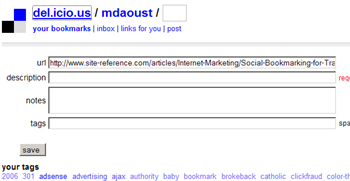
Adding this article to Del.icio.us The idea of social bookmarking seems to have been originated by Del.icio.us back in 2003. Just by visiting the front page of Del.icio.us you can see the social bookmarking in practice. On the right hand side of the page there is a column labeled 'Popular'. These are websites that currently are receiving a lot of attention from users under specific keywords and phrases. These websites are listed under common 'tags' that users have given. Digging for the News Del.icio.us is not the only Web 2.0 flagship that relies on the power of the collective people. Arguably one of the most successful Web 2.0 enterprises is Digg. Digg is a news website which presents headlines from across the Internet. Unlike practically every other news website to date, however, Digg does not rely on editors to determine which news stories are worthy of their front page and which news stories they should ignore. Rather, Digg relies on the input of their users. The system behind Digg is simple. Registered users can navigate their way to “Digg for Stories”. Here everyone can see all of the stories submitted to Digg. If a user likes one of the stories, they simply click on the “Digg It” link. If they do not like the story they can either ignore the story or report it as being lame, a duplicate story, or outright spam. If a story receives enough Diggs in a fast enough amount of time, it gets promoted to the front page. The system seems to work fairly well. Digg has been smart enough to put into place anti-cheating devices which do a fairly good job of catching manipulators of their system. And if someone does break through these barriers, Digg users (often referred to as Diggnation) are usually pretty quick to point out the offending users. Why Should I Care About These Services? This is all fine and interesting, but you might be wondering why you should spend your precious time reading more of this article. The answer is simple: websites like Digg and Del.icio.us represent the opportunity to get a lot of new traffic as well as quality links to your website. Digg and Del.icio.us offer the absolute best type of web traffic: viral traffic. Business owners know that the most reliable prospects are the prospects that come from the referral of someone else, and Digg and Del.icio.us offer just that. In order to get seen on a large scale from any of these websites that rely on a community of users, your content must be good enough to meet the approval of enough people to warrant the elevation of your site to the front page. This, in effect, is like one great recommendation for your website. So how much traffic are we talking about? Darren Rowse of ProBlogger.net noted that when a post of his reached the front page of Del.icio.us, he saw around 8,000 visitors that day from Del.icio.us alone. This does not take into account all the bloggers and website owners who discovered his site from Del.icio.us, posted a link to it on their site or in a forum, which would in turn generate more traffic to his site. Tech-Recipes, a relatively common website on the front page of Digg, wrote a great post on what the digg effect is like. The traffic numbers they post are quite astounding. From being featured in Digg, they regularly see 5,000 – 10,000 visitors per day. This is not unusual either – websites that are featured in Digg are often subject to what has been dubbed the “Digg Effect”. It is quite common, unfortunately, for a dug website to receive so much traffic that it brings down the server. Now both Del.icio.us and Digg users do not tend to be very active users. This has been pointed out by more than one person. Typically they do not click on ads, they do not comment on blogs, and they do not register for an account with you. But the name of the website marketing game is always going to be free exposure, and social bookmarking services like these are great ways to get a lot of free exposure for your website. In addition, these sites will often have secondary and tertiary effects which you may not be able to link back directly to your initial exposure on them. I'm Sold – Where Do I Sign Up? So you are now sold on just how great it can be to be featured on sites like Del.icio.us and Digg. The natural question to ask here is how do you get featured on these sites. I am pretty sure the answer I am about to give is going to be one that you do not like as it is a tired phrase: You need good, unique content. Sound familiar? If you follow SEO at all, you undoubtedly have been told that good, unique content is the best way to get to the top of the rankings. The same thing holds true, but even more so, for social bookmarking websites. In order to be featured on these sites, your website does not have to meet the approval of an automated bot that is scouring the web for information. Instead, your website needs to meet the approval of actual human beings who are going to look at your website, determine whether they like it or not, and then tell you the honest truth. In the past, web pages that have been successful in being featured may have the following traits:
After I wrote the article on Yahoo I received an email asking how one would optimize their site for social bookmarking services. The response to that would have to be simple: optimize your site by offering some great, free content that anyone can access. A Word to the Wise – Don't Cheat As a quick sidebar, it is important to note that those who try to cheat the systems usually find themselves worse off than they were to begin with. It is very tempting when dealing with a system like Del.icio.us and Digg to try and manipulate the system to artificially get your website to the top. The problem with this is simple: if you do succeed in manipulating the system, but do not have the content to really deserve a featured placement, you will undoubtedly turn off more visitors than attract. If your content is deserving of a featured placement, it should rise there naturally. Social Bookmarking – The Future of Search? The point of the article which I referenced above was not to state that Yahoo was washed up, but rather that Yahoo was on the cusp of a new Internet and a new form of search. They recognized that Google would not be beat in the search market; however, this does not mean that they can not beat Google by creating a market more effective than search. Social bookmarking is already becoming a very effective way for experienced web surfers to find the latest information on a particular subject. Do you want to see some of the latest video's to become popular? Just goto http://del.icio.us/tags/video and you can see what others are discovering and bookmarking as valuable. Want to find some rather obscure guide on Ruby on Rails? Lookup the common tags for Ruby on Rails and search through these resources. Social bookmarking has the great ability to reach where search engines cannot: by using viral marketing and popular opinion, social bookmarking has the ability to discover what is important before any bot can spider the site and rank it among the thousands of sites available. Granted, social bookmarking will never replace search completely, but as it grows in popularity, web users are quickly discovering a whole new way to discover web pages that they would never discover otherwise. So
take the time today to examine Digg and Del.icio.us.
Take a little more time to find new social websites
like Digg and Del.icio.us (they are popping up all
over the place) and learn what seems to make users
on these sites click. Social technologies are here
to stay, and they are only going to grow in popularity.
Right now is a golden opportunity for you to gain
great exposure for your website if you simply learn
how to use these services.
This article may be reproduced on the condition that all links within the article remain active and an active link be made to the original location of this article.
E-mail this article to your colleague! Need more translation jobs? Click here! Translation agencies are welcome to register here - Free! Freelance translators are welcome to register here - Free! |
|
|
|
|
|
|
| |||
Legal Disclaimer Site Map |