 |
 |
 |
 |
|
|
Home | More Articles | Join as a Member! | Post Your Job - Free! | All Translation Agencies | |
|
|||||||
|
|
|
|
Arabic
Contents: 1.
Grammar and Spelling Section One - Grammar and Spelling 1. Gender: Arabic has two genders. The genders are usually referred to as masculine and feminine, but the situation is more complicated than that: the 'feminine' singular forms are also used to express 'singulatives', which are plurals of inanimate objects of both grammatical genders. 2. Case: Arabic has three cases – nominative, accusative and genitive. Normally, nouns take the ending -u(n) in the nominative, -i(n) in the genitive and -a(n) in the accusative. 3. Plurals: Arabic has three numbers – singular, plural and dual. The plural of a noun is formed by a suffix in some cases (sound plurals), but frequently the vowel structure of a word is changed to form the plural (broken plurals). There are a number of patterns of how this is done. Some singular nouns take several plurals. Section Two - Punctuation 1. Commas: In Arabic text, commas are the opposite to English ones, that is they look like 6s rather than 9s. The letter و means 'and', and should be used instead of and sometimes together with commas in lists (they are not just big commas!). 2. Speech marks: Either «...» or "" can be used, and they work in the same way as in English. 3. Semi-colons: These look like upside down Roman semi-colons: ؛ 4. Capitalisation: There is no capitalisation in Arabic. Section Three - Measurements and Abbreviations Measurements:
Most units are written out in full in Arabic,
except units that have metres and grams
in them, which are usually shortened to
the Arabic abbreviation of the letter 'm'.
Percentage signs are written on the left-hand side of the numeral. Section Four - Hyphenation Words cannot be split over two lines in Arabic so there is no hyphenation. Section Five - Miscellaneous Peculiarities When English is written within Arabic text it stays in the usual English word order, ie. it is written from left to right within the Arabic right to left text. This is maintained when a whole English phrase is spread over two lines:
Section Six - Geographic Distribution Arabic is one of the world's major languages, spoken in a broad belt extending from the Arabian Peninsula across the Fertile Crescent and on to the Atlantic Ocean. It is the official language of Saudi Arabia, Yemen, United Arab Emirates, Oman, Kuwait, Bahrain, Qatar, Iraq, Syria, Jordan, Lebanon, Egypt, Sudan, Libya, Tunisia, Algeria, and Morocco, making it the mother tongue of about 215 million people. In addition many millions of Muslims in other countries have some knowledge of Arabic, it being the language of the Muslim religion and of the sacred Koran. Arabic is spoken/used in the following countries: Language Family Source: http://www.worldlanguage.com/Languages/Arabic - Copyright © Kenneth Katzner, The Languages of the World, Published by Routledge. Section Seven - Character Set 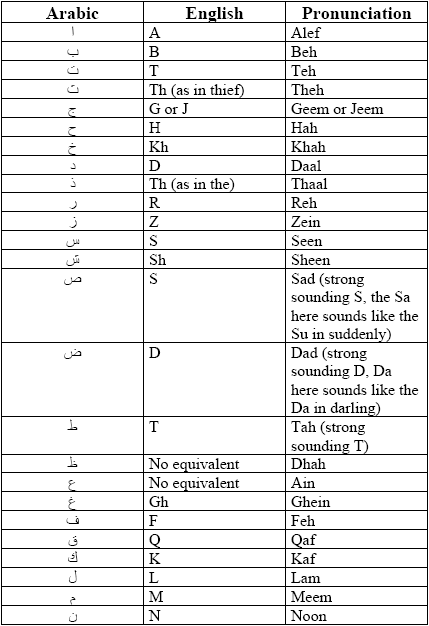
E-mail this article to your colleague! Need more translation jobs? Click here! Translation agencies are welcome to register here - Free! Freelance translators are welcome to register here - Free! |
|
|
|
|
|
|
| |||
Legal Disclaimer Site Map |





