|
 |
 |
 |
|
|
Home | More Articles | Join as a Member! | Post Your Job - Free! | All Translation Agencies | |
|
|||||||
|
|
|
|
Welsh
Read also: Welsh language by Wikipedia Contents: 1.
Grammar and Spelling Section One - Grammar and Spelling There are 28 letters in the Welsh alphabet and it is a phonetic language. Therefore, there are specific letters for sounds which are not to be found, for instance, in English, e.g. ll, ch. And being a phonetic language, only c is used to convey the k sound, for instance. U is a vowel in Welsh (similar to the German umlaut). W can be either a vowel or a consonant. 1. Accents: These are used in Welsh to indicate a change in the position of the stress - normally on the penultimate syllable - and in the length of a vowel. The most common accent is the circumflex, which lengthens a vowel which is normally short. The word then will have a different meaning, e.g, tan (under), tân (fire); gwen (white - feminine form), gwên (smile). They are used with both lower and upper case. 2. Genders: Welsh has two noun genders: masculine and feminine, but no neuter. Some adjectives also have masculine and feminine forms which are used according to the gender of the nouns as in French. The gender of nouns is also an important consideration in the 'mutation' system peculiar to Celtic languages, in which the initial letters of words 'mutate' in particular circumstances, e.g. feminine singular nouns mutate after the definite article, but masculine singular nouns do not. (See notes on mutations later). 3. Word order: The noun normally precedes the adjective, apart from some notable exceptions like 'hen' (old), e.e. hen ddyn (old man) causing a mutation even in plural nouns and masculine singular nouns. This happens also in poetic instances. 4. Cases: There aren't any in modern Welsh. Some numerals also have masculine and feminine forms which also have to 'agree' with the gender of the nouns. These might appear strange as you might get dau (masculine two) and dwy (feminine two) in the same sentence. 5. Plurals: There are many ways of forming plurals in Welsh but the most common is the adding of the suffix 'au' to the singular form, e.g. llyfr - llyfrau. This is not always as simple as it looks since the adding of 'au' sometimes causes a change in the vowel of the word stem, e.g. drws - drysau. Other common plural forms are formed by adding - 'iau', 'ion', 'od', 'i', 'oedd'. 'ydd' generally becomes 'yddion'. Some words change a vowel to form the plural, e.g. porth - pyrth, fforc - ffyrc. Other languages mostly take the plural form of the noun after a numeral or ordinal. But Welsh uses the singular of the noun, as the numeral/ordinal is considered to be an adjective, e.e. deg merch (ten girl). 6. One-letter words: There are many common one-letter words in Welsh, including 'y' (the definite article), which becomes '’r' after a vowel and 'yr' before a vowel, and 'a' the Welsh word for 'and'. There are also common one-letter prepositions - i, o and â. 7. Capitalisation: The use of upper case is generally as in English, but care should be taken not to run an English spell check or Microsoft's autocorrect in case a Welsh 'i' is corrected to an upper case 'I'. Office 2000 now has Welsh as one of its language options. In general capitalisation is the same as in English. As for headings, titles and bullets, the same pattern as that of the English document is used. However, one- or two-letter words in Welsh titles sometimes look better in lower case, e.g. Daily News - Newyddion y Dydd. 8. Apostrophes: The apostrophe is used as in English, for instance, that is, to indicate the elision of two vowels. Section Two - Punctuation Welsh punctuation generally follows the same pattern as English, but should not do so slavishly. Helping to clarify the meaning should be the main consideration. Section Three - Measurements and Abbreviations 1. Measurements: Both Imperial and metric measurements are used. Decimal points and thousands separators, same as English text. Currency: same as in English, except for C (ceiniog) for P (penny). Times and dates: the same abbreviated forms are used as in English. When the time is expressed in whole words, the equivalent Welsh wording is used, e.g. noon = canol dydd, midnight = canol nos. 2. Abbreviations: Equivalent abbreviations: Other abbreviations: The only abbreviations of measurements which might look strange
would be those used for Imperial distances
and weights: Section Four - Hyphenation 1. Hyphenation: Hyphenation is quite common in Welsh. Compound words are often formed with the following prefixes ail/ad/dad/di/prif/cam/ and if the remainder of the word is one syllable, then a hyphen is used, e.g. Ail-ddweud (to repeat, literally to re-say). In other words, it is used to indicate that the stress is not on the normal penultimate syllable. This happens very frequently in placenames, e.g. Pen-bryn and Penbryn, Llanycil and Llan-y-coed. Hyphens are also used within words to separate a 'd' from a 'dd' (e.g. hyd-ddi). 2. End-of-line hyphenation: The rules for this are as follows:
There are so many exceptions to these rules that it is very difficult to generalise. For example, the rule regarding hyphenating before a plural suffix is generally sound, but a road sign to a place called Tremeirchion caused uproar locally because it was hyphenated according to this rule: Tremeirchion. The natural hyphenation would have split the word into its two natural components: 'tre' and 'meirchion' and hyphenated between them. In general, however, the common sense do's and don'ts that apply in English also apply in Welsh, apart from the double consonant rule in relation to the particular Welsh character set. Section Five - Miscellaneous Peculiarities The main peculiarity of the Welsh language is the mutation system. In brief, it involves the changing of initial consonant of words in particular circumstances. There are three types of mutation: soft mutation, aspirate mutation and nasal mutation. The soft mutation is the most common. There are 32 rules for its
use! In a soft mutation - [I WOULD ADVISE NOT ATTEMPTING TO LIST INSTANCES WHERE MUTATIONS OCCUR - IT ONLY MISLEADS BY OVER-SIMPLIFYING] [These changes occur for many reasons but the most common are: Aspirate mutations occur as follows: These are not so common. Nasal mutations: These also occur less frequently than the soft mutation. It is very important for anyone proofreading Welsh to be aware of these because the word Cymru (Wales), for example, might appear as Cymru, Gymru, Chymru or Nghymru - depending on the grammatical construction of the sentence. Section Six - Geographic Distribution Welsh, the language of Wales, is spoken by about 600,000 people, or less than 25 percent of the Welsh population. Like Gaelic, which is spoken in Ireland and parts of Scotland, Breton in Brittany, Cornish in Cornwall and Manx in the Isle of Man, Welsh is one of the Celtic languages which constitute one of the many branches of the Indo-European family. There is still a close resemblance between these Celtic languages, but Welsh is by far the strongest of the group. Celtic tribes entered Britain sometime after the 5th century B.C. The Anglo-Saxon invasions many centuries later drove the Welsh into the west, where they retained their Celtic speech and remained a distinctive people. Welsh is spoken/used in the following countries: Source: http://www.worldlanguage.com/Languages/Welsh - Copyright © Kenneth Katzner, The Languages of the World, Published by Routledge. Section Seven - Character Set [ ] = Alt key codes
Welsh languageWelsh (Cymraeg [kəmˈraːiɡ] or y Gymraeg [ə ɡəmˈraːiɡ]) is a Brittonic language of the Celtic language family that is native to the Welsh people. Welsh is spoken natively in Wales, by some in England, and in Y Wladfa (the Welsh colony in Chubut Province, Argentina). Historically, it has also been known in English as "British", "Cambrian", "Cambric" and "Cymric".
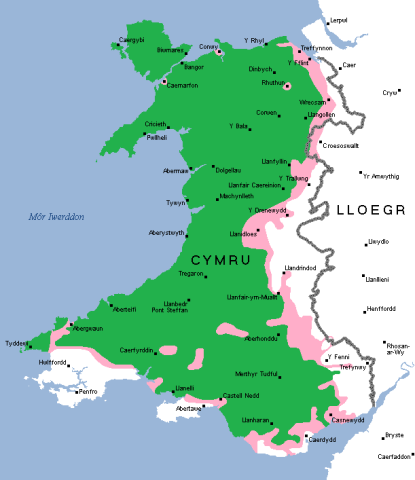
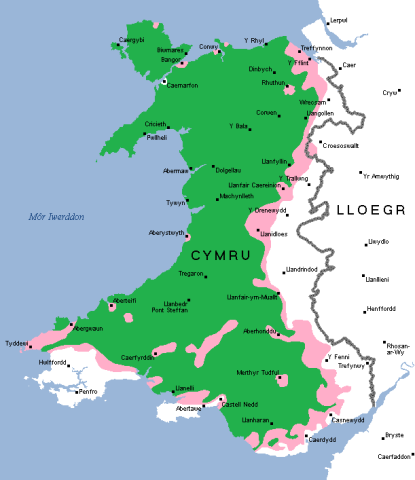
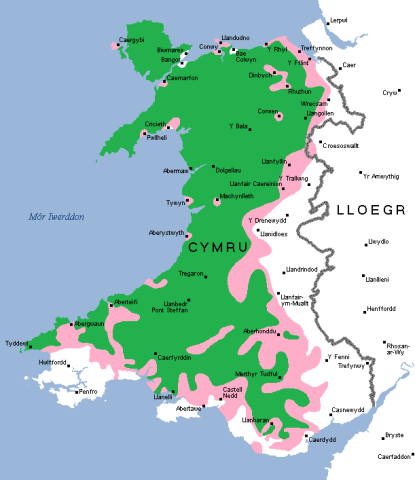
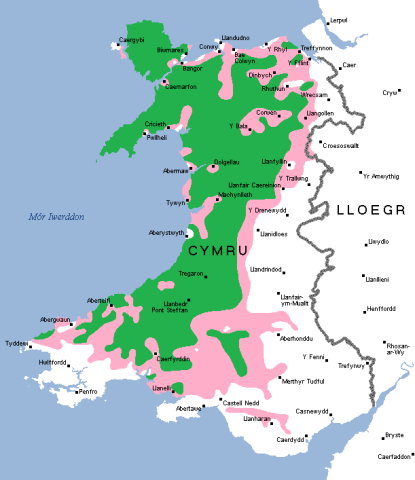
According to the 2011 census, 19.0% of the population of Wales aged three or older (562,016 people) were able to speak Welsh, and nearly three quarters of the population in Wales said they had no Welsh language skills. Estimates suggest that 29.5% (892,200) of people aged three or older in Wales could speak Welsh in December 2021. The Welsh Language (Wales) Measure 2011 gave the Welsh language official status in Wales, making it the only language that is de jure official in any part of the United Kingdom, with English being de facto official. Both the Welsh language and English are de jure official languages of the Welsh Parliament, the Senedd. The Welsh government plans to increase the number of Welsh language speakers to one million by 2050. Since 1980, the number of children attending Welsh-medium schools has increased, and the number going to Welsh bilingual and dual-medium schools has decreased. Welsh is the most vibrant of the Celtic languages in terms of active speakers, and is the only Celtic language not considered endangered by UNESCO. HistoryThe language of the Welsh developed from the language of Britons. The emergence of Welsh was not instantaneous and clearly identifiable. Instead, the shift occurred over a long period of time, with some historians claiming that it had happened by as late as the 9th century, with a watershed moment being that proposed by linguist Kenneth H. Jackson, the Battle of Dyrham, a military battle between the West Saxons and the Britons in 577 AD, which split the South Western British from direct overland contact with the Welsh. Four periods are identified in the history of Welsh, with rather indistinct boundaries: Primitive Welsh, Old Welsh, Middle Welsh, and Modern Welsh. The period immediately following the language's emergence is sometimes referred to as Primitive Welsh, followed by the Old Welsh period – which is generally considered to stretch from the beginning of the 9th century to sometime during the 12th century. The Middle Welsh period is considered to have lasted from then until the 14th century, when the Modern Welsh period began, which in turn is divided into Early and Late Modern Welsh. The word Welsh is a descendant, via Old English wealh, wielisc, of the Proto-Germanic word *Walhaz, which was derived from the name of the Celtic people known to the Romans as Volcae and which came to refer to speakers of Celtic languages, and then indiscriminately to the people of the Western Roman Empire. In Old English the term went through semantic narrowing, coming to refer to either Britons in particular or, in some contexts, slaves. The plural form Wēalas evolved into the name for their territory, Wales. The modern names for various Romance-speaking people in Continental Europe (e.g. Walloons, Valaisans, Vlachs/Wallachians, and Włosi, the Polish name for Italians) have a similar etymology. The Welsh term for the language, Cymraeg, descends from the Brythonic word combrogi, meaning "compatriots" or "fellow countrymen". OriginsWelsh evolved from Common Brittonic, the Celtic language spoken by the ancient Celtic Britons. Classified as Insular Celtic, the British language probably arrived in Britain during the Bronze Age or Iron Age and was probably spoken throughout the island south of the Firth of Forth. During the Early Middle Ages the British language began to fragment due to increased dialect differentiation, thus evolving into Welsh and the other Brittonic languages. It is not clear when Welsh became distinct. Linguist Kenneth H. Jackson has suggested that the evolution in syllabic structure and sound pattern was complete by around AD 550, and labelled the period between then and about AD 800 "Primitive Welsh". This Primitive Welsh may have been spoken in both Wales and the Hen Ogledd ("Old North") – the Brittonic-speaking areas of what are now northern England and southern Scotland – and therefore may have been the ancestor of Cumbric as well as Welsh. Jackson, however, believed that the two varieties were already distinct by that time. The earliest Welsh poetry – that attributed to the Cynfeirdd or "Early Poets" – is generally considered to date to the Primitive Welsh period. However, much of this poetry was supposedly composed in the Hen Ogledd, raising further questions about the dating of the material and language in which it was originally composed. This discretion stems from the fact that Cumbric was widely believed to have been the language used in Hen Ogledd. An 8th-century inscription in Tywyn shows the language already dropping inflections in the declension of nouns. Janet Davies proposed that the origins of Welsh language were much less definite; in The Welsh Language: A History, she proposes that Welsh may have been around even earlier than 600 AD. This is evidenced by the dropping of final syllables from Brittonic: *bardos "poet" became bardd, and *abona "river" became afon. Though both Davies and Jackson cite minor changes in syllable structure and sounds as evidence for the creation of Old Welsh, Davies suggests it may be more appropriate to refer to this derivative language as Lingua Britannica rather than characterising it as a new language altogether. Primitive WelshThe argued dates for the period of "Primitive Welsh" are widely debated, with some historians' suggestions differing by hundreds of years. Old WelshThe next main period is Old Welsh (Hen Gymraeg, 9th to 11th centuries); poetry from both Wales and Scotland has been preserved in this form of the language. As Germanic and Gaelic colonisation of Britain proceeded, the Brittonic speakers in Wales were split off from those in northern England, speaking Cumbric, and those in the southwest, speaking what would become Cornish, and so the languages diverged. Both the works of Aneirin (Canu Aneirin, c. 600) and the Book of Taliesin (Canu Taliesin) were written during this era. Middle WelshMiddle Welsh (Cymraeg Canol) is the label attached to the Welsh of the 12th to 14th centuries, of which much more remains than for any earlier period. This is the language of nearly all surviving early manuscripts of the Mabinogion, although the tales themselves are certainly much older. It is also the language of the existing Welsh law manuscripts. Middle Welsh is reasonably intelligible to a modern-day Welsh speaker. Languages of Wales 1750-1900
Modern Welsh
The Bible translations into Welsh helped maintain the use of Welsh in daily life. The New Testament was translated by William Salesbury in 1567, and the complete Bible by William Morgan in 1588. Modern Welsh is subdivided into Early Modern Welsh and Late Modern Welsh. Early Modern Welsh ran from the 15th century through to the end of the 16th century, and the Late Modern Welsh period roughly dates from the 16th century onwards. Contemporary Welsh differs greatly from the Welsh of the 16th century, but they are similar enough for a fluent Welsh speaker to have little trouble understanding it. During the Modern Welsh period there has been a decline in the popularity of the Welsh language: the number of Welsh speakers declined to the point at which there was concern that the language would become extinct. Welsh government processes and legislation have worked to increase the proliferation of the Welsh language, e.g. through education.
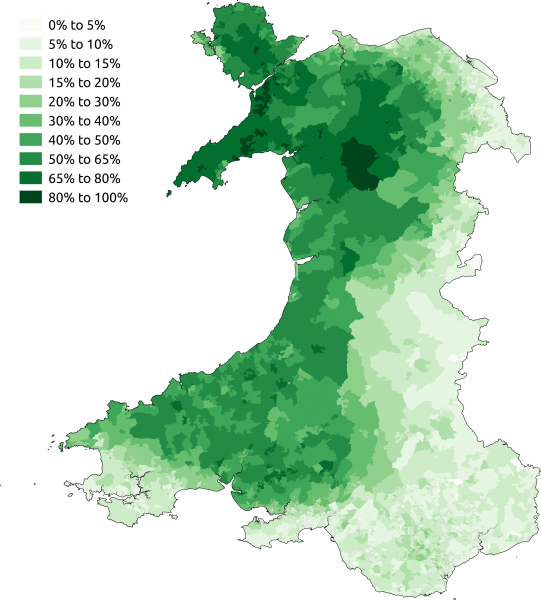
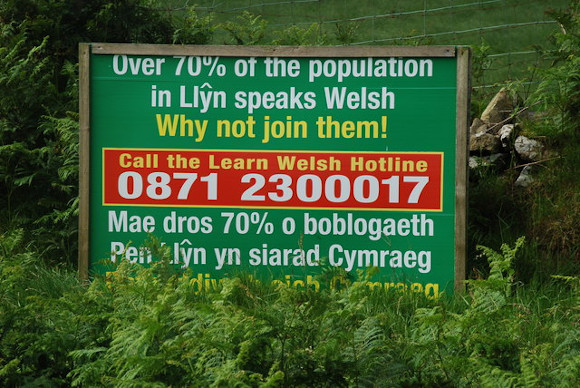
Geographic distributionWalesWelsh has been spoken continuously in Wales throughout history, but by 1911 it had become a minority language, spoken by 43.5 percent of the population. While this decline continued over the following decades, the language did not die out. By the start of the 21st century, numbers began to increase once more, at least partly as a result of the increase in Welsh-medium education.
The 2004 Welsh Language Use Survey showed that 21.7 percent of the population of Wales spoke Welsh, compared with 20.8 percent in the 2001 Census, and 18.5 percent in 1991 Census. The 2011 Census, however, showed a slight decline to 562,000, or 19 per cent of the population. The census also showed a "big drop" in the number of speakers in the Welsh-speaking heartlands, with the number dropping to under 50 percent in Ceredigion and Carmarthenshire for the first time. However, according to the Welsh Language Use Survey in 2019–20, 22 percent of people aged three and over were able to speak Welsh. The Annual Population Survey by the Office for National Statistics (ONS) estimated that, for the year ending in December 2021, 892,200, or 29.5 percent of the population of Wales aged 3 and over, were able to speak the language, implying a possible increase in the prevalence of the Welsh language since the 2011 census. The APS estimates of Welsh language ability are historically higher than those produced by the Census. In terms of usage, ONS also reported that 14.8% (448,400) of people aged three or older in Wales reported that they spoke Welsh daily in December 2021, with 5.2% (158,400) speaking it weekly and 7.6% (228,600) less often. Approximately 1.9% (56,500) reported that they never spoke Welsh despite being able to speak it, with the remaining 70.5% not being able to speak Welsh. The National Survey for Wales, conducted by Welsh Government, has also tended to have a higher percentage of Welsh speakers than the Census, with the most recent results for 2018–2019 suggesting that 22 percent of the population aged 3 and over were able to speak Welsh, with an additional 16 percent noting that they had some Welsh-speaking ability. Historically, large numbers of Welsh people spoke only Welsh. Over the course of the 20th century this monolingual population "all but disappeared", but a small percentage remained at the time of the 1981 census. Most Welsh-speaking people in Wales also speak English. However, many Welsh-speaking people are more comfortable expressing themselves in Welsh than in English. A speaker's choice of language can vary according to the subject domain and the social context, even within a single discourse (known in linguistics as code-switching). Welsh speakers are largely concentrated in the north and west of Wales, principally Gwynedd, Conwy, Denbighshire (Sir Ddinbych), Anglesey (Ynys Môn), Carmarthenshire (Sir Gâr), north Pembrokeshire (Sir Benfro), Ceredigion, parts of Glamorgan (Morgannwg), and north-west and extreme south-west Powys. However, first-language and other fluent speakers can be found throughout Wales. Outside WalesThe rest of the UKWelsh-speaking communities persisted well into the modern period across the border in England. Archenfield was still Welsh enough in the time of Elizabeth I for the Bishop of Hereford to be made responsible, together with the four Welsh bishops, for the translation of the Bible and the Book of Common Prayer into Welsh. Welsh was still commonly spoken there in the first half of the 19th century, and churchwardens' notices were put up in both Welsh and English until about 1860. Alexander John Ellis in the 1880s identified a small part of Shropshire as still then speaking Welsh, with the "Celtic Border" passing from Llanymynech through Oswestry to Chirk. The number of Welsh-speaking people in the rest of Britain has not yet been counted for statistical purposes. In 1993, the Welsh-language television channel S4C published the results of a survey into the numbers of people who spoke or understood Welsh, which estimated that there were around 133,000 Welsh-speaking people living in England, about 50,000 of them in the Greater London area. The Welsh Language Board, on the basis of an analysis of the Office for National Statistics Longitudinal Study, estimated there were 110,000 Welsh-speaking people in England, and another thousand in Scotland and Northern Ireland. In the 2011 Census, 8,248 people in England gave Welsh in answer to the question "What is your main language?" The Office for National Statistics subsequently published a census glossary of terms to support the release of results from the census, including their definition of "main language" as referring to "first or preferred language" (though that wording was not in the census questionnaire itself). The wards in England with the most people giving Welsh as their main language were the Liverpool wards of Central and Greenbank; and Oswestry South in Shropshire. The wards of Oswestry South (1.15%), Oswestry East (0.86%) and St Oswald (0.71%) had the highest percentage of residents giving Welsh as their main language. The Census also revealed that 3,528 wards in England, or 46% of the total number, contained at least one resident whose main language is Welsh. In terms of the regions of England, North West England (1,945), London (1,310) and the West Midlands (1,265) had the highest number of people noting Welsh as their main language. In the 2011 Census, 1,189 people aged three and over in Scotland noted that Welsh was a language (other than English) that they used at home. ArgentinaIt is believed that there are as many as 5,000 speakers of Patagonian Welsh. AustraliaIn response to the question 'Does the person speak a language other than English at home?' in the 2016 Australian Census, 1,688 people noted that they spoke Welsh. CanadaIn the 2011 Canadian Census, 3,885 people reported Welsh as their first language. New ZealandThe 2018 New Zealand census noted that 1,083 people in New Zealand spoke Welsh. United StatesThe American Community Survey 2009–2013 noted that 2,235 people aged 5 years and over in the United States spoke Welsh at home. The highest number of those (255) lived in Florida. Status
Although Welsh is a minority language, support for it grew during the second half of the 20th century, along with the rise of organisations such as the nationalist political party Plaid Cymru from 1925 and Welsh Language Society from 1962. Of the six living Celtic languages (including two revived), Welsh has the most number of native speakers who use the language on a daily basis, and it is the only Celtic language which is not considered to be endangered by UNESCO.
The Welsh Language Act 1993 and the Government of Wales Act 1998 provide that the Welsh and English languages be treated equally in the public sector, as far as is reasonable and practicable. Each public body is required to prepare for approval a Welsh Language Scheme, which indicates its commitment to the equality of treatment principle. This is sent out in draft form for public consultation for a three-month period, whereupon comments on it may be incorporated into a final version. It requires the final approval of the now defunct Welsh Language Board (Bwrdd yr Iaith Gymraeg). Thereafter, the public body is charged with implementing and fulfilling its obligations under the Welsh Language Scheme. The list of other public bodies which have to prepare Schemes could be added to by initially the Secretary of State for Wales, from 1993 to 1997, by way of statutory instrument. Subsequent to the forming of the National Assembly for Wales in 1997, the Government Minister responsible for the Welsh language can and has passed statutory instruments naming public bodies who have to prepare Schemes. Neither the 1993 Act nor secondary legislation made under it covers the private sector, although some organisations, notably banks and some railway companies, provide some of their information in Welsh. On 7 December 2010, the Welsh Assembly unanimously approved a set of measures to develop the use of the Welsh language within Wales. On 9 February 2011 this measure, the Welsh Language (Wales) Measure 2011, was passed and received Royal Assent, thus making the Welsh language an officially recognised language within Wales. The measure:
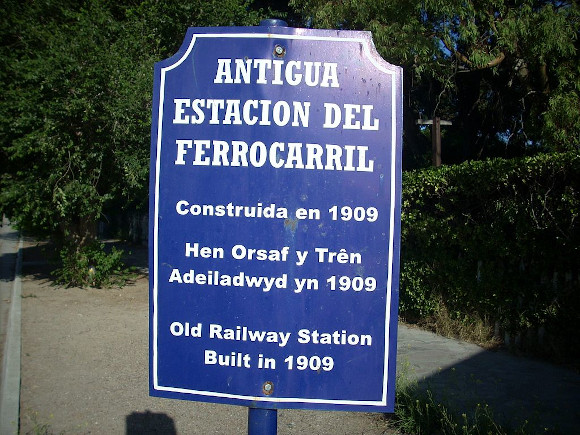
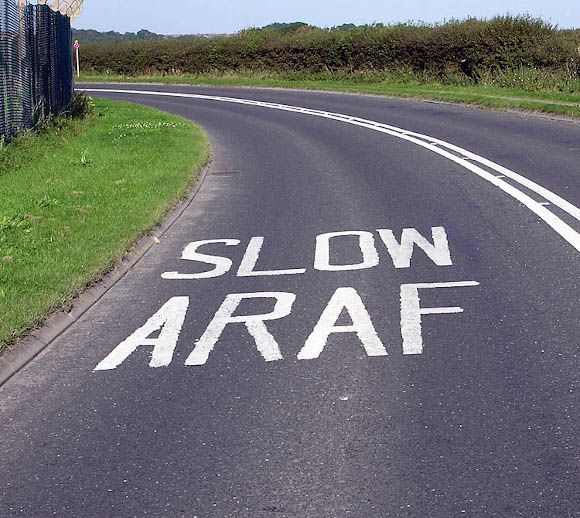
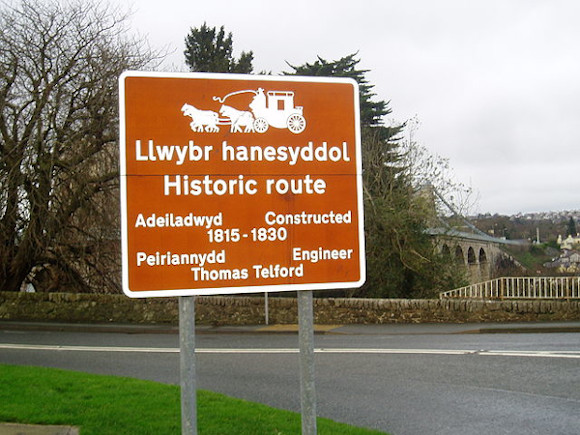
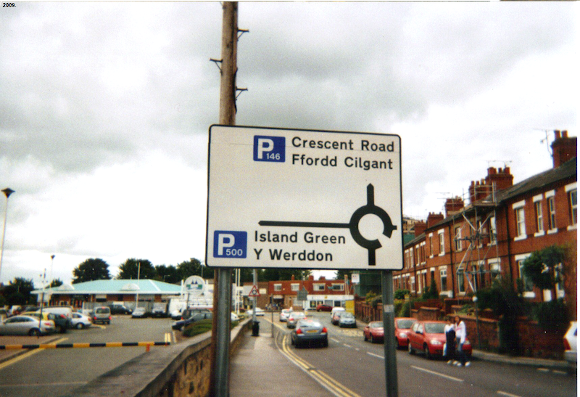
The measure requires public bodies and some private companies to provide services in Welsh. The Welsh government's Minister for Heritage at the time, Alun Ffred Jones, said, "The Welsh language is a source of great pride for the people of Wales, whether they speak it or not, and I am delighted that this measure has now become law. I am very proud to have steered legislation through the Assembly which confirms the official status of the Welsh language; which creates a strong advocate for Welsh speakers and will improve the quality and quantity of services available through the medium of Welsh. I believe that everyone who wants to access services in the Welsh language should be able to do so, and that is what this government has worked towards. This legislation is an important and historic step forward for the language, its speakers and for the nation." The measure was not welcomed warmly by all supporters: Bethan Williams, chairman of the Welsh Language Society, gave a mixed response to the move, saying, "Through this measure we have won official status for the language and that has been warmly welcomed. But there was a core principle missing in the law passed by the Assembly before Christmas. It doesn't give language rights to the people of Wales in every aspect of their lives. Despite that, an amendment to that effect was supported by 18 Assembly Members from three different parties, and that was a significant step forward." On 5 October 2011, Meri Huws, Chair of the Welsh Language Board, was appointed the new Welsh Language Commissioner. She released a statement that she was "delighted" to have been appointed to the "hugely important role", adding, "I look forward to working with the Welsh Government and organisations in Wales in developing the new system of standards. I will look to build on the good work that has been done by the Welsh Language Board and others to strengthen the Welsh language and ensure that it continues to thrive." First Minister Carwyn Jones said that Huws would act as a champion for the Welsh language, though some had concerns over her appointment: Plaid Cymru spokeswoman Bethan Jenkins said, "I have concerns about the transition from Meri Huws's role from the Welsh Language Board to the language commissioner, and I will be asking the Welsh government how this will be successfully managed. We must be sure that there is no conflict of interest, and that the Welsh Language Commissioner can demonstrate how she will offer the required fresh approach to this new role." Huws started her role as the Welsh Language Commissioner on 1 April 2012. Local councils and the Senedd use Welsh, issuing Welsh versions of their literature, to varying degrees. Road signs in Wales are in Welsh and English. Prior to 2016, the choice of which language to display first was the responsibility of the local council. Since then, as part of the Welsh Language [Wales] Measure 2011, all new signs have Welsh displayed first. There have been incidents of one of the languages being vandalised, which may be considered a hate crime.
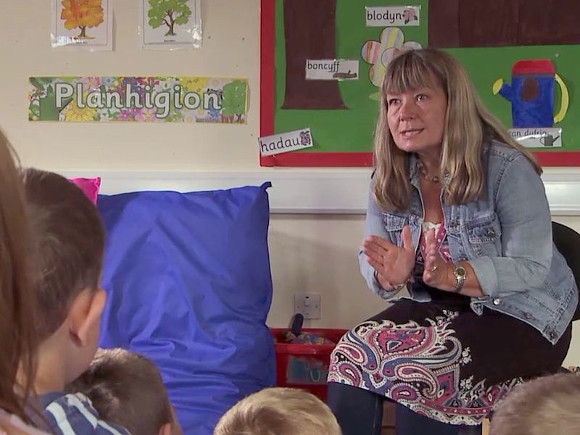
Since 2000, the teaching of Welsh has been compulsory in all schools in Wales up to age 16; this has had an effect in stabilising and reversing the decline in the language. The wording on currency is only in English, except in the legend on Welsh pound coins dated 1985, 1990 and 1995, which circulated in all parts of the UK prior to their 2017 withdrawal. The wording is Pleidiol wyf i'm gwlad, (Welsh for 'True am I to my country'), and derives from the national anthem of Wales, Hen Wlad Fy Nhadau. Some shops employ bilingual signage. Welsh sometimes appears on product packaging or instructions. The UK government has ratified the European Charter for Regional or Minority Languages in respect of Welsh. The language has greatly increased its prominence since the creation of the television channel S4C in November 1982, which until digital switchover in 2010 broadcast 70 per cent of Channel 4's programming along with a majority of Welsh language shows during peak viewing hours. The all-Welsh-language digital station S4C Digidol is available throughout Europe on satellite and online throughout the UK. Since the digital switchover was completed in South Wales on 31 March 2010, S4C Digidol became the main broadcasting channel and fully in Welsh. The main evening television news provided by the BBC in Welsh is available for download. There is also a Welsh-language radio station, BBC Radio Cymru, which was launched in 1977.
The only Welsh-language national newspaper Y Cymro (The Welshman) was published weekly until 2017. There is no daily newspaper in Welsh. A daily newspaper called Y Byd (The World) was scheduled to be launched on 3 March 2008, but was scrapped, owing to insufficient sales of subscriptions and the Welsh Government offering only one third of the £600,000 public funding it needed. There is a Welsh-language online news service which publishes news stories in Welsh called Golwg360 ("360 [degree] view"). As of March 2021, there were 58 local Welsh language community newspapers, known as "Papurau Bro", in circulation. In educationThe decade around 1840 was a period of great social upheaval in Wales, manifested in the Chartist movement. In 1839, 20,000 people marched on Newport, resulting in a riot when 20 people were killed by soldiers defending the Westgate Hotel, and the Rebecca Riots where tollbooths on turnpikes were systematically destroyed.
This unrest brought the state of education in Wales to the attention of the British government since social reformers of the time considered education as a means of dealing with social ills. The Times newspaper was prominent among those who considered that the lack of education of the Welsh people was the root cause of most of the problems. In July 1846, three commissioners, R.R.W. Lingen, Jellynger C. Symons and H.R. Vaughan Johnson, were appointed to inquire into the state of education in Wales; the Commissioners were all Anglicans and thus presumed unsympathetic to the nonconformist majority in Wales. The Commissioners presented their report to the Government on 1 July 1847 in three large blue-bound volumes. This report quickly became known in Wales as the Brad y Llyfrau Gleision (Treason of the Blue Books) since, apart from documenting the state of education in Wales, the Commissioners were also free with their comments disparaging the language, nonconformity, and the morals of the Welsh people in general. An immediate effect of the report was that ordinary Welsh people began to believe that the only way to get on in the world was through the medium of English, and an inferiority complex developed about the Welsh language whose effects have not yet been completely eradicated. The historian Professor Kenneth O. Morgan referred to the significance of the report and its consequences as "the Glencoe and the Amritsar of Welsh history". In the later 19th century, virtually all teaching in the schools of Wales was in English, even in areas where the pupils barely understood English. Some schools used the Welsh Not, a piece of wood, often bearing the letters "WN", which was hung around the neck of any pupil caught speaking Welsh. The pupil could pass it on to any schoolmate heard speaking Welsh, with the pupil wearing it at the end of the day being punished. One of the most famous Welsh-born pioneers of higher education in Wales was Sir Hugh Owen. He made great progress in the cause of education, and more especially the University College of Wales at Aberystwyth, of which he was chief founder. He has been credited with the Welsh Intermediate Education Act 1889 (52 & 53 Vict c 40), following which several new Welsh schools were built. The first was completed in 1894 and named Ysgol Syr Hugh Owen. Towards the beginning of the 20th century this policy slowly began to change, partly owing to the efforts of O.M. Edwards when he became chief inspector of schools for Wales in 1907. The Aberystwyth Welsh School (Ysgol Gymraeg Aberystwyth) was founded in 1939 by Sir Ifan ap Owen Edwards, the son of O.M. Edwards, as the first Welsh Primary School. The headteacher was Norah Isaac. Ysgol Gymraeg Aberystwyth is still a very successful school, and now there are Welsh-language primary schools all over the country. Ysgol Glan Clwyd was established in Rhyl in 1956 as the first Welsh-medium secondary school. Welsh is now widely used in education, with 101,345 children and young people in Wales receiving their education in Welsh medium schools in 2014/15, 65,460 in primary and 35,885 in secondary. 26 per cent of all schools in Wales are defined as Welsh medium schools, with a further 7.3 per cent offering some Welsh-medium instruction to pupils. 22 per cent of pupils are in schools in which Welsh is the primary language of instruction. Under the National Curriculum, it is compulsory that all students study Welsh up to the age of 16 as either a first or a second language. Some students choose to continue with their studies through the medium of Welsh for the completion of their A-levels as well as during their college years. All local education authorities in Wales have schools providing bilingual or Welsh-medium education. The remainder study Welsh as a second language in English-medium schools. Specialist teachers of Welsh called Athrawon Bro support the teaching of Welsh in the National Curriculum. Welsh is also taught in adult education classes. The Welsh Government has recently set up six centres of excellence in the teaching of Welsh for Adults, with centres in North Wales, Mid Wales, South West, Glamorgan, Gwent, and Cardiff. The ability to speak Welsh or to have Welsh as a qualification is desirable for certain career choices in Wales, such as teaching or customer service. All universities in Wales teach courses in the language, with many undergraduate and post-graduate degree programmes offered in the medium of Welsh, ranging from law, modern languages, social sciences, and also other sciences such as biological sciences. Aberystwyth, Cardiff, Bangor, and Swansea have all had chairs in Welsh since their virtual establishment, and all their schools of Welsh are successful centres for the study of the Welsh language and its literature, offering a BA in Welsh as well as post-graduate courses. At all Welsh universities and the Open University, students have the right to submit assessed work and sit exams in Welsh even if the course was taught in English (usually the only exception is where the course requires demonstrating proficiency in another language). Following a commitment made in the One Wales coalition government between Labour and Plaid Cymru, the Coleg Cymraeg Cenedlaethol (Welsh Language National College) was established. The purpose of the federal structured college, spread out between all the universities of Wales, is to provide and also advance Welsh medium courses and Welsh medium scholarship and research in Welsh universities. There is also a Welsh-medium academic journal called Gwerddon ("Oasis"), which is a platform for academic research in Welsh and is published quarterly. There have been calls for more teaching of Welsh in English-medium schools.
Use in professional engineeringWhen conducting applicants' professional reviews for Chartered Engineer status, the Institution of Engineering and Technology accepts applications in Welsh and will conduct face-to-face interviews in Welsh if requested to do so. One of the requirements for Chartered Engineer is also to be able to communicate effectively in English. In information technologyLike many of the world's languages, the Welsh language has seen an increased use and presence on the internet, ranging from formal lists of terminology in a variety of fields to Welsh language interfaces for Microsoft Windows XP and up, Microsoft Office, LibreOffice, OpenOffice.org, Mozilla Firefox and a variety of Linux distributions, and on-line services to blogs kept in Welsh. Wikipedia has had a Welsh version since July 2003 and Facebook since 2009. Mobile phone technologyIn 2006 the Welsh Language Board launched a free software pack which enabled the use of SMS predictive text in Welsh. At the National Eisteddfod of Wales 2009, a further announcement was made by the Welsh Language Board that the mobile phone company Samsung was to work with the network provider Orange to provide the first mobile phone in the Welsh language, with the interface and the T9 dictionary on the Samsung S5600 available in the Welsh language. The model, available with the Welsh language interface, has been available since 1 September 2009, with plans to introduce it on other networks. On Android devices, both the built-in Google Keyboard and user-created keyboards can be used. iOS devices have fully supported the Welsh language since the release of iOS 8 in September 2014. Users can switch their device to Welsh to access apps that are available in Welsh. Date and time on iOS is also localised, as shown by the built-in Calendar application, as well as certain third-party apps that have been localised. In warfareSecure communications are often difficult to achieve in wartime. Just as Navajo code talkers were used by the United States military during World War II, the Royal Welch Fusiliers, a Welsh regiment serving in Bosnia, used Welsh for emergency communications that needed to be secure. Use within the British parliamentIn 2017, parliamentary rules were amended to allow the use of Welsh when the Welsh Grand Committee meets at Westminster. The change did not alter the rules about debates within the House of Commons, where only English can be used. In February 2018, Welsh was first used when the Welsh Secretary, Alun Cairns, delivered his welcoming speech at a sitting of the committee. He said, "I am proud to be using the language I grew up speaking, which is not only important to me, my family and the communities Welsh MPs represent, but is also an integral part of Welsh history and culture". Use at the European UnionIn November 2008, the Welsh language was used at a meeting of the European Union's Council of Ministers for the first time. The Heritage Minister Alun Ffred Jones addressed his audience in Welsh and his words were interpreted into the EU's 23 official languages. The official use of the language followed years of campaigning. Jones said "In the UK we have one of the world's major languages, English, as the mother tongue of many. But there is a diversity of languages within our islands. I am proud to be speaking to you in one of the oldest of these, Welsh, the language of Wales." He described the breakthrough as "more than [merely] symbolic" saying "Welsh might be one of the oldest languages to be used in the UK, but it remains one of the most vibrant. Our literature, our arts, our festivals, our great tradition of song all find expression through our language. And this is a powerful demonstration of how our culture, the very essence of who we are, is expressed through language." Use by the Voyager programmeA greeting in Welsh is one of the 55 languages included on the Voyager Golden Record chosen to be representative of Earth in NASA's Voyager programme launched in 1977. The greetings are unique to each language, with the Welsh greeting being Iechyd da i chwi yn awr ac yn oesoedd, which translates into English as "Good health to you now and forever". VocabularyWelsh supplements its core Brittonic vocabulary (words such as wy "egg", carreg "stone"), with hundreds of word lemmas borrowed from Latin, such as (ffenestr "window" < Latin fenestra, gwin "wine" < Latin vinum). It also borrows words from English, such as (silff "shelf", giât "gate"). PhonologyThe phonology of Welsh includes a number of sounds that do not occur in English and are typologically rare in European languages. The voiceless alveolar lateral fricative [ɬ], the voiceless nasals [m̥], [n̥] and [ŋ̊], and the voiceless alveolar trill [r̥] are distinctive features of the Welsh language. Stress usually falls on the penultimate syllable in polysyllabic words, and the word-final unstressed syllable receives a higher pitch than the stressed syllable.
Symbols in parentheses are either allophones, or found only in loanwords. OrthographyWelsh is written in a Latin alphabet of 29 letters, of which eight are digraphs treated as separate letters for collation:
In contrast to English practice, "w" and "y" are considered vowel letters in Welsh along with "a", "e", "i", "o" and "u". The letter "j" was not used traditionally, but is now used in many everyday words borrowed from English, like jam, jôc (joke) and garej (garage). The letters "k", "q", "v", "x", and "z" are used in some technical terms, like kilogram, volt and zero, but in all cases can be, and often are, replaced by Welsh letters: cilogram, folt and sero. The letter "k" was in common use until the 16th century, but was dropped at the time of the publication of the New Testament in Welsh, as William Salesbury explained: "C for K, because the printers have not so many as the Welsh requireth". This change was not popular at the time. The most common diacritic is the circumflex, which usually disambiguates long vowels, most often in the case of homographs, where the vowel is short in one word and long in the other: e.g. man ("place") vs mân ("fine, small"). MorphologyWelsh morphology has much in common with that of the other modern Insular Celtic languages, such as the use of initial consonant mutations and of so-called "conjugated prepositions" (prepositions that fuse with the personal pronouns that are their object). Welsh nouns belong to one of two grammatical genders, masculine and feminine, but they are not inflected for case. Welsh has a variety of different endings and other methods to indicate the plural, and two endings to indicate the singular (technically the singulative) of some nouns. In spoken Welsh, verbal features are indicated primarily by the use of auxiliary verbs rather than by the inflection of the main verb. In literary Welsh, on the other hand, inflection of the main verb is usual. SyntaxThe canonical word order in Welsh is verb–subject–object (VSO). Colloquial Welsh inclines very strongly towards the use of auxiliaries with its verbs, as in English. The present tense is constructed with bod ("to be") as an auxiliary verb, with the main verb appearing as a verbnoun (used in a way loosely equivalent to an infinitive) after the particle yn:
There, mae is a third-person singular present indicative form of bod, and mynd is the verb-noun meaning "to go". The imperfect is constructed in a similar manner, as are the periphrastic forms of the future and conditional tenses. In the preterite, future and conditional mood tenses, there are inflected forms of all verbs, which are used in the written language. However, speech now more commonly uses the verbnoun together with an inflected form of gwneud ("do"), so "I went" can be Mi es i or Mi wnes i fynd ("I did go"). Mi is an example of a preverbal particle; such particles are common in Welsh, though less so in the spoken language. Welsh lacks separate pronouns for constructing subordinate clauses; instead, special verb forms or relative pronouns that appear identical to some preverbal particles are used. Possessives as direct objects of verbnounsThe Welsh for "I like Rhodri" is Dw i'n hoffi Rhodri (word for word, "am I [the] liking [of] Rhodri"), with Rhodri in a possessive relationship with hoffi. With personal pronouns, the possessive form of the personal pronoun is used, as in "I like him": [Dw i'n ei hoffi], literally, "am I his liking" – "I like you" is [Dw i'n dy hoffi] ("am I your liking"). Very informally, the pronouns are often heard in their normal subject/object form and aping English word order: Dw i'n hoffi ti ("Am I liking you"). Pronoun doublingIn colloquial Welsh, possessive pronouns, whether they are used to mean "my", "your", etc. or to indicate the direct object of a verbnoun, are commonly reinforced by the use of the corresponding personal pronoun after the noun or verbnoun: ei dŷ e "his house" (literally "his house of him"), Dw i'n dy hoffi di "I like you" ("I am [engaged in the action of] your liking of you"), etc. The "reinforcement" (or, simply, "redoubling") adds no emphasis in the colloquial register. While the possessive pronoun alone may be used, especially in more formal registers, as shown above, it is considered incorrect to use only the personal pronoun. Such usage is nevertheless sometimes heard in very colloquial speech, mainly among young speakers: Ble 'dyn ni'n mynd? Tŷ ti neu dŷ fi? ("Where are we going? Your house or my house?"). GrammarWelsh is a moderately inflecting language. Verbs inflect at least for person, number and mood, whilst nouns do for number and there is a masculine feminine distinction, of which the letter is marked via consonant mutation. Colloquial and literary grammar show more differences than in English. Counting systemThe traditional counting system used in the Welsh language is vigesimal, i.e. it is based on twenties, as in standard French numbers 70 (soixante-dix, literally "sixty-ten") to 99 (quatre-vingt-dix-neuf, literally "four twenty nineteen"). Welsh numbers from 11 to 14 are "x on ten" (e.g. un ar ddeg: 11), 16 to 19 are "x on fifteen" (e.g. un ar bymtheg: 16), though 18 is deunaw, "two nines"; numbers from 21 to 39 are "1–19 on twenty"(e.g. deg ar hugain: 30), 40 is deugain "two twenties", 60 is trigain "three twenties", etc. This form continues to be used, especially by older people, and it is obligatory in certain circumstances (such as telling the time, and in ordinal numbers). There is also a decimal counting system, which has become relatively widely used, though less so in giving the time, ages, and dates (it features no ordinal numbers). This system originated in Patagonian Welsh and was subsequently introduced to Wales in the 1940s. Whereas 39 in the vigesimal system is pedwar ar bymtheg ar hugain ("four on fifteen on twenty") or even deugain namyn un ("two twenty minus one"), in the decimal system it is tri deg naw ("three tens nine"). Although there is only one word for "one" (un), it triggers the soft mutation (treiglad meddal) of feminine nouns, where possible, other than those beginning with "ll" or "rh". There are separate masculine and feminine forms of the numbers "two" (dau and dwy), "three" (tri and tair) and "four" (pedwar and pedair), which must agree with the grammatical gender of the objects being counted. The objects being counted appear in the singular, not plural form. DialectsThe differences between the dialects of modern colloquial Welsh are insignificant in comparison with the difference between the spoken and standard language. The latter is much more formal and is, among other things, the language of the Welsh translations of the Bible (but the "Beibl Cymraeg Newydd" – "New Welsh Bible" – is much less formal in language than the traditional 1588 Bible). Among the characteristics of the literary language, in comparison with the spoken language, are more frequent use of conjugated verb forms, a change in the use of certain tenses (for example, the literary imperfect in modern language has the meaning of the subjunctive mood), a reduction in the frequency of the use of pronouns (since the information they convey is usually conveyed by forms of inflected verbs and prepositions) and a more pronounced tendency to replace English borrowings with native Welsh words. For example: consider the question "Do you want a cuppa [a cup of tea]?" In Gwynedd this would typically be Dach chi isio panad? while in the south of Dyfed one would be more likely to hear Ych chi'n moyn dishgled? (though in other parts of the South one would not be surprised to hear Ych chi isie paned? as well, among other possibilities). An example of a pronunciation difference is the tendency in some southern dialects to palatalise the letter "s", e.g. mis (Welsh for 'month'), usually pronounced IPA: [miːs], but as IPA: [miːʃ] in parts of the south. This normally occurs next to a high front vowel like /i/, although exceptions include the pronunciation of sut "how" as IPA: [ʃʊd] in the southern dialects (compared with northern IPA: [sɨt]). The four traditional dialectsAlthough modern understanding often splits Welsh into northern (Gogledd) and southern (De) 'dialects', the traditional classification of four Welsh dialects remains the most academically useful:
A fifth dialect is Patagonian Welsh, which has developed since the start of Y Wladfa (the Welsh settlement in Argentina) in 1865; it includes Spanish loanwords and terms for local features, but a survey in the 1970s showed that the language in Patagonia is consistent throughout the lower Chubut Valley and in the Andes. Subdialects exist within the main dialects (such as the Cofi dialect). The 1989 book Cymraeg, Cymrâg, Cymrêg: Cyflwyno'r Tafodieithoedd (Welsh for 'Welsh, Welsh, Welsh: Introducing the Dialects') was accompanied by a cassette containing recordings of fourteen different speakers demonstrating aspects of different regional dialects. The book also refers to the earlier Linguistic Geography of Wales (1973) as describing six different regions which could be identified as having words specific to those regions. In the 1970s, there was an attempt to standardise the Welsh language by teaching Cymraeg Byw ("Living Welsh") – a colloquially-based generic form of Welsh. But the attempt largely failed because it did not encompass the regional differences used by Welsh-speakers. RegistersModern Welsh can be considered to fall broadly into two main registers—Colloquial Welsh (Cymraeg llafar) and Literary Welsh (Cymraeg llenyddol). Colloquial Welsh is used in most speech and informal writing. Literary Welsh is closer to the form of Welsh standardised by the 1588 translation of the Bible and is found in official documents and other formal registers, including much literature. As a standardised form, literary Welsh shows little if any of the dialectal variation found in colloquial Welsh. Some differences include:
Amongst the characteristics of the literary, as against the spoken, language are a higher dependence on inflected verb forms, different usage of some of the tenses, less frequent use of pronouns (since the information is usually conveyed in the verb/preposition inflections) and a much lesser tendency to substitute English loanwords for native Welsh words. In addition, more archaic pronouns and forms of mutation may be observed in Literary Welsh. Examples of sentences in literary and colloquial Welsh
The differences between dialects of modern spoken Welsh pale into insignificance compared to the difference between some forms of the spoken language and the most formal constructions of the literary language. The latter is considerably more conservative and is the language used in Welsh translations of the Bible, amongst other things – although the 2004 Beibl Cymraeg Newydd (Welsh for 'New Welsh Bible') is significantly less formal than the traditional 1588 Bible. Gareth King, author of a popular Welsh grammar, observes that "The difference between these two is much greater than between the virtually identical colloquial and literary forms of English". A grammar of Literary Welsh can be found in A Grammar of Welsh by Stephen J. Williams or more completely in Gramadeg y Gymraeg by Peter Wynn Thomas. (No comprehensive grammar of formal literary Welsh exists in English.) An English-language guide to colloquial Welsh forms and register and dialect differences is Dweud Eich Dweud by Ceri Jones.
Published in May 2022.
E-mail this article to your colleague! Need more translation jobs? Click here! Translation agencies are welcome to register here - Free! Freelance translators are welcome to register here - Free! |
|
|
|
|||||||||||||||||||||||||||||||||||||||||||||||||||||||||||||||||||||||||||||||||||||||||||||||||||||||||||||||||||||||||||||||||||||||||||||||||||||||||||||||||||||||||||||||||||||||||||||||||||||||||||||||||||||||||||||||||||||||||||||||||||||||||||||||||
|
|
|
| |||
Legal Disclaimer Site Map |