|
 |
 |
 |
|
|
Home | More Articles | Join as a Member! | Post Your Job - Free! | All Translation Agencies | |
|
|||||||
|
|
|
|
Discovering Translation Equivalents in a Tourism Corpus by Means of Fuzzy Searching
In Wilkinson (2005)—the July 2005 issue of Translation Journal —I showed some of the ways in which a monolingual target-language corpus can be a useful performance-enhancing resource in translating and described how students at the Savonlinna School of Translation Studies are able to exploit a 670,000-word corpus of English-language tourist brochures using the corpus analysis program WordSmith Tools (Scott, 2004) in order to improve the quality of their translations. The strategies described for finding potential translation equivalents focused mainly on targeted searches where the translator has some idea of what he or she is looking for—for example obtaining information about collocates; choosing between terms suggested by other translation aids such as dictionaries or the Internet; confirming or rejecting intuitive decisions; and extracting multi-word chunks that help the translator to produce natural-sounding text. However, in many cases, it is by no means obvious how to carry out an effective search, and frequent complaints from first-time users of corpus analysis tools on my translation courses are: "I don't know how to find what I'm looking for" and even "I don't know what to look for." Fuzzy searching As they gain experience in searching corpora with corpus analysis tools, translators gradually learn how to implement creative searches that increase their chances of finding potential translation equivalents. The guiding hand of an experienced corpus user can also speed up this learning process. Examples of searching for unknown terms and phrases in a monolingual corpus are given in Bowker & Pearson (2002, pp 200-202), where it is shown how creative techniques can provide possible equivalents for French source-text terms such as virus dans la nature (viruses in the wild), les virus furtifs et semi-furtifs (stealth viruses and semi-stealth viruses) and réseau poste à poste (peer-to-peer network). Varantola (2002, p 180) has also pointed out that search strategies must sometimes be elaborate. In a workshop experiment, in which her students exploited relatively small self-compiled corpora, some groups employed "sophisticated, indirect deduction chains when searching for corpus information" (Varantola, 2003, p 66). Below I shall provide two examples to illustrate how my students have been able to find translation equivalents through creative searching with the Tourism Corpus when translating Finnish texts into English. The search strategies described may seem obvious to experienced users of corpus analysis tools, but are not always apparent to novices translating into a foreign language. The following examples attempt to illustrate the thought processes of two "typical" novice translators trying to find suitable translation candidates with the help of the Tourism Corpus and other aids. Their thought processes are shown in boxes with a bluish background. Independent travellers don't need guides
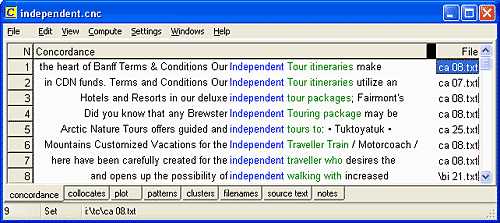
Figure 1: Edited display of the concordance lines generated for the search word independent, sorted alphabetically to the right (In the above screenshot, as in most of those that follow, the display has been heavily edited, mainly to reduce multiple occurrences of the same collocation pattern. However it should be noted that in practice multiple occurrences of the search pattern, or of the search pattern with a specific collocate, is what catches the translator's attention, and reveals the most common way of expressing a term or phrase.)
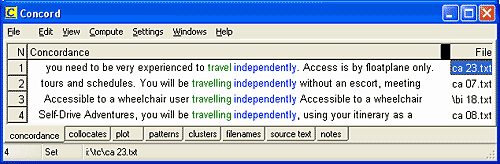
Figure 2: Edited display of the concordance lines generated for the search word independently
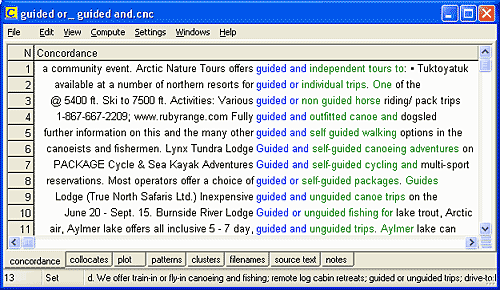
Figure 3: Edited display of the concordance lines generated for the search pattern guided and/guided or, sorted alphabetically to the right
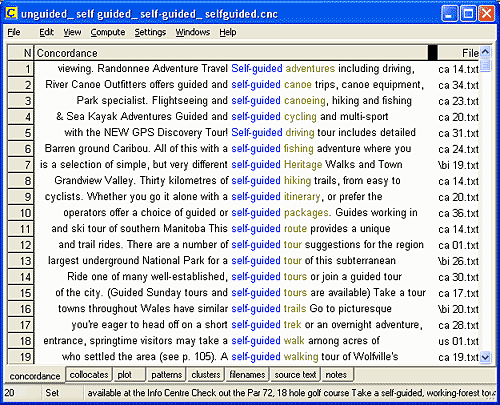
Figure 4: Edited display of the concordance lines generated for the search pattern selfguided/self-guided/self guided/unguided, sorted alphabetically to the right
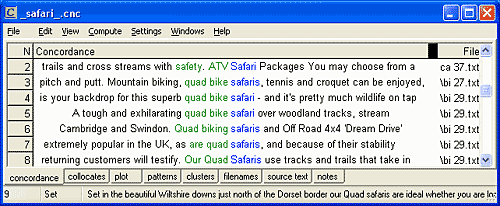
Strange safaris
Figure 5: Edited display of the concordance lines generated for the search pattern safari?, sorted alphabetically to the left
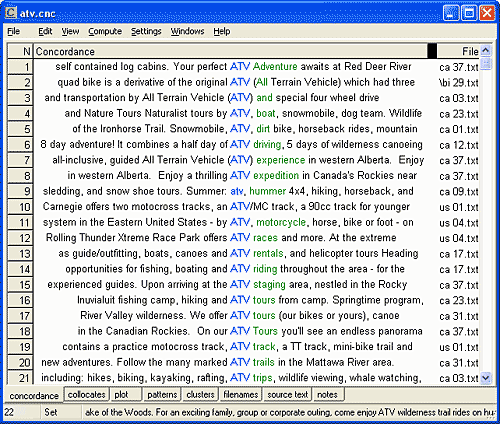
Fig. 6: Edited display of the concordance lines generated for the search word ATV, sorted alphabetically to the right
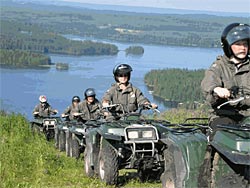
Fig 7. Take an ATV safari with Tahko Safarit Advanced searching with context words Although the above depictions of thought processes are imagined, they are based on discussions with and feedback from student groups about the search strategies they have employed. If these thought processes were portrayed more faithfully (e.g. if they were gathered using a think-aloud method), they would no doubt be more untidy, with more occurrences of frustrating unproductive searches plus a liberal sprinkling of expletives. WordSmith Tools also has an Advanced Search feature that facilitates concordancing with contextually-relevant search words. This works in a way similar to the proximity operators used by search engines—you can restrict a concordance search by specifying a context word or context words which either must (or must not) be present within a certain number of words of your search word. Initially this feature tended to cause the program to "freeze", but the fault seems to have been corrected now, thus making the range of fuzzy search strategies available to users of the WordSmith concordancer even wider. I look forward to seeing how my students exploit this feature during the forthcoming academic year.References Bowker, Lynne & Jennifer Pearson (2002). Working with Specialized Language: a practical guide to using corpora. London: Routledge. Scott, Mike (2004). Oxford WordSmith Tools version 4, Oxford University Press. Varantola, Krista (2002). "Disposable corpora as intelligent tools in translation", in: Tagnin, S. E. O. (Org.). Cadernos de Tradução: Corpora e Tradução. Florianópolis: NUT, 2002, v. 1, n. 9, p. 171-189. Viewable online at: http://www.cadernos.ufsc.br/online/9/krista.htm Varantola, Krista (2003). "Translators and Disposable Corpora", in Federico Zanettin, Silvia Bernardini and Dominic Stewart (eds.) Corpora in Translator Education. Manchester: St Jerome, pp 55-70. Wilkinson, Michael (2005). "Using a Specialized Corpus to Improve Translation Quality", in Translation Journal, Volume 9, No 3. Viewable online at: http://accurapid.com/journal/33corpus.htm Acknowledgements Thanks to Mike Scott and Oxford University Press for permission to use screenshots from Wordsmith Tools, and to Mikko Oinonen of Tahko Safarit Oy (http://www.tahkosafarit.fi/tahkosafarit/main.php) for permission to use the photo in Figure 7.
E-mail this article to your colleague! Need more translation jobs? Click here! Translation agencies are welcome to register here - Free! Freelance translators are welcome to register here - Free! |
|
|
|
|
|
|
| |||
Legal Disclaimer Site Map |
 Corpora
and corpus analysis tools
Corpora
and corpus analysis tools