|
 |
 |
 |
|
|
Home | More Articles | Join as a Member! | Post Your Job - Free! | All Translation Agencies | |
|
|||||||
|
|
|
|
Translation Accreditation Boards/Institutions in Malaysia
According to Puan Siti Rafeah, presently there are around 700 registered part-time translators in ITNMB, but there are no accredited translators in Malaysia. The authorities at ITNMB have yet to apply through the government via an Act to empower them to accredit their registered translators. The authorities at ITNMB are still in the process of applying for this permit to issue accreditation certificates to accomplished translators, and this procedure is still being investigated by the authorities at ITNMB. This will involve meetings at the ministerial level, and working papers must be submitted to the cabinet before it can be approved via an Act. The two institutes that train translators and provide translation courses both in the science and arts fields and provide certificates to successful students in translation in Malaysia are the Malaysian National Institute of Translation (ITNMB) and the Institute of Language and Literature Malaysia (DBP). ITNMB, which was established on 14th September 1993, deals solely with translation activities; DBP, which was formerly involved in translation activities is now solely engaged in the promotion of the Malay language and in publishing academic and general books written in the Malay language. The Malaysian National Institute of Translation (ITNMB)All information regarding ITNMB is taken from the ITNMB Brochure published in 2001 and presented by Hamidah Baba, the managing director of ITNMB in her paper entitled, "ITNMB Penentu Masa Depan Industri Terjemahan dan Kejurubahasaan Negara" (ITNMB - The Future Determiner of the Translation and Interpreting Industry in Malaysia) which was presented on 17th October 2002 at the First International Conference on Language, Linguistics and The Real World at the Petaling Jaya Hilton Hotel in Malaysia. The Malaysian National Institute of Translation (ITNMB-Institut Terjemahan Negara Malaysia Berhad) is situated in Wangsa Maju in Kuala Lumpur. Its aim is to provide the infrastructure for Malaysia's translation industry, in line with the Malaysian Prime Minister's 2020 Vision to see Malaysia as a fully developed and industrialised country. ITNMB has been entrusted to undertake translation, interpretation and information exchange work on the national and international levels. Reasons for the Establishment of ITNMB ITNMB was established for the following reasons:
Objectives of ITNMB The objectives of ITNMB are to:
and international levels; quality works; image; Corporate Statement of ITNMB The corporate statement of ITNMB comprises its identity, vision and mission, which are described below:
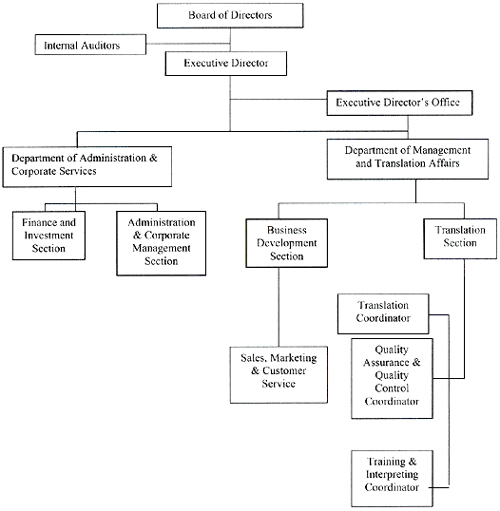
ITNMB's latest Structural Organisational Chart is presented in Figure 1. Figure 1 ITNMB'S ORGANISATIONAL
CHART EFFECTIVE 2002 Functions of ITNMB The functions of ITNMB as determined by the Cabinet are to:
(taken from ITNMB Brochure: 2001) Grading System for Translators Translators who are registered with ITNMB are graded based on a short test which they must take. According to Puan Siti Rafiah binti Sulaiman, head of the translation section at ITNMB, there is a grading system to evaluate the skills of translators who wish to translate documents, especially those from English into Malay. This is a new system that has just been implemented to fulfill ITNMB's need to identify translators for translating books. A translator must sit for a short examination in the specific and general fields in which that he or she intends to translate. This is to assess his/her proficiency in the Malay language. The translated product is then evaluated and graded according to the marks obtained in the examination. The format of the short test is as follows: The test with a total weight of 100% is divided into three parts which are:
All the candidates who sit for this test are required to complete all the above three tests. The first part on Malay Grammar tests their competence in the Malay language, for which they have to sit for an objective test which has 100 questions which test various Malay grammatical rules such as affixes, transitive verbs, etc. to see if the candidate is knowledgeable in all the grammatical rules relevant to translating. The second part, which deals with General Text Translation, requires the candidate to translate a general text of about 500 words if it is a document and about 8-10 pages if it is a book. In the third part which deals with specific texts in a specialised field, a candidate is required to translate a text of about 500 words for a document and about 8-10 pages if it is a book which is relevant to the candidate's field of specialisation. The second and third parts can be done at home by the candidates within a stated time period, and the texts chosen by ITNMB can be either from real clients' work or from chapters of books which are being translated. Based on their performance in the tests, the candidates are classified according to their grades as shown in Table 1. Candidates who score As and Bs are usually called upon by the translation authorities at ITNMB to join their pool of translators to help them in translation tasks for which they are paid well. Those who do not perform well are advised to improve themselves and to sit for the tests again once they are ready. Table 1 Classification of Translators According to Grades
Publication of Translated Books To date, ITNMB has published 43 books in various fields. Of these, only two translated science books in Malay have been published for institutions of higher learning while seven have been translated and published for general reading; these can also be used as reference books for Form 6 students and for students in institutions of higher learning. Presently, the translation services in ITNMB cater for the private sector, where the profits are greater. ITNMB is not very interested as the translated in textbook translation, because books do not sell well in the market and ITNMB has to bear the cost of publishing and later stockpiling the unsold books. ITNMB has learned a lesson from DBP when two million translated books published by DBP could not be sold as reported in the Malay newspaper—Berita Harian dated 19th September 1995. Furthermore, copyright approval has to be obtained from the original author and a specific time limit is given to translate, failing which, the copyright approval has to be requested for again. The translators assigned to translate English-language scientific texts to the Malay language sometimes cannot meet the deadlines given, as they are professionals doing translation on a part-time basis and have other commitments. This causes difficulties for ITNMB. According to Abdul Razak Ismail (1997:49), English-language scientific books translated to the Malay language mainly cater for students in the technical and vocational fields in Institutions of higher learning. The general public is not interested in buying such books which generally do not have much relevance to their work. Students in the fields of science and technology are very few in number. Most of them prefer to photocopy the relevant chapters in a book because not all the chapters are covered for their courses. This cuts their costs. Also, some seniors who have bought translated books sell them at half-price to the junior students who, therefore, do not buy new translated books. Working people would rather buy the original books written in English language which are easier to understand rather than invest their money in poorly translated Malay books which may contain terminology terms which they are not familiar with. Dewan Bahasa dan Pustaka (DBP) The researcher feels that a discussion of DBP - Dewan Bahasa dan Pustaka or the Institute of Language and Literature Malaysia (the Language Academy for Malaysia) is very important because DBP is a very important resource centre for translators who are involved in translating texts from any source language to the Malay language. From DBP, they can get the latest in the Malay language. In this section, the researcher will discuss the structure, organisation, and activities carried out by DBP's various divisions in Malay language planning and in the preparation of language tools such as terminology lists, software programmes, compilation of dictionaries, encyclopedias, and reading materials in the form of books, journals, and magazines on the latest in the field of education. All these resources in the Malay language produced by DBP staff are a great asset to students, academicians, researchers, translators, and foreigners. All of this updated information has been published by DBP in 2002 in a book written in the Malay language and there is also a bilingual version of the same book in Malay and English entitled, CITRA Dewan Bahasa Dan Pustaka (2002). This book can be obtained for free from DBP. The researcher has mentioned important aspects relating to this study in the next few pages which are directly taken from this book. Equipped with the DBP Ordinance 1959, which entrusts it with promoting the national language in Malaysia, DBP declares its vision and mission to uphold Malay as one of the major languages of the world by the year 2020. This farsighted vision is enshrined in DBP's Philosophy, Mission, Motto, Objectives, Corporate Culture, and Clients' Charter
The philosophy of DBP is to build a Nation State through the Malay Language. The philosophy is a manifestation of DBP's tasks and methods of implementing its planned programmes and activities in an effort to establish the identity and to fortify the status of the Malay language as a vehicle of creativity and communication and of building a modern Malaysian civilization. Mission of DBP The mission of DBP is to develop Malay into a language of knowledge in the process of building a Nation State. Motto of DBP The motto of DBP is "Language is the Soul of the Nation". Objectives of DBP The objectives of DBP (CITRA 2002:11-13) are to:
Organisational Structure of DBP (taken from CITRA DBP 2002: 6) DBP is governed by a body known as the DBP Board of Control. The Board which was established under the DBP Ordinance 1959, formulates and implements policies aimed at achieving the objectives of the Institute. The DBP Board of Control comprises the following members:
Each appointed member shall hold office for three years and is eligible for reappointment thereafter. The Education Minister in selecting members to sit on the Board can appoint whosoever in his opinion has knowledge and ability to make positive contributions towards the attainment of DBP's goals. The management and administration of DBP is the responsibility of the Chief Executive Officer—namely, the Director-General. The Board of Control shall be the sole coordination authority pertaining to the coining and standardizing of Malay terminologies. DBP's organisational chart shows that the Director General heads all the branches of DBP in Malaysia. Under his jurisdiction are the Internal Audit Division and the Legal Affairs Unit. The Language, Literature, Publication, Malay Documentation Centre and Policy and Corporate Development Departments also come directly under the Director General and the Deputy Director General. The Language Department comprises the following:
The Literature Department comprises the following:
The Publication Department comprises the following:
The Publication Department with its eight divisions is important for the focus of my study as it deals with the publication of resources which are useful to translators for their translation tasks. The Malay Documentation Centre is on its own with no divisions. The Policy and Corporate Development Division comprises the following:
In 1977, DBP extended its wings to East Malaysia, that is in Sabah and Sarawak Branches in the Northern, Eastern and Southern Regions of West Malaysia DBP opened its other branch offices in the Northern Region in Bukit Mertajam, Penang in 1999, the Eastern Region in Kota Bharu, Kelantan in 1999 and the Southern Region in Johor Bharu, Johore in 2000. Services Provided by DBP The services provided by DBP include translation courses, language planning and development, spreading the latest information on the Malay language via the on-line computerized terminology bank (Bikomta), having regional language cooperation for the development and enhancement of the Malay language corpus, standardization of the Malay language, the compilation and writing of the history of the Malay language, language codification through lexicography, and having a computerized Malay language database. Coining of Terminology Under this section, the researcher will give the viewpoints on how terminology is coined at DBP as given by Hasnah Mohamad, a Language Planning Officer in the terminology division in DBP. The researcher e-mailed Hasnah Mohamad and asked her for the latest process involved in terminology coinage at DBP. In her e-mail to the researcher dated 7th May 2003, Hasnah (2003) gave the steps involved in the process of terminology coinage in the scientific and non-scientific fields, stating that the process is identical for the two. In short, the process as interpreted from Hasnah Mohamad's e-mail by the researcher is as follows:
According to Hasnah Mohamad, presently the process of terminology coinage involves a lot of translation work because of the low level of domestic innovation. She feels that presently we are still borrowing the source language terms and translating them. She suggests that if we can find a new tool, then we can give the Malay term immediately for processes, things etc. According to Hasnah Mohamad, DBP, with the help from authorities in Brunei and Indonesia, has published a book entitled Pedoman Umum Pembentukan Istilah Bahasa Melayu (1972) and she recommends it for further details on terminology coinage. Conclusion The researcher has discussed the two most important translation bodies in Malaysia, namely ITNMB and DBP. ITNMB is on its way to become endorsed as an accreditation board but up till today this dream has still not become a reality. Where translation is concerned, both these bodies have played a significant role in the field of translation in Malaysia. References ______________, ITNMB Brochure. 1995. Kuala Lumpur: ITNMB ______________, ITNMB Brochure. 1995. Kuala Lumpur: ITNMB ______________, CITRA Dewan Bahasa dan Pustaka. 2002. Kuala Lumpur: DBP
E-mail this article to your colleague! Need more translation jobs? Click here! Translation agencies are welcome to register here - Free! Freelance translators are welcome to register here - Free! |
|
|
|
|
|
|
| |||
Legal Disclaimer Site Map |
 Presently there are no Translation Accreditation
Boards in Malaysia. The researcher was informed of this
by Puan Siti Rafiah bt. Sulaiman, the Head of the Translation
Section of the Malaysian National Institute of Translation
(ITNMB). According to her, ITNMB is still in the process
of drawing up translation programmes with the help of
translator certification office-holders in America,
New Zealand and Australia, i.e., the American Translators
Association, New Zealand Translators Association and
the Australian Translators Association. According to
her, the certification office-holders of these associations
will be contacted to evaluate ITNMB's translation programmes
and finally the authorities at ITNMB can have their
translation courses accredited by authorities at the
Malaysian Board of Accreditation or Lembaga Akreditasi
Negara (LAN), which will issue the certificate of
accreditation for ITNMB's translation courses. The authorities
at LAN can do this because although ITNMB reports to
the government, it is registered under the Register
of Companies and thus is still considered a private
institution offering its own courses to the public.
This has not been achieved as yet, but steps are now
being taken in this direction.
Presently there are no Translation Accreditation
Boards in Malaysia. The researcher was informed of this
by Puan Siti Rafiah bt. Sulaiman, the Head of the Translation
Section of the Malaysian National Institute of Translation
(ITNMB). According to her, ITNMB is still in the process
of drawing up translation programmes with the help of
translator certification office-holders in America,
New Zealand and Australia, i.e., the American Translators
Association, New Zealand Translators Association and
the Australian Translators Association. According to
her, the certification office-holders of these associations
will be contacted to evaluate ITNMB's translation programmes
and finally the authorities at ITNMB can have their
translation courses accredited by authorities at the
Malaysian Board of Accreditation or Lembaga Akreditasi
Negara (LAN), which will issue the certificate of
accreditation for ITNMB's translation courses. The authorities
at LAN can do this because although ITNMB reports to
the government, it is registered under the Register
of Companies and thus is still considered a private
institution offering its own courses to the public.
This has not been achieved as yet, but steps are now
being taken in this direction.