 |
 |
 |
 |
|
|
Home | More Articles | Join as a Member! | Post Your Job - Free! | All Translation Agencies | |
|
|||||||
|
|
|
|
Esperanto
Although no recognized country has adopted the language officially, it has enjoyed continuous usage by a growing community of speakers, who are estimated to number around 1.6 million. Today, Esperanto is employed in world travel, correspondence, cultural exchange, conventions, literature, language instruction, and radio broadcasting. There are even about a thousand native speakers of the language. There is evidence that learning Esperanto before another foreign language improves one's ability to learn that language, so much so that it takes less time to learn both than it would to learn just the second. History Main article: History of Esperanto
Esperanto is part of the state educational curriculum of several countries, but is not an official language of any. There were plans at the beginning of the 20th century to establish Neutral Moresnet as the world's first Esperanto state, and the short-lived artificial island micronation of Rose Island used Esperanto as its official language in 1968. In China, there was talk in some circles after the 1911 Xinhai Revolution about officially replacing Chinese with Esperanto as a means to dramatically bring the country into the twentieth century, although this proved untenable. Esperanto is the working language of several non-profit international organizations such as the Sennacieca Asocio Tutmonda and the United Citizens Alliance, but most others are specifically Esperanto organizations. The largest of these, the World Esperanto Association, has an official consultative relationship with the United Nations and UNESCO. The Oomoto religion encourages the use of Esperanto among their followers. The Bahá'í Faith encourages the use of an auxilliary international language, and sees Esperanto as having great potential in this role. Linguistic properties Classification As a constructed language, Esperanto is not genealogically related to any ethnic language. Esperanto can be described as "a language lexically predominantly romanic, morphologically intensively agglutinant and to a certain degree isolating in character" (Blanke 1985). The phonology, grammar, vocabulary, and semantics are based on the western Indo-European languages. The phonemic inventory is essentially Slavic, as is much of the semantics, while the vocabulary derives primarily from the Romance languages, with a lesser contribution from Germanic. Pragmatics and other aspects of the language not specified by Zamenhof's original documents were influenced by the native languages of early speakers, primarily Russian, Polish, German, and French. Typologically, Esperanto has prepositions and a pragmatic word order that by default is Subject Verb Object and Adjective Noun. New words are formed through extensive prefixing and suffixing. Grammar
Esperanto words are derived by stringing together prefixes, roots, and suffixes. This is very regular, so that people can create new words as they speak and be understood. Compound words are formed with modifier-first, head-final order, i.e. the same way as in English birdsong vs. songbird. The different parts of speech are marked by their own suffixes: all nouns end in -o, all adjectives in -a, adverbs in -e, and verbs end in one of six tense and mood suffixes, such as present tense -as. Plural nouns end in -oj (pronounced "oy"), whereas direct objects end in -on. Plural direct objects end in -ojn (pronounced to rhyme with "coin"). Adjectives agree with their nouns; their endings are plural -aj (pronounced "eye"), direct-object -an, and plural direct-object -ajn (pronounced to rhyme with "fine").
The six verb inflections are three tenses and three moods. They are present tense -as, future tense -os, past tense -is, infinitive mood -i, conditional mood -us, and jussive mood -u. Verbs are not marked for person or number. For instance: kanti - to sing; mi kantas - I sing; mi kantis - I sang; mi kantos - I will sing.
Word order is comparatively free: adjectives may precede or follow nouns, and subjects, verbs and objects (marked by the suffix -n) can occur in any order. However, the article la (the) and the demonstratives almost always come before the noun, and a preposition must come before it. Similarly, the negative ne (not) and conjunctions such as kaj (both, and) and ke (that) must precede the phrase or clause they introduce. In copular (A = B) clauses, word order is just as important as it is in English clauses like people are dogs vs. dogs are people. Vocabulary
The core vocabulary of Esperanto was defined by Lingvo internacia, published by Zamenhof in 1887. It comprised 900 roots, which could be expanded into the tens of thousands of words with prefixes, suffixes, and compounding. In 1894, Zamenhof published the first Esperanto dictionary, Universala Vortaro, with a larger set of roots. However, the rules of the language allowed speakers to borrow new roots as needed, recommending only that they look for the most international forms, and then derive related meanings from these. Since then, many words have been borrowed, primarily but not solely from the western European languages. Not all proposed borrowings catch on, but many do, especially technical and scientific terms. Terms for everyday use, on the other hand, are more likely to be derived from existing roots—for example komputilo (a computer) from komputi (to compute) plus the suffix -ilo (tool)—or to be covered by extending the meanings of existing words (for example muso (a mouse), now also means a computer input device, as in English). There are frequent debates among Esperanto speakers about whether a particular borrowing is justified or whether the need can be met by deriving from or extending the meaning of existing words. In addition to the root words and the rules for combining them, a learner of Esperanto must learn some idiomatic compounds that are not entirely straightforward. For example, eldoni, literally "to give out", is used for "to publish" (a calque of words in several European languages with the same derivation), and vortaro, literally "a collection of words", means "a glossary" or "a dictionary". Such forms are modeled after usage in the ethnic European languages, and speakers of other languages may find them illogical. Fossilized derivations inherited from Esperanto's source languages may be similarly obscure, such as the opaque connection the root word centralo "power station" has with centro "center". Compounds with -um- are overtly arbitrary, and must be learned individually, as -um- has no defined meaning. It turns dekstren "to the right" into dekstrumen "clockwise", and komuna "common/shared" into komunumo "community", for example. Nevertheless, there are not nearly as many truly idiomatic or slang words in Esperanto as in ethnic languages, as these tend to make international communication difficult, working against Esperanto's main goal. Writing system
Esperanto is written with a modified version of the Latin alphabet, including six letters with diacritics: ĉ, ĝ, ĥ, ĵ, ŝ and ŭ (that is, c, g, h, j, s circumflex, and u breve). The alphabet does not include the letters q, w, x, y except in unassimilated foreign names. The 28-letter alphabet is: All letters are pronounced approximately as their lower-case equivalents in the IPA, with the exception of c and the accented letters:
Two ASCII-compatible writing conventions are in use. These substitute digraphs for the accented letters. The original "h-convention" (ch, gh, hh, jh, sh, u) is based on English 'ch' and 'sh', while a more recent "x-convention" (cx, gx, hx, jx, sx, ux) is useful for alphabetic word sorting on a computer (cx comes correctly after cu, sx after sv, etc.) as well as for simple conversion back into the standard orthography. The Esperanto speaker community Geography and demographyEsperanto speakers are more numerous in Europe and East Asia than in the Americas, Africa and Oceania, and more numerous in urban than in rural areas (Sikosek 2003). Esperanto is particularly prevalent in the northern and eastern countries of Europe; in China, Korea, Japan, and Iran within Asia; in Brazil, Argentina, and Mexico in the Americas; and in Togo and Madagascar in Africa. An estimate of the number of Esperanto speakers was made by Sidney S. Culbert, a retired psychology professor of the University of Washington and a longtime Esperantist, who tracked down and tested all Esperanto speakers in sample areas of dozens of countries over a period of twenty years. Culbert concluded that between one and two million people speak Esperanto at Foreign Service Level 3, "professionally proficient" (able to communicate moderately complex ideas without hesitation, and to follow speeches, radio broadcasts, etc.) (Wolff 1996). Culbert's estimate was not made for Esperanto alone, but formed part of his listing of estimates for all languages of over 1 million speakers, published annually in the World Almanac and Book of Facts. Since Culbert never published in detail about his sampling methodology, or intermediate results for particular countries and regions, it is difficult to gauge the accuracy of his results. In the Almanac, his estimates for numbers of language speakers were rounded to the nearest million, thus the number for Esperanto speakers is shown as 2 million. This latter figure appears in Ethnologue. Assuming that this figure is accurate, that means that about 0.03% of the world's population speaks the language. This falls short of Zamenhof's goal of a universal language, but it represents a level of popularity unmatched by any other constructed language. Ethnologue also states that there are 200 to 2000 native Esperanto speakers. Marcus Sikosek has challenged this figure of 1.6 million as exaggerated. Sikosek estimated that even if Esperanto speakers were evenly distributed, assuming one million Esperanto speakers worldwide would lead one to expect about 180 in the city of Cologne. Sikosek finds only 30 fluent speakers in that city, and similarly smaller than expected figures in several other places thought to have a larger-than-average concentration of Esperanto speakers. He also notes that there are a total of about 20,000 members of the various Esperanto organizations (other estimates are higher). Though there are undoubtedly many Esperanto speakers who are not members of any Esperanto organization, he thinks it unlikely that there are fifty times more speakers than organization members (Sikosek 2003). Others think such a ratio between members of the organized Esperanto movement and speakers of the language is not unlikely. In the absence of Dr. Culbert's detailed sampling data, or any other census data, it is impossible to state the number of speakers with certainty. Culture
Esperanto is often used to access an international culture, including a large corpus of original as well as translated literature. There are over a hundred regularly published magazines in Esperanto. Many speakers use the language for free travel throughout the world using the Pasporta Servo, or for international pen pals. Penpals are even possible for elementary school students, something that is far more difficult when using an ethnic language like English. To some extent there are also shared traditions in the Esperanto community, like Zamenhof Day. It is frequently criticised that "Esperanto has no culture". However, Esperanto is intentionally culturally neutral: It was intended to be a facilitator between cultures, not the carrier of any one culture. (See Esperanto as an international language.) Two films were produced with dialogue entirely in Esperanto. The films were Angoroj in 1964 and Incubus starring William Shatner in 1965. The anime RahXephon makes use of Esperanto for the acronym of TERRA, which stands for "Tereno Empireo Rapidmova Reakcii Armeo." This can be translated as "Earth Empire Rapid Response Army," though pedants might note that a better Esperanto rendition of this name would be "Rapid-Reaga Armeo de la Tera Imperio". American composer Lou Harrison, who incorporated styles and instruments from many world cultures in his music, used Esperanto titles and/or texts in several of his works. Goals of the Esperanto movementZamenhof's intention was to create an easy-to-learn language to foster international understanding. It was to serve as an international auxiliary language, that is, as a universal second tongue, not to replace ethnic languages. This goal was widely shared among Esperanto speakers in the early decades of the movement. Later, Esperanto speakers began to see the language and the culture that had grown up around it as ends in themselves, even if Esperanto is never adopted by the United Nations or other international organizations. Those Esperanto speakers who want to see Esperanto adopted officially or on a large scale worldwide are commonly called finvenkistoj, from fina venko, meaning "final victory". Those who focus on the intrinsic value of the language are commonly called raŭmistoj, from Rauma, Finland, where a declaration on the near-term unlikelihood of the "fina venko" and the value of Esperanto culture was made at the International Youth Congress in 1980. These categories are, however, not mutually exclusive. The Prague Manifesto (1996) presents the views of the mainstream of the esperanto movement and of its main organisation, the World Esperanto Association (UEA). Esperanto and educationRelatively few schools teach Esperanto officially outside of China, Hungary, and Bulgaria; the majority of Esperanto speakers continue to learn the language through self-directed study or correspondence courses. Several Esperanto paper correspondence courses were early on adapted to email and taught by corps of volunteer instructors. In more recent years, teaching websites like lernu! have become popular. Claude Piron, a psychologist formerly at the University of Geneva and Chinese-English-Russian-Spanish translator for the United Nations, argued that it is easier to think clearly in Esperanto than in many ethnic languages (see Sapir-Whorf hypothesis for an explanation on this theory). "Esperanto relies entirely on innate reflexes [and] differs from all other languages in that you can always trust your natural tendency to generalize patterns. [...] The same neuropsychological law [— called by] Jean Piaget generalizing assimilation — applies to word formation as well as to grammar." (published lecture notes) Several studies demonstrate that, at least for native European-language speakers, studying Esperanto before another foreign language speeds and improves learning the other language. This is presumably because learning subsequent foreign languages is easier than learning one's first, while the use of a grammatically simple and culturally flexible auxiliary language like Esperanto lessens the first-language learning hurdle. In one study (Williams 1965), a group of European high-school students studied Esperanto for one year, then French for three years, and ended up with a significantly better command of French than a control group, who studied French for all four years. Similar results were found when the second language was Japanese, or when the course of study was reduced to two years, of which six months was spent learning Esperanto. See Propedeutic value of Esperanto for other relevant studies. Criticism and Modifications of Esperanto
Common criticisms of the language are that its vocabulary and grammar are too Western European; that its vocabulary, accented letters, and grammar are not Western European enough (a critique addressed by Ido and Interlingua); that it is sexist, artificial, or has failed to live up to expectations. Though Esperanto itself has changed relatively little since the publication of the Fundamento, a number of reform projects have been proposed over the years, starting with Zamenhof's proposals in 1894 and Ido in 1907. Several later conlangs, such as Novial and Fasile, were based on Esperanto.
All text is available under the terms
of the GNU
Free Documentation License
E-mail this article to your colleague! Need more translation jobs? Click here! Translation agencies are welcome to register here - Free! Freelance translators are welcome to register here - Free! |
|
|
|
|
|
|
| |||
Legal Disclaimer Site Map |
 Esperanto
is the most widely spoken
Esperanto
is the most widely spoken 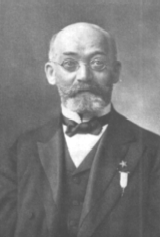 As
a recently constructed language, Esperanto's history
is short and relatively well-known. It was developed
in the late
As
a recently constructed language, Esperanto's history
is short and relatively well-known. It was developed
in the late 

