|
 |
 |
 |
|
|
Home | More Articles | Join as a Member! | Post Your Job - Free! | All Translation Agencies | |
|
|||||||
|
|
|
|
FIST - First International Strike of Translators
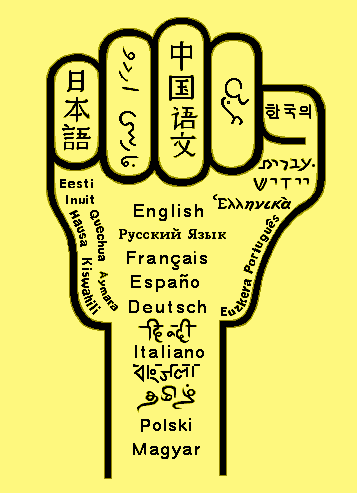
Only A Fantasy? This article is at least partly a fantasy. I know all the reasons why the events I am about to describe are unlikely to take place in the near future. I will even examine these reasons in some detail towards the end. But for now let us simply entertain the idea embodied in my title and see where it leads us. Let us imagine that all the professional translators in the world, working in their separate countries in business, science, diplomacy, or even espionage and the military, have in fact come together as a single group and have launched a strike under a single banner, First International Strike of Translators or "FIST," bearing a device something like the one shown here. Let's just assume this has happened or is about to happen. I then have three questions. Who precisely are we, the ones about to go out on strike? Assuming we can answer this and have decided we have something in common, what is it that we would want, what would be our actual demands? A strike—or the threat of one—is of course the classic weapon to resolve grievances, but we must first define what these grievances are and how they might be resolved. And finally, what effects could such a strike possibly have, both for ourselves and for the world beyond us? Let us begin by talking about who we are, even though we may suppose we know this well enough. First of all, we are people who through birth, study and/or accident have come to be familiar with two or more languages. In all but a few countries this already marks us as unusual. And even in those countries where bilingualism is more accepted, we still stand out because we habitually deal in the detailed process of crossing between our languages and in helping others to do so. In some countries this ability is held in awe, in others it is dismissed as a rote skill and/or a plentiful commodity, and in yet others it is the object of considerable suspicion. In none of these lands, even where translation is more commonplace, is the ability to translate regarded as altogether normal. After all, we translators can actually handle two or more languages, are able to live to some degree in two or more cultures, and may in fact have two or more loyalties. And in a world of single loyalties, single nationalities and single cultural choices, this marks us as different and also as potentially dangerous. We all know this of course, and we do the best we can to prove our loyalty to the countries and companies which employ us. But if we are looking for something to unite us in our undertaking, this is certainly a factor worth considering. Whatever our nations, origins or loyalties, it is likely to be something we have in common. We are able to look at two or more different cultural contexts and explain the first in terms of the second and often the second in terms of the first as well. In a world of single loyalties this is a useful skill but also an odd accomplishment, something that marks us both as dull, devoted drones and as potentially divided outsiders. Such an accomplishment is all the more remarkable in a world where at least some ideological and national distinctions are slowly beginning to blur, blend, perhaps relax a bit. Let's just suppose that some of the internationalist rhetoric we are beginning to hear is actually true, let's imagine that we really are moving into a broader, more multi-cultural world environment. What do we then become? Do we not first and foremost among all human beings bear the banner of such a change? Could it just possibly turn out that we are pioneers and heroes? If the world's definition of freedom were expanded to embrace being free to know more than one culture, might we not rank rather highly in such a hierarchy of freedom? Is all this also a fantasy, or is it something worth considering? Such is my partial answer to the question "Who are we?" And now the second question: what is it that we want? Assuming we could get every translator in the world to go out on strike with us, what would we ask as conditions for returning to work? Would we merely insist on the time-honored demand of improvements in pay and working conditions? Would we perhaps add a few clerical caveats on the maximum numbers of words to be translated per hour? Would we express Luddite dismay at the appearance of computers in our midst? Or would we launch some truly powerful salvos on the philosophical and educational level at a world that still fails to understand the true interactive relationship between language and reality? I am appending a tentative list of such demands—as I see them right now—and invite dialogue with readers to expand and refine them. PROVISIONAL DEMANDS OF THE FIRST
INTERNATIONAL 1. Specific demands concerning pay, working hours, and work conditions, to be formulated cooperatively by an international committee, with possible differences according to specific conditions in various countries and societies. 2. Explicit recognition by all the world's governments of the primacy of the translation process in international communication and a commitment from these governments to ensure, in cooperation with our standing committees, the highest possible standards of translation in all such communication media. 3. A further commitment from the world's governments and universities that they regard language/translation as the major fountainhead of culture and human understanding, and that they realize that knowledge and science are more likely to be seen in the future as a branch of language than language as a branch of knowledge or science. 4. The granting by all countries (or by an international organization) of special passports for translators, similar to those issued to diplomats, facilitating travel for them in all foreign countries they may wish to visit. 5. Granting translators the option to refuse to translate texts they find morally unacceptable, for example declarations of war, terrorist demands, death threats, statements that one nation or people is intrinsically superior to another, assertions about religious or political systems that are injurious to those holding different views. In such cases, translators would at least have the option of returning these statements to their authors for further thought and redrafting. While this demand may appear radical at first, it in fact reflects a process already at work in some international organizations, where the fine print and fine tuning of international agreements sometimes reaches its final shaping in the hands of translators or results from a cooperative process involving them. 6. Gaining widespread recognition and publicity through national and international bodies for what is at present a barely perceived reality, namely that the quality of a translation is to a great extent dependent on the quality and clarity of the original text. Just as it is rarely possible to make a clear xerox from a fuzzy original unless it is first enhanced, so a poorly conceived and indifferently written original text can be just barely rendered into a foreign language with considerable help from the translator. In practical terms, Adjudicative Committees comprised of translators should be formed to deal with problems arising in this area. In major cases where complaints of an "unfaithful translation" may be lodged, the role of such a committee would be to determine if such complaints are justified or if any truly faithful translation would have been possible in the first place. Where complaints are found to be unjustified, the committee shall be empowered to fine those lodging them for willful abuse of the translator and to require them to bear the expense of such proceedings. Decisions of such a committee shall be binding. 7. The right of translators to function as final advisors on the feasibility and usefulness of all computer-based translation aids and to determine standards on how these will be used in their work. This by no means indicates hostility to such devices among translators, many of whom are actually curious or even excited to learn how such devices can help them in their work. This demand merely confirms two recognized circumstances, that the use of computers in translation is still a relatively new and untried process, and that there is a great deal of misleading information in this field. A computer system may work brilliantly in the hands of its inventors and yet create intractable problems when integrated into normal work routines. Some systems which work well in one setting are less successful in others. Other systems, touted only recently as useful translation aids, have disappeared along with their manufacturers. Furthermore, as with interpreters, whose work is often so demanding that they can only work for brief one- or two-hour shifts, there may also be special human needs connected with using computers in the demanding field of translation. This could prove especially true in those cases where advocates of complex and expensive systems promise vastly increased outputs without considering the work or health needs of human translators.(1) And now our most crucial question: would we actually be able to realize these demands by launching—or threatening to launch—such a strike? This question strikes at the heart of our fantasy and also forces us to consider the reasons why, according to many, such a strike could never in fact occur. Or, if it did, could never succeed. I will consider these arguments in a candid manner and without totally denying that such criticisms have some merit. But it also is worth considering that what seems totally impossible today may not be at all impossible a few years or a few decades from now. The first thing we should clearly realize is that we are under no obligation to begin such a strike right away. In fact all practical experience in this field dictates that we should not begin it until we are truly ready. The key to all successful strikes is capable, prolonged, and thorough organization, and this would clearly involve endless work. In the meantime the mere announcement that translators might be planning such a strike or are even discussing its possibility can, in a media-driven world, begin to give us some of the publicity we need to start mobilizing our own resources. It is just possible that we already possess some of the necessary power—we simply need to make this power manifest and begin to shape it in the public awareness and in our own. No doubt some early reports would ridicule our efforts and suggest that they are doomed to failure, as the world at large does not tend to view translators as very important in the scheme of things and supposes that we are all easily replaceable, whether by other translators or by machines. But it is precisely here where our organization and research efforts should concentrate, in order to prepare a credible response to such charges. Thus, I visualize the initial effort to realize these demands as being one of prolonged discussion, organization, international coordination and "consciousness raising" among ourselves, along with a parallel publicity campaign to keep the press and general public apprised of our intentions and progress. One major goal of these discussions and organizing activities will be to provide others and ourselves with accurate answers to our last question: what would happen if the strike actually took place? And to prepare practical answers to this question beforehand. At this point I am prepared to claim on the theoretical plane—leaving some of the hardest questions for last—that if we were successful during the discussion and organization phase, and if we really were able to persuade all translators and interpreters in all fields in all nations to go on strike with us, the results could be nothing less than astounding. Business, communications, international relations, science, the military, espionage, patent registry, and applications for international jobs and divorces would all come to a grinding halt. The entire world—ourselves not least of all—would be astonished by the truly enormous power that flows through our hands. But how would the world react to such a strike, you must by now be asking, would not all governments everywhere simply rush out and hire others to take our places, leaving us all out on our ears without a job? The answer to this question would depend on how effective we had been during the earlier phase of publicizing our demands. If we did a good enough job here, we might never actually have to go on strike. It might be possible to convince the world's governments and businesses of our enhanced value without ever having to fire a shot. Here we would need to stress the specialist nature of our work and persuade the public that it would be far harder to find replacements for us than they think. We do more than move words and phrases around, we regularly fashion and transfer entire realities between nations. But even if we failed in this effort—and even if we failed in our strike—we would still have the satisfaction of knowing, as we stood on the unemployment lines, that it was only a question of time before our replacements came to feel the same way about their work as we do and began to voice the same desires and grievances. We are after all a very special group of people, and any others who try to play our role must necessarily be or become much the same people as ourselves. It's time to consider the really hard questions, which I have postponed until now. I am of course well aware that as of now not all translators will share my views or even grant the need for such a strike. I also know that many translators have worked so long as intermediaries and are so accustomed to professional self-abnegation that for them any such appeal to activism must seem profoundly inappropriate. Other translators work directly for the government or the military and are certain their employers would never countenance anything like what I have described . Yet other translators work in countries where the legitimacy of any strike by the citizenry, much less by government workers, has never been granted. Thus, as innocent and well-meaning as we may see ourselves and our cause, some of us could actually end up being jailed—perhaps even executed (this is after all a fantasy)—for our efforts. Yet I believe that solutions might become possible in all these cases, provided we are not in too great a hurry. On the positive side, translators and interpreters are already international by the very nature of their work. We share an international network of contacts, professional groups, and publications. It is by no means impossible that we can spread the word of our plans far and wide. We are after all also a relatively small group of people, and this has advantages as well as disadvantages. Some may also argue that business and government would simply ransack the schools and universities for linguists to take our places. We can provide against this by expanding our group in the first place to embrace all language professionals, including teachers, perhaps restyling ourselves as FISTITALP or "First International Strike of Translators, Interpreters, Terminologists, and Allied Language Professionals." Or we can just let the government go ahead and draft language professors—it might be amusing to see if they are really able to translate. At this point, my fantasy—to the extent that it is a fantasy— is running low. It really does seem to me that there ought to be some means by which translators can come to enjoy more recognition than they now receive. They are in a very real sense life's true aristocrats, connoisseurs, and Kenner, its enjoyers of multi-realities, as anyone knows who has ever heard them converse or joined them at table. In an increasingly sophisticated and multicultural world they—unlike wealthy idlers, businessmen or scientists—are the true distinguishers of the world's many realities and the touchstone of the differences between them. It is hard to believe, strike or no, that they will not soon be recognized for their unique pioneering qualities. But of course some will simply smile my fantasy away. Such a scenario surely belongs only to the future. Or perhaps someone will come along, do everything I have described and more, and describe me as an old fuddy-duddy for even calling it a fantasy. (1) For further information about these aspects, see Jean Datta's excellent treatment Machine Translation in Large Organizations: Revolution in the Workplace, pp. 167-173, Technology as Translation Strategy, American Translators Association Scholars Monograph Series, Vol. II, 1988, edited by Muriel Vasconcellos, University of New York at Binghampton (SUNY).
E-mail this article to your colleague! Need more translation jobs? Click here! Translation agencies are welcome to register here - Free! Freelance translators are welcome to register here - Free! |
|
|
|
|
|
|
| |||
Legal Disclaimer Site Map |