|
 |
 |
 |
|
|
Home | More Articles | Join as a Member! | Post Your Job - Free! | All Translation Agencies | |
|
|||||||
|
|
|
|
Translation Evaluation in Educational Settings for Training Purposes: Theories & Applications
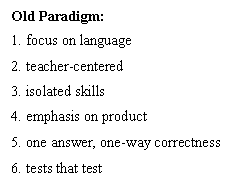
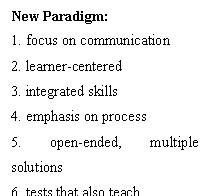
Abstract The present paper addresses a few major questions concerning Persian translation evaluation based on Adab's (2000) model, such as; 1.What is translation evaluation? 2. How can translation competence be evaluated? 3. How is Adab's model adaptable in Persian? The paper, therefore, examines different trends in translation evaluation based on the subcomponents of translation competence. English is considered as the source language from which trainee translators render SL texts to Persian as the target language. Richard's (2002) comparison of new and old paradigms in assessment are addressed in translation evaluation. Finally, an evaluation framework is proposed as a suitable tool to help assess translational texts in Persian. Key Terms: translation competence, translation quality, quality assessment, Anglophone tradition, macro-level analysis, translational text. Introduction In educational settings, as Adab (2000) believes, "translation evaluation is one of the most significant issues which must be addressed duly in order to determine the level of competence achieved by the translator". Adab (ibid) contiues: "besides measuring translation competence, evaluating the target text helps identify areas in which competence is still to be developed". We may argue that it is impossible to evaluate or study translation cometence without considering trenslation product. By evaluating a target text, here a text translated by a translator from English to Persian, we may, performing a macro-level analysis, evaluate the translating process to a considerable extent. In this article, the researcher has traced Anglophone tradition outlines to propose a model for evaluating translational texts in Persian at three consequitive stages. Firstly, in order to evaluate students' abilities to produce and then edit a text in the TL (students' translation performance), it is suggested that students' translations be evaluated by an assessor whose native language is the language to which students have translated the ST. In this case the evaluator has no knowledge of the SL. At the second stage, a bilingual evaluator is asked to compare and contrast students' translations and SL texts. Finally, the results of the stages 1 & 2 are compared to arrive at an objective evaluation grade. Importance of Testing Observing a test session, one may guess that its objective is to evaluate students' performance on language abilities. Heaton (1990) believes that this is only one of the objectives of a test and in fact it is the primay aim of evaluation. He continues: "a test is concerned with evaluation for the purpose of enabling teachers to increase their own effectiveness by making adjustements in their teaching to enable certain groups of students or individuals in the class to benefit more". It is clear that Heaton puts emphasis on the learner-focused methods in both teaching and testing. To him, learning is much more important than teaching (ibid). Both teachers and students can learn from tests, both can benefit a lot. Teachers can elicit a lot of immediate feedback from their students to adjust their ways of teaching based on the students' needs. Students themselves can learn from their results. They can change or adjust their ways of learning. The interaction between teachers and students leads to a perfect learning situation in which every and each student learns from his or her learning. Examinations would be the best guide for students to adjust learning strategies. So, we may come to this conclusion that 'evaluation is a must'. Testing And Teaching Heaton (1990) believes that "both teaching and testing are so closely interrelated that it is virtually impossible to work in either field without being constantly concerned with the other". He, in fact, believes that findings and results of suitable tests will provide teachers with their teaching methodology. They will choose the most appropriate methodologies in their classes in order to put what they have elicited from their students into practice. Translation teaching and testing are no exceptions. A suitable translation test lets the instructor select the best way of teaching in a translation class. Students' results are the best yardstick for the instructor firstly to evaluate his/her own methodology and secondly to conduct his course of teaching in the best way. To see the other side of the coin, translation teaching method determines the type of testing. Accordig to Heaten (ibid), "the interrelation between teaching and testing is a mutual process in which one determines the other". In translation classes depending on the course objective teachers may resort to different methodologies which, in turn, lead to different types of testing. So, it is not possible to suggest a common methodology or a common test type in different translation classes. Translation Evaluation Highlights -There is no perfect test and no foolproof grading or marking system. Tests are relative in nature in that many factors are effective. For example the course objective is of prime importantce. It determines the type and form of the evaluation system. A test designed for technical traslation theories differs from that of a nontechnical. Marking systems, too, are different from system to system. In some educational settings grades are out of 20, in others out of 100 or even sometimes students' papers will be given grades like A, B, C, or D. Therefore no common grading system exits. It is one of the factors which has affected the objectivity of testing systems round the world. -Although evaluation is made on students' performance, it is meant to assess their translation competence. Due to the fact that translation competence is not directly measurable, we have to evaluate students' traslation performance. -Translation competence is the student's ability to comprehend the ST, his ability to produce a text in the TL, and finally his competence in editing and revising the TT based on SL textual elements. So, translation competence is what we mean to evaluate. Translation performance is not an exact representative illustration of a student's translation competence. -The objectives of the course are to be well-established in advance. Students have the right to know what they are learning during the course. Instructors and students should come to an agreement on course objectives. Course objectives determine test objectives and consequently appropriate testing strategy. There should also be a unity between students' intrests and course objectives. Both instructors and students must be so adaptable that no change in course syllabi can deviate their ways of teaching or learning respectively. -Students should not experience any sort of stress or anxiety while they are translating. Stress and anxiety do impact students' performance. It is the instructor's responsibility to alleivate any source of stress or anxiety. The exam atmosphere should be completely relaxing and free from any anxiety or pressure. -It is important to give students enough time to complete any given task. On traslation exams some extra time should be devoted to let students revise and edit their traslations. They should feel no time pressure because it turns to be a sourse of stress and anxiety for the students. -Examinees should access required Dictionaries, Encyclopedias, Databanks, etc. for their translation performance is affected excessively. Online dictionaries and databanks are of great help in screen translation and e-rendering. -A good translation examination is meant to determine how competent students are in applying knowledge, not recalling it. Taking translation into account as a communicative skill, there seems no necessity to check specialized or even general vocabulary or rule as a way to measure ones translation ability. That is why students must be free to use any kind of translation tool. In case the test is meant to check students' vocabulary (technical terms), we will have another story. -As mentioned earlier, it is ideal for students to learn from themselves. This can be called a process which continues during a program or a semester. Such a sort of learning system requires a progress test module in which students compare their previous results and their present ones to check their progress, if any. Instructors are also required to give students back their papers to provide them with their own progress feedback. -Such a progress test is criterion-referenced. In this sort of assessment, each student is evaluated against the criteria previously well-defined by the instructors. The assessment won't be relative since it is not based on the comparison of students' performance on the task. Correcting each paper, an instructor has no image of the student himself nor of other students in the same class. It, in turn, would guarantee the evaluation objectivity. - Adding appropriate notes or comments to students renditions is a must. Such notes should be based on pure facts found in coursebooks and course objectives. The instructor's linguistic and translational intuition is of no value in commenting. In fact it is a part of test objectivity; meaning that the instructor is objective in his/her judgements. -Students papers are given back to them. This facilitates the process of learning from testing. Students will, moreover, gain self-confidence. When they check their papers which have been corrected based on objective criteria, there would be no objection though. -Students' questions are welcome. They may need to know of the criteria based on which their papers have been corrected. Instructors' comments should be persuasive, objective and to-the point. It cannot be denied that instructors are responsible for their judgements. -Instructors must introduce sufficient, appropriate sources to students hoping that they learn from their errors and mistakes. -Students should be asked to collect their exam papers and/or translations to check their own progress in a semester or during their program. -Students are asked to evaluate themselves, their progress during a term and at the end of the term (self evaluation). Changing Paradigm In recent years, there has been a radical change in the application of assessment procedures that are utterly different from traditional forms. These forms of assessment are more students-centered in that, in addition to being an assessment tool, they provide students with a tool to be more involved in their learning and give them a better sense of control for their own learning. These new methods also provide teachers with useful information that can form the basis for improving their instructional plans and practices (Richards 2002). Richards lists the following shifts in assessment paradigm:
Although Richard's (2002) comparison is concerned with language teaching, his method can be well adapted to translation assessment as follows; -Considering translation as an interactive communication, there should be more emphasis on its communicative nature in that concepts, ideas, messages, etc. are to be transformed and/or transferred from the SL to the TL. A translator/assessor must keep in mind the fact that what is important in translation work is the process of communication. -New assessment & teaching systems are learner-centered in which instructor/assessor is consideed as a learning enabler or facilitator. It is the learner who learns or to be taught. Learning is much more important than teaching. Learning is the ultimate goal of assessment. Assessment should speed up learning processes. -Since translation classes require students to sharpen their translation skill as a multi-layered phenomenon containing other skills such as SL comprehension, TL production and TL editing, a translation test is rightly thought to assess integrated translation skills. Such an assessment system lets students experience different learning environments in translation. -It is high time we concidered translation as a product. Translation process is what examiners aim to evaluate. They, in fact, want to observe or evaluate how students of translation apply their translation knowledge and skills. -Evaluators should not expect a single solution to problematic areas in translation tests. Solutions may vary depending on students' backgrounds. Some parameters will undoubtedly, affect their solutions/answers including; culture, gender, specific knowledge background, psychological mode at the time of exam, etc. Different solutions to the same question/problem should be kept in mind. -Tests should be administered to help learners become more capable of taking charge of their own learning. In fact, the primary goal of any test must be facilitating the learning processes. A test is a student's mirror of his/her own learning processes. The image reflected in it, shows different areas of learning and blurry parts where more effort is needed to sharpen weak skills. -As, based on this new paradigm, this form of assessment focuses more on measuring learners' abilities to appropriately use language in real-life situations, the ST to be translated should be authentic and real-life. It is of prime importance to choose a text which is in line with students' level of translation proficiency as well. Even texts chosen for primary translation classes must be as authetic and real-life as possible. -More authetic forms of assessment include; portfolio, interviews, journals, project work, and self or peer assessment. These methods are becoming increasingly common in the ESL classrooms. They can also be adopted to translation classes. They will, surely, pave the way for assessors to have a more objective evaluation of students' translation skills. Translation Competence The concept of translation competence (TC) can be understood in terms of knowledge necessary to translate well (Hatim & Mason, 1990 and Bybee 1996). However this definition is too general, it is more productive to divide knowledge into different subtypes. Waddington (2000) defines 'translation competence' as "a combination of linguistic competence and the ability to translate". Then, translation competence can be defined as a three-stage process. It starts from the "comprehension of the ST, meaning that the primary skill needed to translate is to well comprehend the sourse text. The second stage would be the ability to produce a text in the TL" (ibid). A competent translator must be an excellent user of his/her mother tongue. This ability should not be limited to what the user has aquired subconsciously from his/her environment. A translator must have the specialist's knowledge of the language to which he is translating. The third element comprising translation competence is "editing competence". It requires a detailed analysis and comparative-contrastive study of both ST and TT. This comparison leads to the translator's awareness of possible mismatches in his rendering. He then will be able to revise his product in the TL. This very model provided here is based on a macro-level analysis of translation competenece. Translator's knowledege of both source and target cultures are ignored in this model. Translation Competence Evaluation It is disscussed that in studying language(s), competence cannot be evaluated directly. Performance, because of its accessibility, is what we evaluate or even measure. By studying translation performance, we can, indirectly, evaluate translation competence as defined previously. There have been two trends in translation competence evaluation namely German tradition and Anglophone tradition. German tradition which is based on micro-textual analysis of texts is more atomistic and of analytical nature. Its scientific and explicit tools for evaluating texts have given it a sort of quantative feature. The followers of this tradition evaluate a translation based on painstaking comparison of the ST and TT. This sort of comparison is exercised even at morpheme level to guarantee the exact matching of SL items and their equivalents. The followers of this trend have devised translation (evaluation) models which seem mechanical & mathematical. In their models, the ST is the only functional source for the evaluator to analyze a given TT comparatively. Ignoring cultural elements is one of the shortcomings of such models. Koller (1979), Wills (1982), and Nord (1991) are among the followers of German tradition. Contrary to German tradition, there is a well-known Anglophone tradition. It is less analytical and explicit than the German tradition. The holistic evaluation strategies formulated in this tradition give it a macro-textual form of assessment. In fact, the comparison of the ST and TT in Anglophore tradition is indirect. As a result, there would be less objectivity in testing systems. In Anglophone tradition culture is known as an indispensable element which influences the translation process and product. Some well-known followers of this trend are; Newmark (1988), Sager (1983), Hewson and Martin (1991) and Williams (1989). The position of the evaluator is of prime importance in which, based on Skops theory, the purpose of the ST, the purpose of the translator and that of the TT should match. For the purposes of evaluating a translation product, the evaluator should be well aware of this common purpose and see if it is achieved. The evaluators would assess a translation differently in case of pedagogical purposes. Undoubtedly, they will treat a translation more painstakingly if they are dealing with translations as a fail-pass criterion for a translator to be known as a professional. Evaluation Framwork A broad framework for evaluation is required to assess the development of language skills. Translation evaluation requires a heightened awareness of aspects of text linguistics and functional approaches, drawing on concepts proposed by scholars such as Snell-Hornby (1988) who advocates an integrated approach to translation and Baker (1992) who calls for an interdisciplinary approach. Development of translation competence should be a natural consequence of the implementation of such approaches. Morever, a trainee translator must have a level of sufficient L2 socio-cultural experience and language competence to be able to make decisions without some delibration of comparative-contrastive, linguistic and stylistic use. It is believed that students' translations must be evaluated based on the following parameters; A: Students' comprehension of the ST (competence) B: Students' production ability in the TL (performance) C: Students' editing ability in the TL (performance) To check the students' ability to produce a TT and to edit that, it is suggested that students' papers be corrected by assesssors whose native language is the language to which students have translated a text. Such an assessor has no knowledge of the SL. In fact, he evaluates the translation product regardless of its original ST. In case of our study, some B.A. holders in Persian Literature were asked to evaluate students' translations as mere compositions in the TL without considering the ST. These raters were expected to keep in mind factors such as text difficulty of the products, grammaticality of the utterances produced by the translators, wording and faultless use of collocations, text integrity & unity, and punctuation. Then, a bilingual evaluator was asked to compare and contrast students' translations and STs to make sure the degree of students' comprehension of the ST and their renderings into the TL. The researcher himself undertook this task. Each evaluator (at first and second stages) gave marks to the students' papers. The results of the 1st and 2nd stages were calculated to arrive at a standard mean out of 20. In case of any inconsistency between the first and second stage grades, a third evaluator was asked to evaluate the papers. Appropriate comments were added to students' renditions in order to provide them with enough feedback on their performance. Students' papers were then given back to them. The instructor is obliged to introduce enough suitable source books or materials to students hoping that they would correct their errors and mistakes. Concluding Remarks Evaluation is one of the most indispensable parts of any educational system. In fact, evaluation and teaching have complementary roles. The findings and results of any objective evaluation lead to improvements in teaching methods and even approaches. Translation competence evaluation can be made at two completely different levels; micro-level and macro-level analysis. In this paper the pros and cons of each approach were discussed in detail. It was discussed that the results of evaluation help students take charge of their own learning processes. Finally, it was mentioned that Adab's (2000) model is one of the best models to evaluate both translation process and product. It needs some modifications to be well adapted in Persian though. The researcher suggested that the first stage of translation evaluation introduced in Adab's model be exercised by an evaluator who is not familiar with the SL at all. This evaluator assesses the translation product as a mere composition in the TL. It leads to an unbiased & objective assessment of both process and product of translation; once considering ST and the other time considering just TT as a mere production in the TL. The mean grade would be a representative reflection of the students' translation competence. Refrences: Farahzad, F. (2003), Sequencing Texts on the Basis of Difficulty in a Translation Programme, in Translation Studies (1): 31-34 Heaton, J.B., (1990), Writing English Language Tests, New York, Longman House, J., (1997), Translation Quality Assessment: A Model Revisited, Tubingen: Narr Mousavi, S.A., (1999), A Dictionary of Language Testing, Tehran, Iran: Rahnama publications Richads, J.C., and Renandyds, W.A., (2002), Methodology in Language Teaching, Cambridge, Cambridge University Press. Schaffner, C., (1997), Skopos Theory in M. Baker, Encyclopedia of Translation Studies, London: Routledge Published - April 2009
E-mail this article to your colleague! Need more translation jobs? Click here! Translation agencies are welcome to register here - Free! Freelance translators are welcome to register here - Free! |
|
|
|
|
|
|
| |||
Legal Disclaimer Site Map |