|
|
| Advertisements |
|
|
|
The Arabic Language and Folk Literature. A call for gathering and translating Arab folk tales.
By Srpko Lestaric
srpkole@EUnet.yu
Become a member of TranslationDirectory.com at just
$12 per month (paid per year)
A long time ago, during my first days spent in
Arab countries, I noticed—as did everyone from the Arabic
translators' tribe—the great importance of knowing the
colloquial language of the region (al-'arabiyya al-'aammiyya,
or al-lugha ad-daarija).
 Diglossia in Arabic is almost indescribable.
Numerous vernaculars are related to classical Arabic (al-'arabiyya
al-fushaa) in the same way as modern Romance languages are
related to Latin, and they differ from each other as much
as these latter languages differ from each other. Most people
understand you when you speak fusha, "modern standard
Arabic" (SA—American academics usually use the acronym
MSA), but then you sound ridiculous (people smile and even
laugh), because nobody uses it in speech, except in certain
formal situations. It is almost solely the language of writing
and only the educated can use it in oral communication with
some ease. It is not a mother tongue, but nevertheless it
is taught in schools (B. F. Grimes: Ethnologue—Languages
of the World, SIL, Dallas, 13th ed. 1996). Diglossia in Arabic is almost indescribable.
Numerous vernaculars are related to classical Arabic (al-'arabiyya
al-fushaa) in the same way as modern Romance languages are
related to Latin, and they differ from each other as much
as these latter languages differ from each other. Most people
understand you when you speak fusha, "modern standard
Arabic" (SA—American academics usually use the acronym
MSA), but then you sound ridiculous (people smile and even
laugh), because nobody uses it in speech, except in certain
formal situations. It is almost solely the language of writing
and only the educated can use it in oral communication with
some ease. It is not a mother tongue, but nevertheless it
is taught in schools (B. F. Grimes: Ethnologue—Languages
of the World, SIL, Dallas, 13th ed. 1996).
Naturally, the tales Arab grandmothers tell children are anything
but examples of SA. I tried to find some of these tales, knowing
that they would help me a great deal to learn the language
of everyday speech. But, lo and behold—there were no
such books. Absolutely none. Not in Damascus, Baghdad, Amman,
Kuwait, or Cairo—nowhere!
Year after year I was greatly amazed to find out that throughout
the Arabs' homeland there was not a single compilation of
folk tales written in their original dialects and published
for general audience reading.
As an admirer of folk traditions, I was badly disappointed.
There are only a few collections prepared for scientific purposes
and a few others compiled by non-Arabs and translated into
English, German or Russian. I do not count those that are
stylized or, rather, translated into SA, which are numerous;
they are not authentic, no matter how very beautiful, important
and strongly expressive SA is in itself. 
It is obvious that neither the ideology of Pan-Arabism nor
the Islamic dogma favors any attempt to promote spoken dialects.
In some Arab countries printing a story or a novel (plays
and poems excepted) in the "vulgar language" is
nowadays against the law. Extremely dogmatic people will even
tell you that there is no such a thing as Arabic dialects!
They believe that publishing original tales would jeopardize
the Arabs' unity. However, in their homes and in the streets,
these very people speak in dialect only.
On the other hand, it is clear to everyone that Arab folktales
do exist as they always have existed and that they must be
something special, bearing in mind the glorious cultural heritage
of the Arabs enriched by Persian and Indian influences. I
myself have gathered some of them and was enchanted. Little
children all over the world—and the children hidden in
all of us grown-ups as well—ought not to be prevented
from reading them.
In the last two or three decades the Arabs themselves have
started, at a slow pace, to take care of their lore in the
field of oral literature. Article 7 of the Final Recommendations
of the Arab Folklore Symposium held in March 1977 in Baghdad
reads: "Encouragement of translating vital selections
of the Arab folklore into foreign languages and publishing
them all over the world for the purpose of greater divulgation
and to help prevent plagiarism and falsification." But
there are still no books of original folk tales in Arab bookstores
or libraries.
In order to familiarize the peoples of the former Yugoslavia
with these treasures, some years ago I translated into Serbo-Croatian
and published a compilation of 35 Arab folk tales from Jerusalem,
recorded by Enno Littmann (Modern Arabic Tales, Leiden, 1905)
from the mouth of a gifted Arab named Selim Ga'anine, whose
name is now unfortunately forgotten. The title of the book
was An Anthology of Arab Folktales (published by "Vreme
knjige", Belgrade, 1994).
It took me many years until I had a good pile of such authentic
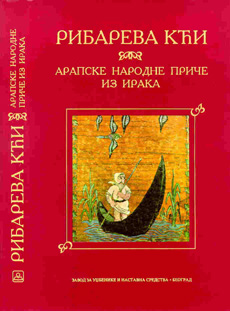
tales in my hands. My second book of the kind, entitled Ribareva
kci ("The Fisherman's Daughter," published by
"Zavod za udzbenike", Belgrade, 1998), contains
40 tales (sawaalif sha'biyya) from Mesopotamia, plus 24 anecdotes,
all told in the lively Arabic vernaculars of Waadi ar-Raafidayn.
This book is my own compilation, based on research in archives,
old periodicals and museums, not on fieldwork.
Both of these translations use a kind of language that sounds
somewhat "dialectal" and slightly archaic, although
it is actually based on modern urban speech. I gave them the
final touch by reading each translated tale aloud in the "epic"
way used in telling tales to children.
The Fisherman's DaughterAnthology, is a book of
about 320 pages, including an extensive study on the relationship
between SA and "al-'aammiyya." The book has its
Arabic part too: a detailed table of contents with the full
names of the tellers and compilers, one complete tale in the
Arabic script, its full scientific transliteration (for students
of Arabic), and information about my work in this field.
The font used for the above-mentioned transliteration is composed
in accordance with the ZDMG system.
Here we come to a matter which is of utmost importance, in
my opinion. It is my appeal to every Arab in the world to
send me as many Arab dialectal folk tales as he/she can, written
or taped, for my further work. This appeal is found in the
book itself, but it is of little help as our publisher cannot
even afford to put it on the Web—let alone send twenty
or thirty copies of the book to scholars abroad.
As far as folk tales are concerned, "translations"
into SA are absolutely outside my interest. (I already have
hundreds of them.) Only authentic tales in their original
dialects—mainly eastern ones—are called for. For
further information contact me at any time by e-mail or at
the following address:
Srpko Lestaric
11080 Zemun, Yugoslavia, Dobanovacka 83
Phone: (++381-11) 10 30 15 home (after 4 p.m. Western European
time)
311 2743 Office
Thanks in advance.
This article was originally published at Translation Journal (http://accurapid.com/journal).
Submit your article!
Read more articles - free!
Read sense of life articles!
E-mail
this article to your colleague!
Need
more translation jobs? Click here!
Translation
agencies are welcome to register here - Free!
Freelance
translators are welcome to register here - Free!
|
|
|
| Free
Newsletter |
|
|
|
|
|