|
 |
 |
 |
|
|
Home | More Articles | Join as a Member! | Post Your Job - Free! | All Translation Agencies | |
|
|||||||
|
|
|
|
Incongruity of Company Law Terms
The analysis is based on three translations of the Polish Code of Commercial Companies and Partnerships published by Tepis, Zakamycze and C.H. Beck and six bilingual dictionaries of legal and/or business terms written by Kienzler, Kozierkiewicz, Małkiewicz, Myrczek, Ożga and Pieńkos (listed in the Bibliography). All the dictionaries were published after 2000, most of them in the last two years. 1. Incongruity of legal terms Terms are defined by Sager as lexical items representing discrete concepts that form the knowledge system of a given subject field; hence, terms are 'depositories of knowledge' (2001:259). It is especially visible in the legal field where terms are grounded in country-specific legal systems whose knowledge basis is defined in national legislation. A legal term is a depository of national legal knowledge and this knowledge is part of its meaning. As a result, legal terms show a certain degree of asymmetry between national systems, which inevitably poses a major translation problem. There are several degrees of terminological incongruity, ranging from identical concepts (very rare) or near equivalence to conceptual voids without any equivalents in the TL. The degree of incongruity may be measured as differences between essential and accidental features; it is also explained with reference to intersection and inclusion (Љarčević 1997: 237-8).
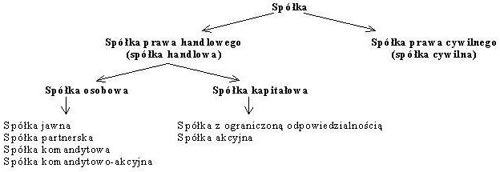
2. General classification of Polish business entities The simplest type of business activity in Poland is osoba fizyczna prowadząca działalność gospodarczą (lit. a natural person running a business activity). It is an individual who owns all the assets and has unlimited liability. The corresponding functional equivalents are: a sole trader (EN) and sole proprietorship (US). Despite slight regulatory differences, such as no registration requirement in the US (cf. Mallor et al. 2004: 819), the terms show a relatively high degree of conceptual similarity; hence, a function equivalent is highly acceptable. In general, if a business entity is formed by two or more persons, it is referred to as spółka. Polish spółki may be divided into spółki prawa handlowego, referred to as spółki handlowe, formed under the Polish Code of Commercial Partnerships and Companies 2000 (Kodeks Spółek Handlowych, which replaced Kodeks Handlowy 1934 modeled on the German code, cf. Tynel et al. 2002: 9), and spółki prawa cywilnego, referred to as spółki cywilne, formed under the Polish Civil Code 1964 (Kodeks Cywilny). Spółki handlowe are further divided into unincorporated bodies called spółki osobowe (i.e. partnerships) and incorporated bodies called spółki kapitałowe (i.e. companies (En)/corporations (US)). The classification of major Polish entities is shown in Chart 1: Chart 1. Classification of Polish business entities spółki.
3. Partnerships formed under the Civil Code spółka cywilna, also known as spółka prawa cywilnego, is formed under the Civil Code and is a relatively rare type of entity. It does not have a legal personality and does not even have a status of przedsiębiorca [entrepreneur]; as a result, it may not acquire rights and incur liabilities in its own name; and it may not sue and be sued. In this type of organization, each partner is treated as a separate entrepreneur with unlimited liability. If its net revenues from sale reach EUR 400,000 in two consecutive years, it has to be transformed into a commercial law partnership or company. The dictionaries propose as many as seven equivalents, shown in Table 1:
Table 1. Dictionary equivalents of spółka cywilna/spółka prawa cywilnego.
As already noted, the two terms refer to the same concept, spółka cywilna being a short version of spółka prawa cywilnego. The synonymous nature is not reflected in the dictionaries, all of which propose different non-related equivalents. spółka cywilna is a good example of high terminological incongruity. In the common law system no distinction is made between entities formed under civil law and commercial law as business entities are regulated mainly under company law (EN) or corporate law (US). Nevertheless, it is possible to approximate the concept, but first one should eliminate incorrect equivalents. spółka cywilna is an unincorporated association; hence, it should not be referred to as a company. The term private company, proposed by Myrczek and Pieńkos, exists in English law and refers to a company with legal personality whose shares are not available to the general public. Therefore, it may be regarded as a functional equivalent of Polish spółka z ograniczoną odpowiedzialnością. The most literal equivalent, i.e. a civil partnership, listed in all the entries except for Kozierkiewicz, could not have been more misleading. In England under the Civil Partnership Act 2004 it is "a relationship between two people of the same sex". Owing to significant publicity, this term may be wrongly interpreted in other English-speaking countries even though they use other terms to refer to homosexual marriages (e.g. civil union, domestic partnership). This example serves as a good warning against literal/formal equivalents which may evoke different concepts in the TL. The terms nontrading partnership and noncommercial partnership, intended to function as a contrast to a commercial partnership, seem to be too restrictive in meaning. They are defined by the Black's Law Dictionary (BLD) as "a partnership that does not buy and sell but instead is a partnership of employment or occupation", which is not the case with the Polish spółka cywilna. Kozierkiewicz proposes a hyperonym partnership; a recourse to a generic word is one of the techniques to deal with nonequivalence. An English partnership does not require any formal registration, but may be formed by way of a written or oral agreement. However, this term may be too general in some contexts, especially when it is necessary to make a distinction between partnerships formed under the Civil Code and the Commercial Code. On the other hand, Brodecki claims that referring to spółka cywilna as a partnership is misleading, "despite its name, is not a partnership at all but rather a cooperation relationship uniting its members without entailing the formation of a separate commercial entity" (2003: 148). It is worth noting that a similar German-law concept (Gesellschaft bürgerlichen Rechts—GbR) is referred to as a civil law association or partnership. The most transparent equivalent is civil law partnership proposed by Myrczek. It is an accurate SL-oriented equivalent, informing recipients that it is a kind of partnership formed under civil law. Some researchers also argue for another SL-oriented equivalent private partnership (cf. Kierzkowska). Owing to the high system-specific nature of the Polish term, it is difficult to find an adequate TL-oriented equivalent. 4. Partnerships and companies formed under commercial law The most popular type of entity, i.e. spółka handlowa, is a general term for partnerships and companies formed under commercial law. It does not necessarily mean that an entity is involved in trade. As already noted, spółki handlowe comprise both unincorporated entities referred to as spółki osobowe and incorporated entities known as spółki kapitałowe. spółka osobowa [lit. association of persons] is an unincorporated body without legal personality. However, it has certain qualities of a legal person: it may, inter alia, acquire rights and incur liabilities in its own name; it may sue and be sued. At least one partner has unlimited liability for partnership debts. In general, partners are involved in the day-to-day management of partnership affairs. spółka kapitałowa [lit. association of capital] is an incorporated body with legal personality it acquires upon registration in the National Court Register [Krajowy Rejestr Sądowy]. It allows shareholders to pool their capital and to have their liability limited by shares. Shareholders are usually not personally involved in the management of company affairs, which is vested in a separate body called Zarząd (Management Board) that is supervised by Rada Nadzorcza (Supervisory Board). Table 2 presents equivalents found in the dictionaries and the translations of the Code. Table 2. English equivalents of spółka osobowa and spółka kapitałowa.
spółka osobowa is unproblematic and has a nearly uniform equivalent as this concept is very similar to the English partnership. There are two exceptions involving calques: Małkiewicz, who proposes a misleading literal equivalent of personal partnership, and Ożga, who does not distinguish between a partnership and a company and evokes a false friend private company. Surprisingly, more variation may be found with regard to spółka kapitałowa, the rendering of which is not symmetrical to that of spółka osobowa. It has as many as five equivalents and two dictionaries, i.e. Ożga and Kienzler, do not have this entry at all despite its being an important concept in Polish commercial law.2 Its direct functional equivalent is a company (EN) or corporation (US). The literal equivalent, i.e. a capital company, is a tautology (cf. Żebrowski 2003: 59); the same applies to incorporated company since in English law a company is an incorporated body. Another literal equivalent, association of capital, which is provided by three dictionaries, may however be misleading in some cases as according to the BLD, an association is "an unincorporated organization that is not a legal entity separate from the persons who compose it". For this reason the functional equivalents (company, corporation) should be a preferred choice. 4.1. Partnerships The next section discusses four types of Polish partnerships (spółki osobowe). All of them require registration in the National Court Register (KRS). spółka jawna [sp.j.] is the most typical and traditional type of partnership. It may be formed by natural and legal persons. Its most important distinguishing feature is that all partners have unlimited liability and are jointly and severally liable for its liabilities. It is best suited for small-scale service provision or production (cf. Koch & Napierała 2005: 36). The remaining three types of partnerships are of a hybrid nature (ibid.), where liability of some partners is limited. spółka partnerska [sp.p.], which is a new type of partnership introduced by the amended Code 2000, may be founded only by natural persons qualified to practice certain freelance professions (e.g. lawyers, accountants, physicians, sworn translators). Partners are not liable for liabilities related to the practice of profession by other partners or acts and omissions of employees supervised by other partners although unlimited liability may be imposed on partners in the governing document. spółka komandytowa [sp.k.] is similar to spółka jawna; however, at least one of partners (komplementariusz/general partner) has unlimited liability while others (komandytariusz/limited partner) are liable to the amount of their contribution. General partners represent a partnership and manage its affairs. spółka komandytowo-akcyjna [S.K.A.] combines features of spółka komandytowa and spółka akcyjna, i.e. a limited partnership and a limited company. At least one partner has unlimited liability and at least one partner is a shareholder whose liability is limited by shares. These are usually larger enterprises, the minimum capital requirement being PLN 50,000. There are also stricter corporate governance requirements, e.g. when a number of shareholders is higher than 25 persons, it is necessary to establish a supervisory board which does not include any general partner. Table 3 shows English equivalents of the partnerships. Table 3. Equivalents of spółki osobowe.
It is worth noting that all the three translations of the Polish Code use the same equivalents for partnership types. The equivalents are SL-oriented; this is however not surprising in view of the target audience of the translation, i.e. close recipients, including international investors (cf. Żebrowski 2002). spółka is nearly uniformly rendered as a partnership. The closest functional equivalent of spółka jawna is an unlimited/general/ordinary partnership in England (or simply a partnership) and a general partnership in the US. Kierzkowska argues against the TL-oriented general partnership in favor of the SL-oriented registered partnership. She claims that the former may be misleading by suggesting that it is an entity formed under English law.3 The latter, as she argues, approximates general legal mechanisms and signals the difference: in contrast to English law, Polish law requires a partnership to be registered; hence, a registered partnership (2005: 87-88). However, since the essential properties of the SL and TL concepts are the same, the functional equivalent seems to be acceptable. As for other equivalents proposed by the dictionaries, an unlimited company, which refers to an incongruous concept unique to English law, is a misunderstanding. Likewise, a general mercantile partnership seems to be a calque of spółka handlowa jawna.4 The concept of spółka komandytowa is well known both in English and US law, where it is called a limited partnership. There are obviously regulatory differences between the Polish, English and American systems; however, the two concepts are so similar that this is the only type of entity which has a direct functional equivalent proposed by most of the sources. Some dictionaries (Pieńkos and Małkiewicz) do not distinguish between a limited partnership and a limited company, which in fact evoke two distinct concepts of English law. In the former at least one of the partners has unlimited liability while in the latter all partners' personal liability is limited by shares or by guarantee. Kienzler's partnership limited by shares is misplaced as this type of partnership does not have a share capital. It is a good equivalent of spółka komandytowo-akcyjna, though. The two partnerships introduced in 2000, spółka partnerska and spółka komandytowo-akcyjna, have not been accommodated by most dictionaries yet. spółka partnerska, where listed, has the SL-oriented equivalent professional partnership and the worth-noting functional equivalent limited liability partnership proposed by Kozierkiewicz. There is quite a large conceptual similarity between the English and US limited liability partnership and the Polish term as regards essential features; this form of organization is used by professionals who want to limit their liability for partnership debts.5 spółka komandytowo-akcyjna has only the SL-oriented equivalent limited joint-stock partnership in the analyzed materials. This type of partnership is based on the so-called French-German model, where an entity is a derivative of a limited partnership (Lewandowski 2005: 23). It is worth noting that a similar German entity (Kommanditgesellschaft auf Aktien) and a French entity (société en commandite par actions) are frequently referred to as a partnership limited by shares, even though a German entity has a legal personality. This equivalent would be immediately recognizable among international recipients. A corresponding English entity, company limited by shares, is based on the Swiss model, which is substantially different from and incomparable to the French-German model (cf. Lewandowski 2005: 23). 4.2. Companies / Corporations The Polish Code defines only two types of companies which most of all differ in the amount of minimum capital and corporate governance requirements. Both companies pay corporate income tax and have a legal personality they acquire upon registration in the National Court Register (KRS). In spółka z ograniczoną odpowiedzialnością (Sp. z o.o.) the minimum capital requirement is PLN 50,000. The company may be formed by natural and legal persons whose liability is limited by shares. It may only be privately held and as noted by Brodecki "it cannot issue stock in the form of a document (only 'rights' are issued to its shareholders) and it cannot be listed on a stock exchange" (2003: 95). As a result, it is best suited for small- and medium-scale ventures that do not require to pool capital from a large group of investors. spółka z ograniczoną odpowiedzialnością is referred to as a 'historically younger sister of spółka akcyjna' (Koch & Napierała 2005: 41). In spółka akcyjna (S.A.), which is mainly intended for large-scale ventures, the minimum capital requirement is PLN 500,000. The company may be formed by natural and legal persons whose liability is limited by shares. Shareholders are more separated from the day-to-day management of operations than in Sp. z o.o. Furthermore, there are more stringent disclosure and corporate governance requirements; for example, it is obligatory to establish a Supervisory Board (Rada Nadzorcza). Now let us have a look at English equivalents (Table 4). Table 4. English equivalents of spółka z ograniczoną odpowiedzialnością and spółka akcyjna.6
The two types of companies are traditionally rendered through SL-oriented equivalents: limited liability company (Sp. z o.o.) and joint stock company (S.A.), which may be found even in the Stanisławski Dictionary written in the 60-ties. The same English equivalents are frequently used to refer to similar companies functioning under Continental legal systems and are well suited for international receivers. It should be emphasized that the semantic field of company is differently organized in the common law and civil law systems. For example, English law makes a finer categorization: it distinguished between unlimited and limited companies, companies limited by guarantee and by shares, and private and public companies. By contrast, all Polish companies are limited and are limited only by shares; however, their breakdown into Sp. z o.o. and S.A. is not based on the criterion whether they are privately or publicly held. Thus, the boundaries of the TL and SL concepts will inevitably differ. In respect of spółka z ograniczoną odpowiedzialnością, it was analyzed by Kierzkowska, who rejected the English limited company as a misleading equivalent due to the fact that limited companies may be both private and public while Sp. z o.o. may be only privately held (2002: 106). However, the addition of 'private' would easily eliminate this problem; a private limited company is a functional equivalent (listed by Kozierkiewicz) and is referred to in the literature as comparable to Sp. z o.o. (cf. Brodecki 2003: 95). To eliminate limitation by guarantee, it is also possible to use a private company limited by shares as a functional (GB) equivalent. Furthermore, Sp. z o.o. is similar to US close corporations, also known as closely-held corporations, private corporations, privately-held corporations. However, Kierzkowska recommends a limited liability company as a SL-oriented equivalent to signal that a company was formed under a foreign law. She notes that the concept of limited liability is known in English law; hence, it will be possible to apply connotative equivalence by reference to familiar concepts (2002: 107). She further admits that this term is problematic and misleading in American usage since in US law it is an unincorporated body (2002: 107); the US LLC is treated as a partnership for tax purposes. It may be regarded as a false friend in the US system and should not be proposed as a US-oriented equivalent (Kozierkiewicz, Ożga). Similarly, a limited partnership proposed by Ożga as a GB-oriented equivalent is not adequate since the Polish entity is a company, not a partnership. The same applies to US-oriented limited partnership, which, although taxed either as a partnership or a corporation, includes partners that have unlimited liability. spółka akcyjna, which has as many as 16 equivalents, is more problematic. The widespread equivalent joint-stock company is however not neutral. According to the BLD, a joint-stock company is "1. an unincorporated association of individuals possessing common capital, the capital being contributed by the members and divided into shares, of which each member possesses a number of shares proportionate to the member's investment. 2. A partnership in which the capital is divided into shares that are transferable without the express consent of the partners". It means that this term refers to unincorporated entities in the US context. As noted by Griffin, joint stock companies appeared in England in the 17th century. They were a complex form of partnership created by royal charter; associations of members who contributed capital for trade ventures. Joint stock companies had a separate legal identity; however, their members did not have limited liability unless otherwise stipulated in the charter (2000: 3). The Joint Stock Companies Act 1844 introduced registered companies (in contrast to incorporation by royal charter or by an Act of Parliament); which could be formed by more than 25 members and had to register in the Registrar of Companies (ibid: 4-5). However, members' liability remained unlimited until the Joint Stock Companies Act 1856, and it was obligatory to add 'limited' to the company's name (Lowry 2006: 17). It is claimed that Sp. z o.o. resembles an English public limited company (Brodecki 2003: 95). In fact, spółka akcyjna most frequently resembles public company limited by shares (EN) or publicly-held corporation/ public corporation (US); however, it may also be a private company limited by shares/a close corporation when, as the case may be, its shares are not available to the general public (e.g. quoted on the stock exchange or alternative markets). For this reason the following equivalents may be too specific in some contexts: public limited company, public limited liability company (?), publicly-held corporation, public limited company with share capital, as they refer only to a public S.A., and a private limited company as it refers only to a private S.A. In specific reference these may be good functional equivalents after the translator establishes whether a given S.A. is private or public. The dictionaries also propose more general equivalents which however do not allow one to distinguish between Sp. z o.o. and S.A.: registered company (both S.A. and Sp. z o.o. require registration), incorporated company/enterprise (both S.A. and Sp. z o.o. are incorporated and are legal persons), company limited by shares (in both S.A. and Sp. z o.o. shareholders' liability is limited by shares). To sum up, the choice of the right equivalent in a given context may be a difficult task as it requires a good knowledge of SL and TL legal concepts. Owing to the terminological incongruity between the common law and civil law systems, it is impossible to find the one and only 'proper' equivalent. The three translations of the Code as well as other professional literature on Polish company law use the same equivalents for major types of business entities: spółka jawna (registered partnership), spółka partnerska (professional partnership), spółka komandytowa (limited partnership), spółka komandytowo-akcyjna (limited joint-stock partnership), spółka z ograniczoną odpowiedzialnością (limited liability company) and spółka akcyjna (joint stock company). These are safe SL-oriented equivalents that are in most cases well suited for international recipients from civil law countries. On the other hand, recipients from common law countries, who are accustomed to the different conceptual organization of these semantic fields, may require more natural equivalents, even at the expense of sometimes elusive accuracy. After all, the legal translator's task is to produce a functional text in the TL. As noted by Alcaraz and Hughes, "Even if one denies translators any truly creative role in text production, they must be regarded as (saving mishaps) expert wielders of words, cunning artisans who devise, exploit and perfect techniques of adaptation and adjustment in their quest for elusive, and no doubt occasionally illusory equivalents" (2002:23). 1 It is worth noting that a company and a corporation are false friends in British and American English, denoting different types of entities in English and US law. 2 Kienzler's and Ożga's dictionaries miss some important Polish-specific concepts and at the same time include phrases that are obscure in Polish, e.g. the former lists spółka kapitalizacyjna rather than spółka kapitałowa while the Polish>English volume of the latter lists a translation of the English concept spółka posiadająca osobowość prawną z mocy przywileju lub rejestracji in the absence of spółka cywilna, spółka partnerska or spółka komandytowo-akcyjna. 3 Similar reservations are however not raised against a limited partnership as an equivalent of spółka komandytowa. 4 spółka jawna may be also referred to as spółka handlowa jawna, which causes confusion in some dictionaries. For example, Ożga proposes 2 equivalents for the former and as many as 4 equivalents for the latter, including an erroneous private company.5 In the US system there are also other functional equivalents: a limited liability limited partnership and a professional corporation (which however has a legal personality) used by professionals to practice their profession with their liability limited to some extent 6 It is new and useful practice in some Polish dictionaries to include information about the origin or orientation of equivalents. 7 It seems to be a spelling error as it should be a public limited company. 8 It seems that 's' was lost; the English company is referred to in the Companies Act as limited by shares. Abbreviations and Reference Materials BLD: Garner, B.A. (2004). Black's Law Dictionary. 8th Ed. West Group. Kienzler: Kienzler, I. (2005). Polsko-angielski słownik terminologii gospodarczej. Dictionary of Economic Terms Polish-English. Vol. II. C.H. Beck. Kozierkiewicz: Kozierkiewicz, R. (2005). Dictionary of Business Terms. Polish-English. Vol. II. C.H. Beck. Myrczek: Myrczek, E. (2005). Dictionary of Law Terms. Słownik terminologii prawniczej angielsko-polski, polsko-angielski. C.H. Beck. Małkiewicz: Łozińska-Małkiewicz, E., J. Małkiewicz. (2005). Polsko-angielski słownik terminologii prawniczej. Toruń: Wydawnictwo Ewa Jerzy Małkiewicz. Ożga: Ożga, E. (2001). Słownik terminologii prawniczej. Część 1 polsko-angielska. 2nd Ed. Bydgoszcz: Oficyna Wydawnicza Branta. Pieńkos: Pieńkos, J. (2002). Polsko-angielski słownik prawniczy. Kraków: Zakamycze. Beck: Kodeks Spółek Handlowych. Polish Commercial Companies Code. (2006). 4th Ed. Translated by K. Michałowska. C.H. Beck. Tepis: Kodeks Spółek Handlowych. Polish Code of Commercial Partnerships and Companies. (2004). CD-ROM. Tepis/Rzeczpospolita. Translated by E. Gołębiowska, A. Setkowicz-Ryszka. Zakamycze: Kodeks Spółek Handlowych. Code of Commercial Companies. (2004). 2nd Ed. Translated by R. Bem, E. Kucharska, J. Marynowicz, A. Mączka.
Bibliography Alcaraz, E., B. Hughes (2002). Legal Translation Explained. St Jerome: Manchester. Brodecki, Z. (Ed.) (2003). Polish Business Law. Haga: Kluwer Law Inernational. Griffin, S. (2000). Company Law: Fundamental Principles. 3rd Ed. Longman. Harvey, M. (2002). "What's so Special about Legal Translation?". Meta XLVII (2). 7 August 2006 <http://www.erudit.org/revue/meta/2002/v47/n2/008007ar.pdf>. Kierzkowska, D. (2002). Tłumaczenie prawnicze. Warszawa: Wydawnictwo Tepis. Kierzkowska, D. (ed.) (2005). Kodeks tłumacza przysięgłego z komentarzem. Warszawa: Wydawnictwo Tepis. Koch, A., J. Napierała (Eds.) (2005). Prawo spółek handlowych. Kraków: Zakamycze. Lewandowski, R. (2005). "spółka komandytowo-akcyjna w prawie brytyjskim na tle prawnoporównawczym". Prawo spółek 12/2005. 23. Lowry, J., A.J. Dignam (2006). Company Law. 3rd Ed. LexisNexis. Mallor, J., A. J. Barnes, T. Bowers, A. W. Langvardt (2004). Business Law. The Ethical, Global, and E-Commerce Environment. 12th Ed. Boston: McGrawHill Irwin. Sager, J.C. (2001). "Terminology. Theory". In: M. Baker (ed.) Routledge Encyclopedia of Translation Studies. Routledge: London and New York. 258-262. Љarčević, S. (1997). New Approach to Legal Translation. The Hague: Kluwer Law International. Tynel, A., J. Funk, W. Chwale (2002). Międzynarodowe prawo handlowe. Warszawa: Difin. Venuti, L. (2001). "Strategies of Translation". In: M. Baker (ed.) Routledge Encyclopedia of Translation Studies. Routledge: London and New York. 240-244. Weston, M. (1991). An English Reader's Guide to the French Legal System. New York, Oxford: Berg. Żebrowski, P. T. (2003). "Angielskie przekłady polskiego kodeksu spółek handlowych. Porównanie, ocena i wnioski dla tłumaczy." Lingua Legis 11. 57-68.
This article was originally published at Translation Journal (http://accurapid.com/journal).
E-mail this article to your colleague! Need more translation jobs? Click here! Translation agencies are welcome to register here - Free! Freelance translators are welcome to register here - Free! |
|
|
|
|
|
|
| |||
Legal Disclaimer Site Map |
 Legal
translation is regarded by some researchers as one
of the most challenging endeavours, "combining the
inventiveness of literary translation with the terminological
precision of technical translation" (Harvey 2002).
It is mainly due to the specificity of legal language
and, in particular, the system-bound nature of legal
terminology and differences between the common law
and civil law systems. A good illustration of problems
connected with terminological incongruity may be found
in company law and classifications of business entities.
Since types of entities and requirements they have
to meet are defined in national legislation, the concepts
are bound to differ. It is also worth noting that
company law has been recently subject to a number
of changes, the most important ones being the introduction
of a limited liability partnership in England,
as well as a limited liability company, limited
liability partnership/limited liability limited partnership
in the US, spółka partnerska and spółka
komandytowo-akcyjna in Poland. In this paper I
will analyze the classification of Polish business
entities and their Polish equivalents.
Legal
translation is regarded by some researchers as one
of the most challenging endeavours, "combining the
inventiveness of literary translation with the terminological
precision of technical translation" (Harvey 2002).
It is mainly due to the specificity of legal language
and, in particular, the system-bound nature of legal
terminology and differences between the common law
and civil law systems. A good illustration of problems
connected with terminological incongruity may be found
in company law and classifications of business entities.
Since types of entities and requirements they have
to meet are defined in national legislation, the concepts
are bound to differ. It is also worth noting that
company law has been recently subject to a number
of changes, the most important ones being the introduction
of a limited liability partnership in England,
as well as a limited liability company, limited
liability partnership/limited liability limited partnership
in the US, spółka partnerska and spółka
komandytowo-akcyjna in Poland. In this paper I
will analyze the classification of Polish business
entities and their Polish equivalents.