|
 |
 |
 |
|
|
Home | More Articles | Join as a Member! | Post Your Job - Free! | All Translation Agencies | |
|
|||||||
|
|
|
|
Translation of Charactonyms from English into Russian
The article tackles a topical problem of translation of charactonyms from English into Russian. Normally charactonyms are transcribed or transliterated but if their stems contain additional information of their bearer or even create in a literary work a system of its own their transcription deprives a foreign reader a lot of nuances and vividness of description. The author of the article suggests to find characteristics codified in the name by means of the elements of context called motivators. The charactonyms are divided into 4 types and the translation equivalents into 8 groups. The equivalents are classified due to the dictionary equivalents of the common stem of the charactonym. The experimental material is processed and given in the form a diagram and a table. The suggested classification can be used for different types of onyms and other pairs of languages. The minimum function of personal names is nominal; some designation must be fixed to a person. Moreover, the formal attributes of proper names can play an important role in literature by evoking, for example, an epoch, social status, or nationality of the characters. In translation, proper names are usually given in their original spelling, or if they are to be rendered into the language with another script, Russian for example, they are transliterated. Along with their nominal function, given names and family names often perform a descriptive or characterizing function. Such meanings are an integral part of the total meaning in many books. Names performing a characterizing function will be called charactonyms or significant names. If names in a literary work have such functions, it is better to translate the functions in some way, but unfortunately they are often ignored even in the translations of outstanding works by Sheridan, Dickens, and Thackeray into Russian and by Gogol, N. Ostrovsky, and Chekhov into English. The tradition of transliterating (or transcribing in the same alphabet) proper names in literature may be explained by the wish to keep the nominal function simple, to transmit the nationality of the character, and to avoid excessive expressive coloring which can give the name a nuance of a nickname. At the same time if a personal name characterizes its bearer, the expressive-and-stylistic function may dominate the nominal one. One of the signs of a characteronym is its common stem. A common stem is a part of a name or an entire name that resembles in its form an "ordinary" word: Smith (smith—a worker in metal), Sawders (sawder—flattery, blarney), Hennie (henny—hen-like). If this common stem characterizes (conveys attributes to) the bearer of the name, the stem becomes a significant (= meaningful) element of the name and this name may be called a charactonym. The presence of a common stem itself does not necessarily imply the presence of a characteristic meaning. The relevance of the significant element must be suggested by means of motivators2. Motivator is a part of text, expressing by the means of synonyms, homonyms, confusables, and words with similar semantic fields resemblance with the meanings of a morpheme or morphemes of the proper name and giving the name its characterizing function. For example, for the family name of Mr. Parakeet, an incidental character in the novel by E. Waugh Decline and Fall, the motivator is bird-like: By half-past two the house was quiet; at half-past three Lord Parakeet arrived, slightly drunk and in the evening clothes, having 'just escaped less than one second ago' from Alastair Trumpington's twenty-first birthday party in London... The party, or some of it, reassembled in pajamas to welcome him. Parakeet walked round bird-like and gay, pointing his thin white nose and making rude little jokes at everyone in turn in a shrill, emasculate voice3. <5. p. 130> 4 Motivators may be divided into two groups, explicit and implicit. The explicit motivators are usually situated in a narrow context and are expressed either with a word or a word combination. Rather stable motivators can be the words pointing to the resemblance in appearance: "little Mr. Finch" (motivator little for the family name Finch); "what wrath Mr. Scowler, was in" (motivator wrath for the family name Scowler (scowl)); ethical qualities: "autocrat Driver" (motivator autocrat for the family name Driver); position or rank: "general Goodwin" (motivator general for the family name Goodwin (a good win). The implicit motivator characterizes a person on the basis of a broader context. An example of a charactonym with an implicit motivator can be the family name of Grimes from Decline and Fall by E. Waugh. The school teacher, Captain Grimes, who symbolizes moral degradation, hard drinking, and ill breeding, is given the family name with a stem grime—"a surface of thick black dirt." He is always drunk because he lost his leg when he "was run over by a tram in Stoke-on-Trent." This character is not given a clearly and compactly expressed characteristic by any specific word or pun with his name, but from a broader context you can size him up and compare him with dirt that is impossible to get rid of. Here is an example passage characterizing him: ...I'm a public-school man. That means everything. There's a blessed equity in the English ...social system,' said Grimes, 'that ensures the public-school man against starvation. One goes through four or five years of perfect hell at one age when life is bound to be hell, anyway, after that the social system never lets one down. <5. p. 50> A charactonym can have clearly different shades of meaning in contexts within the same book. Thus, a charactonym has no absolutely permanent characteristic meaning. Rather such names express a semantic continuum, and to translate them properly is a tough challenge. But motivators allow one to find the main characteristic dominating others, while still allowing ambiguity. On the whole the charactonyms can be of four types: 1) We may speak of characteristic names as names whose significant element does not have a stylistically colored significant element, i.e., a connotation defined with expressive terms such as derogatory, colloquial, etc., e.g., "Parakeet." 2) By contrast, we may speak of expressive-and-characteristic names, that is with a stylistically colored significant element: "Scribbler" (the common noun scribbler is marked in "Longman Dictionary of Contemporary English" as derog or humor): An academician who is incompetent to understand the meaning and value of a literary work may write a treatise titled, 'A Comparative Study of the Use of the Comma in the Literary Works of Otto Scribbler'. <2. p. 119> 3) We may also speak of intersemantisizing names whose motivators become other names from the narrow context. In this case closely situated common stems create a certain semantic field and become motivators to each other. The names concretize descriptive meanings, evoke the semantics of each other so to say and consequently become relevant for translation even without any other context. Normally these are different kinds of enumerations: "Sauerkraut" (sauerkraut), "Broccoli" (broccoli), "Articiocchi" (artichoke) that create a semantic field of "vegetables": "Marry, indeed am I, my gracious liege—the poor Lord Spinachi once, the humble woodman these fifteen years syne—ever since the tyrant Padella (may ruin overtake the treacherous knave!) dismissed me from my post of First Lord." ... The acquaintance Her Majesty showed with the history and noble families of her empire was wonderful. "The House of Broccoli should remain faithful to us," she said; "they were ever welcome at our Court. Have the Articiocchi, as was their wont, turned to the Rising Sun? The family of Sauerkraut must sure be with us—they were ever welcome in the halls of King Cavolfiore." <4. p. 121> 4) Finally, we may speak of expressive names, names that are expressive in terms of their lexical meanings but have no motivators—for example, "Blunt" may be defined as a person "obtuse in understanding or discernment," a fool. However, such names must be treated as conditional or quasi charactonyms until they are justified by the context in literary works. In real life it is not correct to associate the lexical meaning of an expressively colored family name with its bearer. If the meaning of an expressive name is not reinforced by a motivator, we may assume that the meaning is at least somewhat less important than it would be otherwise and that its translation is not obligatory. Thus, such names will not be treated further in this paper. Remaining comments will refer to characteristic, expressive-and-characteristic, and intersemantisizing names, all of which demand the presence of motivators. The remainder of this paper will discuss the strategies used in translating such charactonyms. There are eight types of translation equivalents, and the following purpose is to illustrate their frequency and to discuss their effectiveness:
Of course, all translation work (which must be distinguished from literary imitation) must be based on lexical equivalents that are found in standard dictionaries. Dictionaries are not perfect authorities because they cannot keep up with all the changes which take place in language, but they provide standards that alert us to alternative variants and ambiguity. When we do not know or doubt a meaning of a word we turn to a dictionary. Also, every person brings additional nuances and associations to the meanings of words, especially as it concerns stylistic colouring, but the standard meanings are fixed in large, standard dictionaries. The dictionary used for this study is the New English-Russian Dictionary in 3 vol. [2]. The Russian equivalents were checked according to the usage labels of the Dictionary of Modern Literary Russian in 17 vol. [3]. The analysis for this study was carried out on 140 charactonyms translated into Russian from four works by English and American writers of nineteenth and twentieth centuries: the tale by W. M. Thackeray "The Rose and the Ring" <4> (translated by R. Pomerantseva <9>), the novel The Newcomers <3> (also translated by R. Pomerantseva <10, 11>), a book by Peter L.J. and Hull R. "The Peter Principle" <2> (translated by L. Stepanov <8>), and the long poem by Byron, Don Juan <1> (translated by T. Gnedich <6>) 5. Of these 140 charactonyms 88 are characteristic, 32 expressive-and-characteristic and 20 intersemantisizing names. The significant elements of these names regardless of the coloring are rendered by the odd numbered types of equivalents listed above: a usual equivalent, an occasional equivalent, an equivalent with a changed characteristics and an irrelevant equivalent. These odd numbered types distinguish different ways in which translation equivalents reflect lexical attributes of the original names, or not. These types will be discussed first, and a discussion of the even numbered types, which are used with irrelevant coloring (as distinguished by usage labels), will follow. 1. The usual equivalent is an equivalent of a significant element taken from the dictionary: Fresco (fresco is in Russian фреска)—Фреско (Fresco). Though the Russian stem ends in "a," "o" functions as a sign of an Italian name. A. Fresco, a painter in Excelsior City, produced a few successful canvases and then appeared to run out of artistic inspiration. <2. p. 116> А. Фреско, художник из города Триумфа, создал несколько имевших успех полотен, но затем его, по-видимому, оставило творческое вдохновение. <8. p. 242> This usual equivalent is often applied to render international stems (Fresco, Quartz, Jargon, Oval, Cube etc.). The usual translation is normally used if a dictionary equivalent is expressed in one word, but not several ones or descriptively when an occasional equivalent is used. 3. The occasional equivalent is a translation with the help of a word not registered as a direct equivalent of the significant element but which reflects the same characteristics. The task gets more complicated as the translator declines the dictionary (usual) equivalent and has to find an equivalent which would keep both the meaning and stylistic coloring: Goodwin (a good win is in Russian "cлавная победа" (slavnaya pobeda)—Побединг (Pobeding: pobeda (a win) + ing as a sign of an english name): Consider the case of the late renowned General A. Goodwin. His hearty, informal manner, his racy style of speech, his scorn for petty regulations and his undoubted personal bravery made him the idol of his men. He led them to many well-deserved victories. <2. p. 21> Вдумайтесь в историю прославленного генерала Побединга, ныне покойного. Манера быть на дружеской ноге с подчиненными, любовь к крепким выражениям, пренебрежение к мелочным требованиям устава и несомненная личная храбрость снискали обожание солдат и офицеров. Он командовал ими во многих заслуженно выигранных битвах. <8. p. 43> This strategy of translating charactonyms from English into Russian is most common. The popularity of occasional equivalents can be explained by the thing that the translators apply to syntactical compression, and in Еnglish a lot of charactonyms consist of two or even more stems: Hardsman—hard man, Goodenough—good enough etc. 5. In case of the equivalent with changed characteristics, the equivalent does not reflect the characteristics expressed by the significant element from the original, but instead characterizes the person by another trait: Saucier (saucy is in Russian "дерзкий" (derzky)—Б. Алда (Balda: balda (blockhead): Miss P. Saucier was hired as a sales girl in the appliance department of the Lomark Department Store. From the start she sold less than the average amount of merchandise. This alone would not have been cause for dismissal, because many other sales people were below average. But Miss Saucier's record keeping was atrocious: she punched wrong keys on the cash register, accepted competitors' credit cards and—still worse—inserted the carbon paper with the wrong side up when filling in a sales-contract form...Worst of all, she was insolent to her superiors. <2. p. 41> Мисс Б. Алда работала продавщицей в отделе бытовых приборов в универмаге «Низкосорт». Она была уволена. С самого начала выручка от проданных ею товаров оказывалась ниже, чем в среднем на каждого продавца. Само по себе это не могло служить основанием для увольнения, поскольку хватало и других, чьи показатели были ниже среднего. Но мисс Б. Алда кошмарно обращалась с учетом: она нажимала не те клавиши кассового аппарата, принимала кредитные карточки, выданные конкурирующими фирмами, и—того хуже—выписывала квитанции под копирку, положенную обратной стороной... И совсем плохо было то, что она грубила начальству. <8. p. 167> In this case the Russian equivalent, Б. Алда (балда means a blockhead), characterizes not a saucy but stupid person. Thus, the translation emphasizes not the shop-girl's insolence but her stupidity. On the whole the translator has coped with the rendering of the name successfully in terms of coloring but with changed characteristics. 7. The equivalent which does not reflect the characteristics of its bearer can be realistically described as an irrelevant equivalent. An illustration of such an equivalent is the family name of a school teacher, Cleary, from the book The Peter Principle. This character could explain difficult subjects simply and clearly. In translation the name was rendered as Светлу (Svetlu), but in the Russian language the word светлый (svetly) does not have the meaning easy to understand: Probationer-teacher C. Cleary's first teaching assignment was to a special class of retarded children. Although he had been warned that these children would not accomplish very much, he proceeded to teach them all he could. By the end of the year, many of Cleary's retarded children scored better on standardized achievement tests of reading and arithmetic than did children in regular classes. <2. p. 39> Учителю С. Светлу выпало проходить испытательный срок в особом классе для детей, отставших в умственном развитии. Его предупредили насчет ограниченных способностей учеников, но он все равно старался научить их всему, чему мог. На итоговых экзаменах по чтению и арифметике многие из этих детей показали лучшие знания, чем ученики обычных классов. <8. p. 164> In translating charctonyms it is also necessary to take into account stylistic coloring. The stylistic aspect of the significant element is contained in the presence or absence of usage labels. The stylistic coloring of the significant element in the target text must correspond to or be close to the coloring of the source text. A neutral style would be when there are no usage labels: Bead (beads) neutral—Четкинс (четки) neutral. Among the characteronyms, stylistic irrelevance arises if an equivalent is labelled "derog," "dial," "euph," "humor," "infml," "sl," "taboo," etc., e.g., Glumboso (gloomy boss) neutral—Развороль (Razvorol') meaning plunderer, with a label colloquial. If we assume that stylistic colouring in the target text can differ from the source text, we can describe four more basic strategies in translating charactonyms. As listed above, they are: 2. The usual equivalent with irrelevant colouring: J.S Minion was a maintenance foreman in the public works department of Excelsior City. He was a favourite of the senior officials at City Hall. They all praised his unfailing affability. 'I like Minion,' said the superintendent of works. 'He has good judgement and is always pleasant and agreeable.' <2. p. 20> Ф. Аворит состоял в должности мастера и выполнял эксплуатационные работы на предприятиях, подчиненных муниципалитету города Триумф. Старшие служащие городской ратуши не чаяли в нем души. Все они превозносили его за безотказность. «Мне нравится Аворит, - говорит главный инженер.—Он знает, что к чему, всегда приветлив и покладист». <8. p. 42> In the Russian translation, the common stem, фаворит, (that is favourite) is synonymous with minion, but unlike in English the word фаворит, is rather neutral, despite the negative connotation.
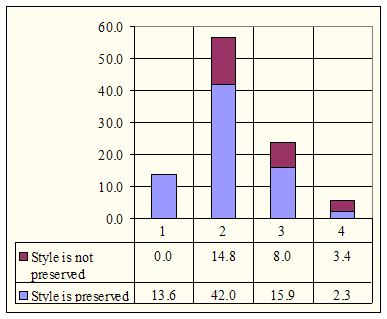
...insomuch that Mrs. Bolter, the levantine auctioneer's wife, would not make the poor old man a bow when she met him... <3. p. 346> Стоит ли удивляться, что после этого миссис Удирайл, супруга беглого аукционщика, повстречав нашего бедного старика, даже не изволила поклониться ему. <10. p. 390> The Russian stem удирал (udiral) matches for the context but in comparison to the English bolter it has a very colloquial coloring. 6. The equivalent with a changed characteristics and irrelevant colouring: Initial and Digital Codophilia is an obsession fоr speaking in letters and numbers rather than in words. For example, 'FOB is in NY as OC for IMC of BU on 802.' By the time, if ever, that the listener realizes that Frederick Orville Blamesworthy is in New York as Operative Coordinator for the Instructional Materials Centre of Boondock University conducting business concerning Federal Bill 802, he has lost the opportunity to observe that the speaker did not really know much. Codophiliacs manage to make the trivial sound impressive, which is what they want. <2. p. 109> Кодофилия—знаковая и цифровая—выражается в маниакальном стремлении изъясняться не словами, а буквами и числами. Например, «Ф.О.Б. в Н.Й. как К.И. по пор. Ц.У.П.Р.У. по 802». К тому времени, когда слушатель поймет (если он вообще поймет), что Фредерик Орвил Бедолаг находится в Нью-Йорке в роли координатора-исполнителя, посланного Центром учебных пособий Райдеканского университете, чтобы заняться делами, связанными с проектом федерального закона №802, он, слушатель, уже не сможет сообразить, что сказавший это ничего, в сущности, не сообщил. Одержимые кодофилией умеют представить пустяк как нечто важное. Того, собственно, и добиваются. <8. p. 151> The Russian equivalent Бедолаг with a stem бедолага (bedolaga—a poor devil) has a low colloquial label. Concerning the change of the characteristics in Russian, the character is not blamed (he is worthy to blame), but is considered to be a sick person. 8. The irrelevant equivalent with irrelevant colouring: ...and the friends of the parties had the pleasure of recognizing in the miniature room, No. 1246, "Portrait of an Officer,"—viz., Augustus Butts, Esq., of the Life Guards Green... <3. p. 242> ...и светские знакомые Клайва имели удовольствие лицезреть в зале миниатюры "Портрет офицера" под номером 1246, в коем узнавали Огастеса Уродли, эсквайра, из Зеленой лейб гвардии ...<11. p. 93> The family name Butts (butt—a mark for shooting) with the motivator officer makes a semantic field "army." The translator has rendered instead of the neutral and proper to the context neutral meaning an expressive meaning—a person that people make fun of or even tried to associate it even with buttocks. But the latter meaning is suggestive which is not supported by the context. The three types of charactonyms identified in the source texts and their translations were divided into eight groups of translation equivalents, depending on the type of translation. The percentage of charctonyms of each type despite different quantity allows to compare the frequency of use of a certain way of translation. The proportion of the translation equivalents among the characteristic names is given below in the table and Bar chart 1: Table to Bar chart 1
Bar chart 1. Translation equivalents of characteristic names
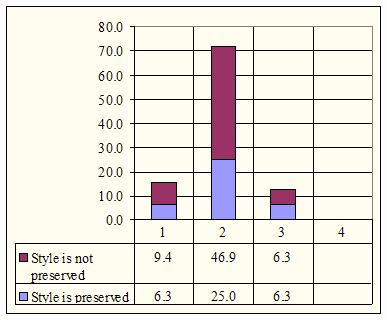
As we can see from the chart the occasional equivalent with irrelevant coloring dominates among 88 characteristic names with 42 % (37 cases). And the most unpopular equivalent is #2 the usual equivalent with irrelevant colouring which is absent here; groups 7 and 8 master 2,3% and 3,4 % respectively. The ways of translation among the characteristic and expressive names is given in the table and bar chart 2: Таble to Bar chart 2
Bar chart 2. Translation equivalents of expressive-and characteristic names
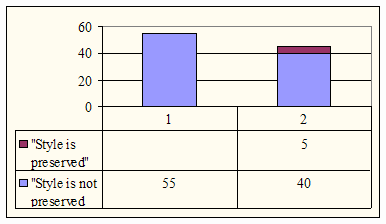
The occasional equivalent with irrelevant coloring is also the main way of translation of the expressive-and-characteristic names—15 cases of 32—46,9%. Irrelevant equivalents that is types 7 and 8 are absent here. Groups 1, 5 and 6 master 6,3 % each. The data of intersemantisizing names is presented in the table and Bar chart 3. Таble to Bar chart 3.
Bar chart 3. Translation equivalents of intersemantisizing names
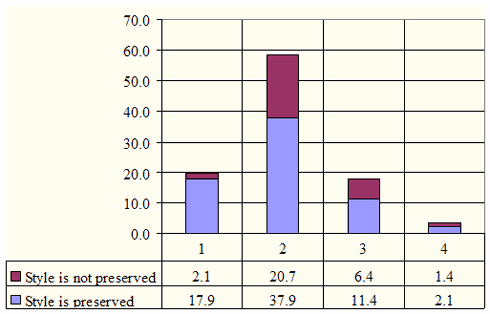
Among these names in the most cases is used usual equivalent—55 % that is 11 cases of 20. Types of translation 2, 5—8 are not used at all, the occasional equivalent with irrelevant colouring is used only once that makes 5%. The figures of distribution of charactonyms regardless of the type of charactonym are presented in the table and Bar chart 4 below.
Bar chart 4 Translation equivalents of charactonyms
On the basis of these figures, the 3rd group of equivalents, occasional equivalents, is the most popular. The equivalent is apt to have neutral significant elements because in this case one does not need to render additional stylistic coloring. In choosing an equivalent from this group the translator pays much more attention to the context than to the dictionary equivalent. The second place is taken by the equivalent #4, the occasional equivalent with irrelevant colouring (28 %). So on aggregate the occasional equivalent and the occasional equivalent with irrelevant coloring master the majority with 82 cases (58,5 %). Group #1 takes the 3rd place (25 cases)—the translation closest to the source text. For their rendering it is enough to take the equivalent from the dictionary and maybe add an ending or change some letters to give a coloring of a foreign name: Kinsman, Muttons, Bugsby, Blackstick etc. So the family name Kinsman is rendered in the book "The Peter Principle" <2> as Род Стуеник (Rod Stuenik) that is the dictionary equivalent in the meaning of "a relative" is used. Foreign colouring is achieved here by splitting the russian word родственник "rodstvennik." The smallest in number group among relevant equivalents is #2 (3 cases), when the usual equivalent does not render the colouring. The small number in this group can be explained by the fact that the usual equivalent suggests the relevant colouring. This group is presented only among expressive-and-characteristic charactonyms: Sawders (sawder colloq.)—Льстивер (L'stiver), but the Russian word "лесть" (l'est') is not expressively marked although it suggests a negative connotation. Groups # 5 (equivalent with a changed characteristics) and 6 (equivalent with a changed characteristics and irrelevant colouring) take 4th and 5th places respectively. These groups testify to the fact that translators not only reject a usual equivalent, but also face the change of characteristics in the name. Style is preserved in most cases—group # 6 makes only 9 cases (6,42%), but group #5 with preserved style—16 (11,42%). The irrelevant types, #7 and #8, which take 8th and 6th places respectively, have statistically insignificant numbers. In conclusion, it should be noted that charactonyms, being the artistic creations of writers, are closely connected with the whole figurative system of a literary work. By rendering the charactonyms of the target text closer to the source text the translator performs a poetic function that is also of high value. Bibliography 1. Zhivogliadov A.A. Semantico-stilistichesky potential angliyskoy onomastiky: Diss. ... kand. filol. nauk. М., 1986. The PhD thesis by A.A. Zhivogliadov on the semantic and stylistic potential of the english onomastics. 2. New English-Russian Dictionary in 3 vol.\ Yu.D. Apresyan, E.M. Mednikova, A.V. Petrova and others. Moscow. 1999. 3. Slovar sovremennogo russkogo literaturnogo yazyka, tt. I-XVII, Akademiya Nauk SSSR—Institut russkogo yazyka.: Izd-vo Akademii Nauk SSSR, 1948—1965. ("Dictionary of Modern Literary Russian," in 17 vol. Moscow - Leningrad. 1948—1965. 4. Kalashnikov A.V. Perevod znachimykh imen sobstvennykh: Diss. ... kand. filol. nauk. М., 2004. The PhD thesis by the author of the paper deals with the translation of charactonyms. Books for Experimental Research 1.Byron J.G. Don Juan. Moscow: Foreign Languages publishing house, 1948. 2.Peter L.J., Hull R. The Peter Principle. Lnd.: Pan Books Ltd, 1976. 3.Thackeray W.M. The Newcomes. Memoirs of a Most Respectable Family Edited by Arthur Pendennis, esq. Thackeray's complete works New York: Thomas Y. Crowell &Company. 4.Thackeray W.M. The Rose and the Ring and Ballads. New York Hurst & Company Publishers. 5.Waugh E. Prose. Memoirs. Essays.—Мoscow: Progress, 1980. 6.Byron J. Don Juan. Perevod T.G. Gnedich. M.: Pravda, 1988. Byron, J.G. 1988. Don Juan. Translated by T.G. Gnedich. Moscow: Pravda. 7.Waugh, E. Upadok i razrusheniye. Perevod S. Belova i V. Orla. M.: Hudozhestvennaya literatura, 1984. Waugh, E. Upadok i razrusheniye. Translated by S. Belov & V. Orl. Moscow: Hudozhestvennaya literature, 1984. 8.Peter, L.J. Printcip Pitera. Perevod L.V. Stepanova. M.: Progress, 1990. Peter, L.J. Printcip Pitera. Translated by L.V. Stepanov. Moscow: Progress, 1990. 9.Thackeray W.M. Sobraniye sochineny: V 12 tomakh. T. 12. Povesty, ocherky, roman. M.: Hudozhestvennaya literatura, 1980. Thackeray W.M. Collected Works in 12 v. V. 12 Narratives, essays, novel. Moscow: Hudozhestvennaya literature, 1980. 10.Thackeray W.M. Sobraniye sochineny: V 12 tomah. T. 8. Newcomy: Zhizneopisaniye odnoy vesma pochtennoy sem'i, sostavlennoye Arturom Pendennisim, esquirom. Perevod R. Pomerantsevoy. M.: Hudozhestvennaya literatura, 1978. Thackeray W.M. Collected Works in 12 v. V. 8. Newcomy: Zhizneopisaniye odnoy vesma pochtennoy sem'i, sostavlennoye Arturom Pendennisim, esquirom. Translated by R. Pomerantseva. Moscow: Hudozhestvennaya literature, 1978. 11.Thackeray W.M. Sobraniye sochineny: V 12 tomah. T. 9. Newcomy: Zhizneopisaniye odnoy vesma pochtennoy sem'i, sostavlennoye Arturom Pendennisim, esquirom. Perevod R. Pomerantsevoy. M.: Hudozhestvennaya literatura, 1979. Thackeray W.M. Collected Works in 12 v. V. 9. Newcomy: Zhizneopisaniye odnoy vesma pochtennoy sem'i, sostavlennoye Arturom Pendennisim, esquirom. Translated by R. Pomerantseva. Moscow: Hudozhestvennaya literatura, 1979. 1 Originally this paper has been contributed to the journal of the International Council of Onomastic Sciences ONOMA vol. 40, 2005. 2 The term is borrowed from the thesis by А.А. Zhivogliadov [1]. 3 The personal names in question are underlined and their motivators are printed in bold type. 4 In <> are marked books for experimental research. 5 For a more detailed analysis see the thesis by A.V. Kalashnikov [4].
E-mail this article to your colleague! Need more translation jobs? Click here! Translation agencies are welcome to register here - Free! Freelance translators are welcome to register here - Free! |
|
|
|
||||||||||||||||||||||||||||||||||||||||||||||||||||||||||||||||||||||||||||||||||||||||||||||||||||||||||||||||||||||||||||||||||||||||||||||||||||||||
|
|
|
| |||
Legal Disclaimer Site Map |
 Abstract