|
 |
 |
 |
|
|
Home | More Articles | Join as a Member! | Post Your Job - Free! | All Translation Agencies | |
|
|||||||
|
|
|
|
A Journey into Chinese-English Environmental Translation
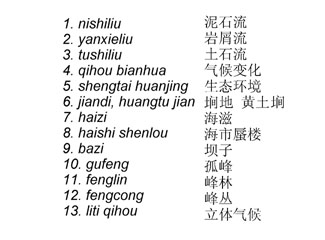
Introduction One of the great pleasures—and occasionally frustrations—in translation is hunting for translations of new words and unfamiliar terminology. It can be like a journey—you begin in one place, follow some false trails, backtrack a bit, and then stumble into a goldmine. Along the way you learn all about things that you'd never even thought existed before, some very useful, and some positively abstract. This article presents some of my own small journeys, tracking down English translations for Chinese words and phrases in the environmental field. I touch on a few common issues, such as misleading dictionary entries, words that don't appear in the dictionaries at all, and region-specific words. The range of topics covers geomorphology (the study of landforms), climatology, and general environmental terminology. For reference, the Chinese characters for each of the words discussed are listed in Figure 1. Dealing with dictionaries This discussion will begin by looking at words and phrases for which misleading English translations have been enshrined in the corpus of bilingual Chinese-English dictionaries. Top of my list in this category is nishiliu - a word that describes a certain sort of geological mass movement, a type of landslide. The primary English equivalent that is provided by almost every dictionary is "mud-rock flow", which also happens to be the literal character-for-character translation of the Chinese word. Unfortunately, as far as I can tell, "mud-rock flow" has no currency in common English usage. Instead, the closest equivalent is "debris flow". Both the English and the Chinese terms refer to a rapidly flowing, and sometimes destructive, mixture of rocks and fine particles ("debris") carried by torrential waters, a phenomenon common in mountainous regions.
To confirm this hypothesis, I undertook a quick web page survey through Yahoo (www.yahoo.com). A web page search for the phrase "mud-rock flow" returned 959 hits. Then, to test the theory that these pages had been written by individuals using Chinese-English bilingual dictionaries, I ran the same search but excluded web pages with the terms "china" and "cn" (this was done by entering +"mud-rock flow" -china -cn in the Search box). This resulted in a total of only 12 hits, of which six were also definitely related to China or Taiwan. Thus, out of a total of 959 web pages carrying the phrase "mud-rock flow", 953 were connected with China or Chinese in some way, leaving only 6 that had no confirmed link. For comparison, a search for the phrase "debris flow" returned 17,300 hits from around the world. This would suggest that "mud-rock flow" is a product of Chinese bilingual dictionaries, and may be an example of 'translationese'—a literally translated term or phrase used instead of the 'natural' option in the target language. Interestingly, there are two other Chinese words for debris flow that appear to be used less often: yanxieliu ("rock debris flow") and tushiliu ("earth-rock flow"). The latter of these is used more frequently in Taiwan (Taipei Municipal Teachers College 2003). In some cases the bilingual dictionaries provide one of the possible equivalents in the target language, but omit others. An example is with qihou bianhua. Qihou literally means "climate", and bianhua means "change" or "vary". The obvious translation of qihou bianhua, and the one featured in most bilingual dictionaries, is "climate change". At this point it is worth noting that, scientifically speaking, the word "climate" refers to "the integrated weather experienced by a site or region over a period of many years" (Sturman and Tapper 1996). Therefore, climate change is the change in the long-term averaged weather patterns. The definition of qihou in the Xiandai Hanyu Cidian (Modern Chinese Dictionary, 1996 edition) agrees with that for the English word climate: "The general meteorological conditions in a specific region, as determined by many years of observations". The problem arises when short-term phenomena and changes are included as examples of qihou bianhua in Chinese texts: for example, cold waves/cold surges (a winter-time meteorological phenomenon) and typhoons are listed as examples of qihou bianhua in Zhao and Chen (1999). In this instance, qihou bianhua really means "fluctuations in the weather". In another example, in a Taiwanese movie I saw recently, one character says to another "Qihou bianhua le" when the weather changed from hot and dry to wet and stormy. Translated according to the dictionary, this would become "The climate has changed." In reality, it means that the weather has changed. So, there are really two different senses to this compound, only one of which is supplied by the dictionaries. Pitfalls can also arise when a compound word or phrase is provided with the full literal translation, but, in the target language, a part of that compound is not usually associated with the other part. An example is with shengtai huanjing. Again, most dictionaries provide the literal translation, "ecological environment", which is not an unused or impossible combination in English. The problem is that this compound is rarely used as such in English. Usually when we speak of the "environment", we are talking about the "ecological environment": there is no need to add the word "ecological". In Chinese, huanjing can also refer to shengtai huanjing, but the full compound is customarily used, in contrast to the English. Of course, sometimes the dictionaries don't provide us with the word at all. An example of one word that I cannot find even in large Chinese-only dictionaries is jian, jiandi or huangtu jian. According to the Atlas of Landforms of China (1985), this is a type of shallow valley peculiar to loess regions. A jian may be several hundred metres to several kilometres wide and tens of kilometres long, and has a flat valley floor. It is formed where loess has filled a previous river valley, and is mainly formed in river headwaters in areas not yet reached by headward erosion caused by the modern river (Atlas of Landforms of China 1985). Fortunately, the same reference provides a handy English word for the landform, "loess vale", which seems a reasonable translation. Interestingly, the character for jian has the same pronunciation as another character which refers to ravines or gullies in general. Another word that has evaded the dictionaries, and which has received some interest in the Chinese media this year, is haizi. To all intents and purposes, haizi refers to a mirage, but the usual Chinese word for mirage is haishi shenlou. Mirages hit the news in the northern coastal city of Dalian this year, when a line of hills, together with several chimneys, mysteriously appeared over the sea near the port. According to a spokesperson from the Dalian Meteorological Observatory, quoted in the Bandao Chenbao newspaper on 31 July 2003, this was a haizi, not a haishi shenlou. What's the difference? asked the baffled reporter. The Observatory spokesperson replied that the cityscape of far-away London appearing in the air over the desert or the East China Sea would be an example of haishi shenlou, whereas an image of an island appearing above the real island would be an example of haizi. Further, haishi shenlou are usually short-lived phenomena, whereas haizi last for some time. I would be curious to know whether haizi is a recently coined word. Intriguing landforms and local climates As is apparent above in the discussion on huangtu jian, locally-important landforms can be given names that are very specific to that kind of landform and that region. Since China has such a wide range of landscapes, the language has developed a number of interesting locally-specific or landform-specific terms, some of which, because of their specificity, give rise to difficulties when translating them to another language. For example, southwest China, and Yunnan and Guizhou in particular, has many tectonically-formed basins known locally as bazi. These usually have a relatively flat floor, and are ringed by hills or mountains, often arranged along bounding faultlines. Kunming, the capital of Yunnan, lies in such a basin. The basin is bounded to the west by the dramatic fault scarp of Xishan (the Western Hills), which towers above the expanse of Dianchi, the largest lake in Yunnan. It should be noted that bazi refers specifically to the floor of the basin (i.e. the plain), and does not include the surrounding hills. The issue of landform naming is also met when discussing the wonderful variety of karst landforms in China, of which the spectacular hills in the vicinity of Guilin, in Guangxi, are the most famous example. Three words are used to describe these hills in Chinese, depending on their arrangement. A single tower or hill is referred to as gufeng, whereas groups of peaks are divided into fenglin and fengcong. The Landform Atlas of China provides a useful translation for gufeng—"solitary peak", and Sweeting (1995) suggests "peak forest" for fenglin and "peak cluster" for fengcong. The Hanyu Da Cidian (Chinese-English Dictionary, 1993 edition) agrees with peak cluster for fengcong, but falls down with fenglin, for which it suggests hoodoo, fungling, or needle karst. Hoodoo is an actual word (from similar roots to "voodoo"), and refers to bizarre rock pinnacles or columns formed in arid regions that are subject to occasional heavy rainfalls (Bates and Jackson 1987). Although much of the Guangxi karst is certainly fantastic in form, the processes of formation are somewhat different due to the humid climate. So, hoodoo can be eliminated as a possible translation. Fungling is obviously a transliteration of the Chinese pronunciation, but does not follow current pinyin (romanisation) usage. Needle karst sounds reasonable, but would appear to have little currency in the geomorphological literature. Having eliminated all of these dictionary options, we can look at what writers most commonly use, and here the straight pinyin transliteration seems to win—as long as it is accompanied by a description or brief translation in the manner of Sweeting (1995). Interestingly, European karst terminology tends to focus on the forms of the individual hills; thus there is tower karst and cone karst, among others. Sweeting (1995) notes that, for example, the term 'tower karst' cannot be applied to fenglin because one area of fenglin may contain hills of a wide variety of shapes. Sometimes we come across compound words that simply do not make sense translated directly into English. Thus, for example, many writings on Yunnan province refer to the liti qihou, or 'three-dimensional climate', of the mountainous region in the northwest of the province. What this refers to is fairly clear—the large difference in altitude between the valley floors and the plateaux and mountain tops results in a marked vertical gradation of climatic zones over a short horizontal difference. For instance, if you travel from the famous town of Lijiang to pretty Lugu Lake, you must cross the gorge of the Jinsha River, the name given to the upper reaches of the Yangtze. Starting from a cool plateau above 2000 m, in a short space of time you plunge down a dusty zigzag road to the valley floor, where you see bananas and mangoes growing on the mighty river's banks. It's an impressive display of liti qihou. Although the phenomenon is of course common to all mountain environments, the problem is how to translate this phrase into English. We do not normally think of climate as having dimensionality in the sense that there could be a difference between a 2-d and a 3-d climate. Probably the best solution is to paraphrase the idea, something like a "steep vertical climatic gradient", which unfortunately sacrifices some of the original's elegance. Conclusions What can we take from this discussion on environmental translation? Personally, the main conclusion that I would make, and here I am of course biased, is that it is an absolutely fascinating field, one where it is possible to learn much about the world around us. Secondly, and one that translators should already be aware of, is that we shouldn't put total faith in dictionaries. Dictionaries are compiled by people like you and me, with a finite knowledge of the world, and so are not infallible. The most up-to-date dictionary, too, is always out of date, as new words and phrases are constantly added to a language and old ones go out of fashion. And thirdly, research unfamiliar terms thoroughly—indeed, you will never cease to stumble over interesting facts and opinions during your journey through the lesser-travelled paths of the linguistic world.
Figure 1: The pinyin and characters for the Chinese words that appear in the text, in order of occurrence. References Atlas of Landforms of China Editing Group, 1985, Atlas of Landforms of China, Beijing: The Publishing House of Surveying and Mapping, 210 pp. Bates, R. L. and Jackson, J. A. (eds.), 1987, Glossary of Geology, Third Edition, Alexandra, Virginia: American Geological Institute, 788 pp. Sturman, A. P. and Tapper, N. J., 1996, The Weather and Climate of Australia and New Zealand, Melbourne: Oxford University Press, 476 pp. Sweeting, M. M., 1995, Karst in China: Its Geomorphology and Environment, Berlin: Springer-Verlag, 265 pp. Taipei Municipal Teachers College, 2003, http://www.geoscience.tmtc.edu.tw. Zhao Ji and Chen Chuankang (eds.), 1999, Zhongguo Dili, Beijing: Gaodeng Jiaoyu Chubanshe (Higher Education Press), 620 pp.
E-mail this article to your colleague! Need more translation jobs? Click here! Translation agencies are welcome to register here - Free! Freelance translators are welcome to register here - Free! |
|
|
|
|
|
|
| |||
Legal Disclaimer Site Map |