 |
 |
 |
 |
|
|
Home | More Articles | Join as a Member! | Post Your Job - Free! | All Translation Agencies | |
|
|||||||
|
|
|
|
Translating Law Texts is Translating Culture
Civil, Common or Customary: Which law do you follow?
Before addressing these questions, let us examine the key aspects of the two systems. Contrary to what is generally believed, civil law does not mean “Direito Civil” under the Brazilian system. This system’s history began when Roman emperor Justinian united all of the laws in continental Europe and consolidated them into a single code under the name of “Corpus Juris Civilis.” This would later come to be known as Civil Law, Continental Law or Roman Law. In those countries that adopted civil law, legislation represents the primary legal basis. The courts of law base their sentences on the provisions of the legal codes, which determine the solutions for each individual case. The common law system, adopted by American countries and those of an Anglo-Saxon background, is the system whereby custom prevails over enacted law. Past cases (case law) are the main source of law or are the basis for creating rules of conduct. As opposed to Roman Law, US law is founded to a greater extent on usual practice and customs rather than on the efforts of legislators. Nonetheless, the difference between civil law and common law resides not in the mere act of enactment but rather in the methodological approach applied to the codes and legislation. So, have you discovered what system is used in Brazil? If you are still in doubt, check out the map below: 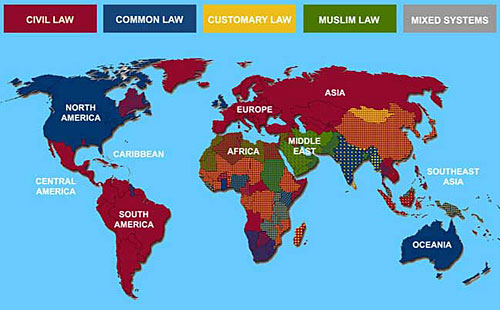 Global
Distribution of Legal Systems Despite the fact that the US legal system is based on common law, US Commercial Law has drifted away from this trend for historical reasons. Based on the federal system embraced by the country, each state had its own trade law, which actually hindered the country’s trading activities. By virtue of uniform state laws, the latter were slowly unified in their commercial practices. The 1896 Negotiable Instrument Law and the 1906 Uniform Sales Law are examples of uniform laws. In the late 1940’s, the National Conference of Representatives on Uniform State Laws, together with the American Institute of Law, began to elaborate a new comprehensive code. It united all of the previous laws into one single code – the Uniform Commercial Code (UCC) – whose final version was made public in 1957. To the contrary, Brazilian Commercial Law dates back to 1808 when the Portuguese royal family arrived in Brazil and opened the country’s seaports for trade with friendly nations. From its origins right up to the enactment of the Brazilian Commercial Code, the country’s trading activities were governed by Portuguese law and by the Spanish and French Commercial Codes. What is the connection between this history of Law and our day-to-day work as translators? The growth in international trade and the increased number of international trading companies has contributed to an escalating demand for corporate documentation translations. Among the numerous kinds of documents that the legal translator deals with on a daily basis, the translation of contracts is by far the most requested. When dealing with these documents, it is crucial that the translator be acquainted with the local culture and have knowledge of the legal texts of the countries involved in order to grasp the meaning of certain clauses typical to contract texts.
Next, I will point out some of difficulties I have encountered with words whose translation depends on the particular context. What would be the translation for the Portuguese term “lei?” There are three possibilities: law is the most widely known, followed by act, and lastly the false cognate statute (Statute of Fraud, for example, means Lei de Fraude.) On the other hand, what would be the translation of “law?” The first meaning that comes to mind is the Portuguese lei. This translation is employed strictu senso, i.e. when making reference to a norm, such as in Lei do Divórcio. When preceded by an indefinite article or followed by the letter s, the translation would definitely be lei. Nonetheless, in a broad sense law may be translated as Direito, with the meaning of a system of principles. In its turn, the word jurisdiction may be translated as the Portuguese jurisdição (a geographical aspect), competência (the area for which a judge may be competent to rule) or Estado (nation.) Commonly found as the translation for the expression counterclaim, the Portuguese pedido em contrário means simply reconvenção. And what exactly does “reconvenção” mean? Look it up in the Plácido e Silva legal dictionary! Will anyone risk guessing the meaning of the Portuguese expression “Carta de Conforto?” It is not a letter sent to a friend who lost a loved one. Carta de Conforto is the translation used for Comfort Letter, more akin to a Carta de Abono or a Carta de Recomendação. A literal and erroneous translation was attributed to this expression and unfortunately became common usage. Faced with so many differences, it is very difficult to translate legal topics literally. Therefore, careful research of the area of law is necessary to understand those concepts behind the terminology and ensure the translation of the idea and not merely the words. Daniela Schraider Mochny has a degree in Translation and Interpretation from Mackenzie University (1995) and a second degree in Business Administration from the same university (1996). After working for 10 years as a translator, Mochny began to study legal translations and completed several specialization courses offered by Caldas Law Studies Center. When not translating, she enjoys diving, swimming and traveling.
This
article was originally published in Сcaps Newsletter
(http://www.ccaps.net)
E-mail this article to your colleague! Need more translation jobs? Click here! Translation agencies are welcome to register here - Free! Freelance translators are welcome to register here - Free! |
|
|
|
|
|
|
| |||
Legal Disclaimer Site Map |
 A
good translator of legal texts must not only master
legal jargon, he or she will also be required to know
the history of continental Europe and of England.
The common law and civil law legal systems are the
two main systems of the western world. No literal
interpretation of these terms would be comprehensive,
as it is impossible to embrace all of the associated
meanings, concepts and cultural heritage in a mere
two words. Accordingly, these terms are known simply
as the common law and the civil law legal systems.
So which of these systems is current in Brazil, and
why?
A
good translator of legal texts must not only master
legal jargon, he or she will also be required to know
the history of continental Europe and of England.
The common law and civil law legal systems are the
two main systems of the western world. No literal
interpretation of these terms would be comprehensive,
as it is impossible to embrace all of the associated
meanings, concepts and cultural heritage in a mere
two words. Accordingly, these terms are known simply
as the common law and the civil law legal systems.
So which of these systems is current in Brazil, and
why?
 There
is still no set of criteria to define how legal documentation
should be translated.
Some translators assert that this type of translation
should preserve the original context of the text at
all costs, even if this jeopardizes clarity and style.
Other professionals prefer to respect the style and
format of the target language. My advice to those
who are just beginning to translate legal documentation
is to always follow the client’s instructions
and adopt its pre-established glossary. This rule
is especially important in the case of corporate articles
of association, as the client will usually prefer
not to make changes to formulas the company has already
adopted. Hence, if the translator intends to diverge
from the formula, they need to be able to justify
such a decision. Sources that are confirmed as reliable
and fundamental for this type of translation, such
as the Plácido e Silva legal dictionary and Black’s Law Dictionary should not be
cast aside.
There
is still no set of criteria to define how legal documentation
should be translated.
Some translators assert that this type of translation
should preserve the original context of the text at
all costs, even if this jeopardizes clarity and style.
Other professionals prefer to respect the style and
format of the target language. My advice to those
who are just beginning to translate legal documentation
is to always follow the client’s instructions
and adopt its pre-established glossary. This rule
is especially important in the case of corporate articles
of association, as the client will usually prefer
not to make changes to formulas the company has already
adopted. Hence, if the translator intends to diverge
from the formula, they need to be able to justify
such a decision. Sources that are confirmed as reliable
and fundamental for this type of translation, such
as the Plácido e Silva legal dictionary and Black’s Law Dictionary should not be
cast aside. 

