|
 |
 |
 |
|
|
Home | More Articles | Join as a Member! | Post Your Job - Free! | All Translation Agencies | |
|
|||||||
|
|
|
|
The Tricky Terminology of the Oil and Gas Industry
Q:
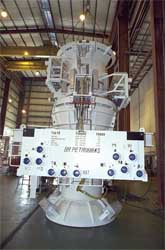
When is a Christmas tree not a Christmas tree?
The technology required to drop a 3000-meter pipe from an oil platform to a fixed point on the ocean floor is mind-boggling. Think about it for a minute: from a floating platform 200 or 300 miles out in the South Atlantic Ocean and subject to all the movements caused by wind and waves, you drop an inflexible pipe to the ocean floor three kilometers down! Then, once it is bolted to the ground, you begin to drill. The platform must remain in a constant position relative to the hole in the ground – with minimal lateral movement (twist) or drift so as not to put undue tension on the pipe. That must put an incredible strain on any equipment or positioning system, regardless of its sophistication.
Ensuring an accurate translation of all the technical specifications and physical engineering requirements for this kind of operation can be a very challenging exercise. The technology and nomenclature is often created by individuals who are non-native English speakers. Take “risers,” for example. I used to sit on risers when I went to high school track meets back in the U.S. They were sometimes called “bleachers.” But in the oil industry, risers are “the vertical portion of an outflow line that conveys oil and/or natural gas from the well to the platform.” Similarly, “extremities” are hands and feet of the human body in normal English language usage. For example, “his extremities were frozen.” In the world of petroleum exploration, extremities are a “length of pipeline.” When dealing with multi-million dollar contracts, it is important to get these and other terms right. One of the things that we have learned is that it is critically important to have a good, up-to-date glossary of technical terms. English glossaries are available on the Internet, and Petrobras has a fairly complete glossary of terms in Portuguese and English in its latest Annual Reports, which can be found at http://www2.petrobras.com.br/Petrobras/ingles/visao/vis_relatorio.htm. It is there that you will learn that “farm-in” has nothing to do with agriculture. It deals with the partial or total acquisition of concession rights. Likewise, “farm out” does not refer to sharecropping.  Furthermore, you certainly would not want to go to an oil company to pick up a Christmas Tree for the year-end holiday: you would wind up with a multi-valve contraption that drillers use at the top of a well casing to control the flow of oil from the well. If you use it underwater, then it is called a “wet” Christmas tree. On a final note, it is not all sitting and looking at a screen. Last year, for example, we worked on a project for an international offshore oil exploration company that performs deep water drilling. This is about sitting on top of a 3000-meter pipe bolted to the ocean floor. Think about doing this in the North Sea, in the wintertime, in a howling Arctic gale! It makes working in the South Atlantic a very attractive alternative. The company came to us after seeing one of our ads in a trade magazine and asked us to translate the specifications in a request for proposal (RFP) into English and then to put their responses back into Portuguese. The more sophisticated the technology, the more demanding the vocabulary. The search for the right word or phrase took us, via Internet, to the most recent generation of engineering drawings. The problem that comes up time and time again is that the specifications will use a term that was originally coined in English and translated into Portuguese by an engineer who was probably in a hurry. That presents a real challenge when translating back to the original English. One of the most interesting things about what we do as translators is that we are occasionally privileged to look beyond the day-to-day press releases and see the elegant technology and engineering that lies behind. We have even had the opportunity to escort a company representative to the auction where the bids were opened. The process did not take long, and the auction was conducted in Portuguese, of course. We were able to participate, although nothing very high-tech. Just old-fashioned, whisper-in-the-ear type interpretation, but interesting and challenging nevertheless. Peter Warner is one of the Heads of the Ccaps Portuguese to English translation service, which is designed for clients whose business activities require extensive use of reports, presentations, websites and other text-based products in English to compete in the global marketplace. Together with Steve Yolen, he plays in Copacabana Handshake, an American folk music band.
This
article was originally published in Сcaps Newsletter
(http://www.ccaps.net)
E-mail this article to your colleague! Need more translation jobs? Click here! Translation agencies are welcome to register here - Free! Freelance translators are welcome to register here - Free! |
|
|
|
|
|
|
| |||
Legal Disclaimer Site Map |
 Brazil is one of the world’s leaders in the development
of deep water drilling technology. It is not rocket
science but it comes quite close. The translation of
oil industry documents can often be pretty dull fare.
Those of us who do a lot of work in the field can testify
to that. But every once in a while we are privileged
to have a close look at Brazil’s deep water drilling
technology. Take it from us, it is impressive. If you
sit back a bit and let your imagination roam, you can
come up with some pretty incredible images.
Brazil is one of the world’s leaders in the development
of deep water drilling technology. It is not rocket
science but it comes quite close. The translation of
oil industry documents can often be pretty dull fare.
Those of us who do a lot of work in the field can testify
to that. But every once in a while we are privileged
to have a close look at Brazil’s deep water drilling
technology. Take it from us, it is impressive. If you
sit back a bit and let your imagination roam, you can
come up with some pretty incredible images.