|
 |
 |
 |
|
|
Home | More Articles | Join as a Member! | Post Your Job - Free! | All Translation Agencies | |
|
|||||||
|
|
|
|
The Spanish Reality in the United States – A Unique Challenge
Versión
española
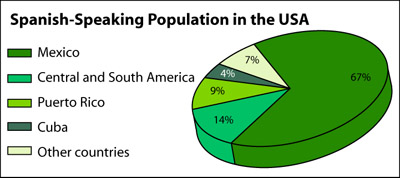
Despite the striking differences within the Hispanic group, it has gained such power in North American society that it has become an audience that attracts great interest from both private and public enterprises. While corporations have their eyes set on part of the more than US$ 350 million currently consumed by the Hispanic community, the government and politicians are eager for their votes and support. This last fact has actually provided incentive for the nationalization of many Hispanic immigrants and the consequent use of their voting rights. Just like any other Spanish-speaking immigrant, I have had the opportunity to experience the complexity involved in the use of the language in this country, both on a personal and professional level, as I work with communications in Spanish. One of the reasons for this unexpected complexity is the wide variety of origins of Spanish speakers in the United States. According to data from the US Census Bureau published in 2004, almost 40 million Hispanics reside in the country, in addition to the almost 4 million Hispanics from Puerto Rico. Among these 40 million, 67% come from Mexico, 14% from Central and South America, 9% from Puerto Rico, 4% from Cuba and 7% from other countries and regions.
This variety of origins gives rise to endless debates regarding terminology-related decisions, not only when writing texts but also when translating into Spanish for use in the United States. Therefore, terms like "autobús" can also appear as "camión" (Mexico), "guagua" (Cuba and Puerto Rico), "colectivo" (Argentina and Venezuela), etc. Such situations create the controversial need for the use of a generic or neutral Spanish in communications targeted at the Hispanic market in the United States. However, a country-specific solution is adopted in certain situations: one chooses to use Mexican editors when the content is directed at an audience that is mainly Mexican, Puerto Rican editors when the audience is mainly Puerto Rican, and so on. When it comes to communicating in Spanish in the North American territory, there are several circumstances that inevitably lead to the controversial Spanglish, which involves the use of English words in a Spanish dialogue and the indiscriminate use of “Anglicisms.” Listed below are some of the most important of these circumstances:
Such circumstances are crucial when it comes to creating understandable content and translations that efficiently communicate with this target audience. It is no easy task to write in Spanish or translate a text from English into Spanish having the Hispanic market in mind. Despite our origins and regionalisms, we all have the need to communicate in a correct and efficient way, doing our best to overcome these obstacles while at the same time meeting our clients' needs. Every good professional should be willing to undertake the investigation and training necessary to convey the desired message effectively and help clients understand the idiosyncrasies of Spanish communications within the US-based Hispanic community. In order to more easily instruct those clients who wish to establish communications in Spanish targeted at this market, it is necessary that they consider the factors that define the client's participation in this process, such as:
These factors may generate unnecessary problems that could easily be avoided with investments in a preliminary consensus in the form of guidelines and glossaries. The preparation and creation of these control elements should be supervised by an advisory team of translators and editors from different origins with expertise in the US Hispanic market. This team should work closely with the client in the analysis of contents and creation of standards and glossaries. Reaching a consensus requires hard work, but the list of benefits is endless—significant cost reduction, more organized and predictable work processes and higher quality content that is more generic and consistent… However, it is also important to point out that this teamwork is a breeding ground that can be observed, controlled and manipulated by the client to create content and translations that fit their communication purposes. Although this fascinating theme involves countless components, I will finish this article highlighting the importance of the Spanish language as a common denominator and unifying element for all Hispanics residing in the United States. It integrates them into a powerful group regardless of origins or lexical differences. And the power that Spanish confers to this group is reason enough to preserve and defend it, remembering always to respect our lexical differences and our enriching diversity. María Ángeles Prieto is a seasoned expert in the field of Spanish-language copywriting, translation and adaptation of advertising and marketing materials for Spanish-speaking markets in the United States, Latin America and Spain. Born in Spain, she dedicated most of her extracurricular life to studying French, English and German. She has a degree in Advertising and Public Relations from the Complutense University of Madrid. In 1990, she moved to New York where she worked for renowned marketing companies focused on the Latin American and US Hispanic markets. She also co-founded SpanLingua in 1998 and since then her work has been mainly focused on managing translation and adaptation projects targeting the US Hispanic market. Prieto has two boys and loves to spend time with them whenever possible.
This
article was originally published in Сcaps Newsletter
(http://www.ccaps.net)
E-mail this article to your colleague! Need more translation jobs? Click here! Translation agencies are welcome to register here - Free! Freelance translators are welcome to register here - Free! |
|
|
|
|
|
|
| |||
Legal Disclaimer Site Map |
 The
issue of the Spanish language in the United States
is not an easy topic to approach. We need to bear
in mind the diversity of Spanish in this country,
as well as the need to establish a common denominator
in this amazing melting pot. But there is more to
it. Linguistic and cultural influences and the major
repercussions of the use of Spanish in the media also
play a critical role when it comes to US Spanish.
The
issue of the Spanish language in the United States
is not an easy topic to approach. We need to bear
in mind the diversity of Spanish in this country,
as well as the need to establish a common denominator
in this amazing melting pot. But there is more to
it. Linguistic and cultural influences and the major
repercussions of the use of Spanish in the media also
play a critical role when it comes to US Spanish.